
Oracle Critical Patch Update January 2018
Released January 2018 · Oracle's advisory ↗ · ← Critical Patch Update, October 2017 · Critical Patch Update, April 2018 →
197 CVEs in this release, one square each
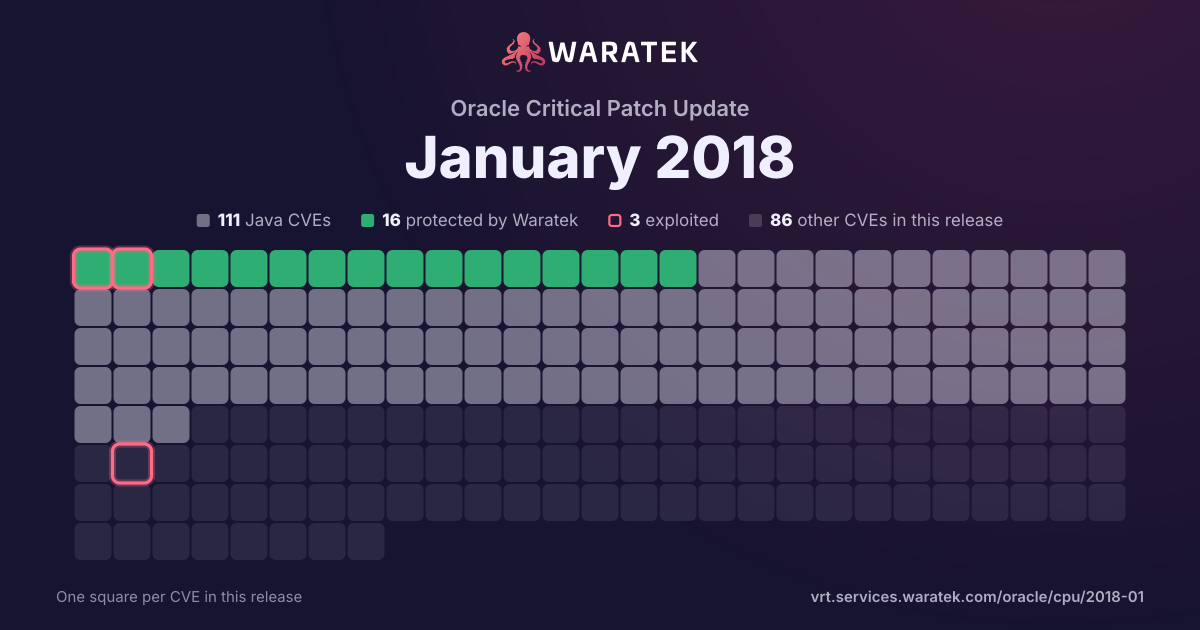
By status
16Protected by Waratek1Mitigation candidate94No exploit published25Outside Waratek scope61Not applicable
3Exploited, marked by the ring
No exploit published. For 94 of them, Oracle's security advisory is the source of public detail.
Protected by Waratek. Waratek RASP can block exploitation of these on systems that have not applied the patch yet.
Overview 3 matches · 1 in Waratek scope · 1 protected · 0 exploited · 0 CISA KEV · 2 EPSS ≥ 0.5
Protected by Waratek
1
33.3%
Rule in development
0
0.0%
Mitigation candidate
0
0.0%
No exploit published
0
0.0%
Outside Waratek scope
0
0.0%
Not applicable
2
66.7%
Withdrawn CVE
0
0.0%
blocked by ARMR today
1
33.3%
partly blocked
0
0.0%
not blocked
2
66.7%
not established
0
0.0%
unrecorded
0
0.0%
Exploited
0
0.0%
Working exploit published
3
100.0%
Proof of concept only
0
0.0%
Forecast only
0
0.0%
No public exploit
0
0.0%
split by
peak 1 / month
May 161
Not applicable1
Medium1
not blocked1
Working exploit published1
Jun 160
Jul 160
Aug 160
Sep 160
Oct 160
Nov 160
Dec 160
Jan 170
Feb 170
Mar 170
Apr 171
Protected by Waratek1
Critical1
blocked by ARMR today1
Working exploit published1
May 170
Jun 170
Jul 170
Aug 170
Sep 171
Not applicable1
High1
not blocked1
Working exploit published1
May 16Jul 16Sep 16Nov 16Jan 17Mar 17May 17Jul 17Sep 17
| CVE | Severity | Published▾ | Status | Exploitation | Description |
|---|---|---|---|---|---|
| CVE-2017-0781 | High | 2017-09-14 | Not applicable | Working exploit published | A remote code execution vulnerability in the Android system (bluetooth). Product: Android. Versions: 4.4.4, 5.0.2, 5.1.1, 6.0, 6.0.1, 7.0, 7.1.1, 7.1.2, 8.0. Android ID: A-63146105. |
| CVE-2017-5645 | Critical | 2017-04-17 | Protected by Waratek | Working exploit published | In Apache Log4j 2.x before 2.8.2, when using the TCP socket server or UDP socket server to receive serialized log events from another application, a specially crafted binary payload can be sent that, when deserialized, can execute arbitrary code. |
| CVE-2016-2107 | Medium | 2016-05-05 | Not applicable | Working exploit published | The AES-NI implementation in OpenSSL before 1.0.1t and 1.0.2 before 1.0.2h does not consider memory allocation during a certain padding check, which allows remote attackers to obtain sensitive cleartext information via a padding-oracle attack against an AES CBC session. NOTE: this vulnerability exists because of an incorrect fix for CVE-2013-0169. |