
Oracle Critical Patch Update January 2018
Released January 2018 · Oracle's advisory ↗ · ← Critical Patch Update, October 2017 · Critical Patch Update, April 2018 →
197 CVEs in this release, one square each
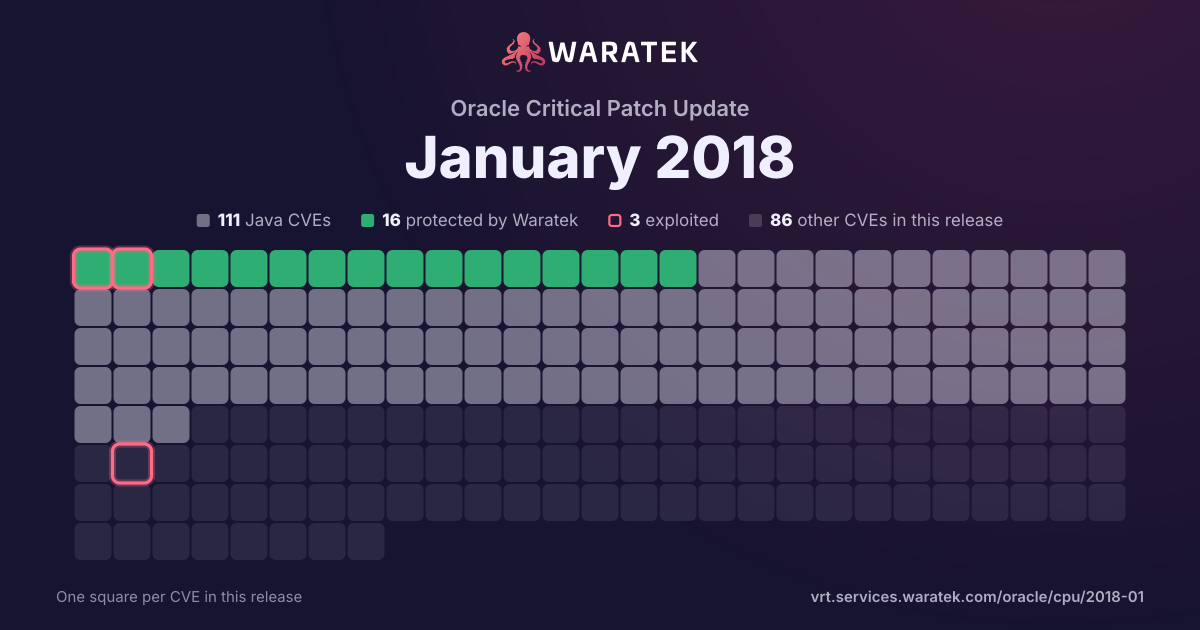
By status
16Protected by Waratek1Mitigation candidate94No exploit published25Outside Waratek scope61Not applicable
3Exploited, marked by the ring
No exploit published. For 94 of them, Oracle's security advisory is the source of public detail.
Protected by Waratek. Waratek RASP can block exploitation of these on systems that have not applied the patch yet.
Overview 1 match · 0 in Waratek scope · 0 protected · 0 CISA KEV
1match
0in Waratek scope0.0%
0protected0.0%
0CISA KEV0.0%
Protected by Waratek
0
0.0%
Rule in development
0
0.0%
Mitigation candidate
0
0.0%
No exploit published
0
0.0%
Outside Waratek scope
0
0.0%
Not applicable
1
100.0%
Withdrawn CVE
0
0.0%
blocked by ARMR today
0
0.0%
partly blocked
0
0.0%
not blocked
1
100.0%
not established
0
0.0%
unrecorded
0
0.0%
Exploited
1
100.0%
Working exploit published
0
0.0%
Proof of concept only
0
0.0%
Forecast only
0
0.0%
No public exploit
0
0.0%
| CVE | Severity | Published▾ | Status | Exploitation | Description |
|---|---|---|---|---|---|
| CVE-2017-9798 | High | 2017-09-18 | Not applicable | Exploited | Apache httpd allows remote attackers to read secret data from process memory if the Limit directive can be set in a user's .htaccess file, or if httpd.conf has certain misconfigurations, aka Optionsbleed. This affects the Apache HTTP Server through 2.2.34 and 2.4.x through 2.4.27. The attacker sends an unauthenticated OPTIONS HTTP request when attempting to read secret data. This is a use-after-free issue and thus secret data is not always sent, and the specific data depends on many factors including configuration. Exploitation with .htaccess can be blocked with a patch to the ap_limit_section function in server/core.c. |