
Oracle Critical Patch Update July 2017
Released July 2017 · Oracle's advisory ↗ · ← Critical Patch Update, April 2017 · Critical Patch Update, October 2017 →
272 CVEs in this release, one square each
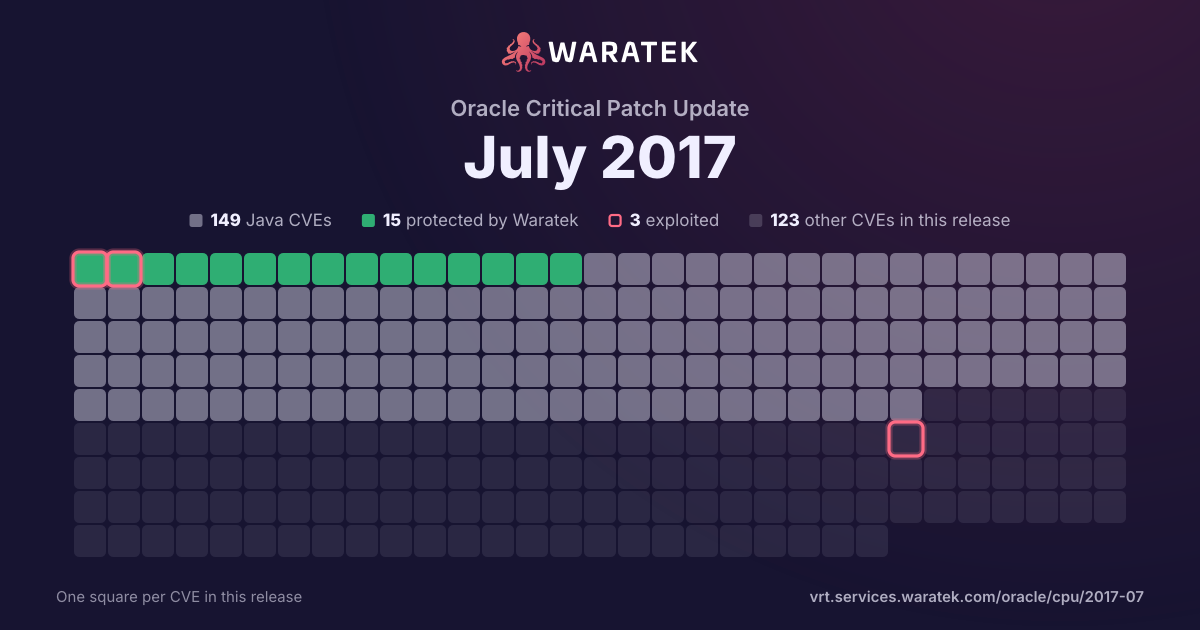
By status
15Protected by Waratek3Mitigation candidate131No exploit published30Outside Waratek scope93Not applicable
3Exploited, marked by the ring
No exploit published. For 126 of them, Oracle's security advisory is the source of public detail.
Protected by Waratek. Waratek RASP can block exploitation of these on systems that have not applied the patch yet.
Overview 3 matches · 0 in Waratek scope · 0 protected · 0 exploited · 0 CISA KEV · 1 public PoC · 1 EPSS ≥ 0.5
3matches
0in Waratek scope0.0%
0protected0.0%
0exploited0.0%
0CISA KEV0.0%
1public PoC33.3%
1EPSS ≥ 0.533.3%
Protected by Waratek
0
0.0%
Rule in development
0
0.0%
Mitigation candidate
0
0.0%
No exploit published
0
0.0%
Outside Waratek scope
0
0.0%
Not applicable
3
100.0%
Withdrawn CVE
0
0.0%
blocked by ARMR today
0
0.0%
partly blocked
0
0.0%
not blocked
3
100.0%
not established
0
0.0%
unrecorded
0
0.0%
Exploited
0
0.0%
Working exploit published
1
33.3%
Proof of concept only
0
0.0%
Forecast only
0
0.0%
No public exploit
2
66.7%
| CVE | Severity | Published▾ | Status | Exploitation | Description |
|---|---|---|---|---|---|
| CVE-2016-2834 | High | 2016-06-13 | Not applicable | No public exploit | Mozilla Network Security Services (NSS) before 3.23, as used in Mozilla Firefox before 47.0, allows remote attackers to cause a denial of service (memory corruption and application crash) or possibly have unspecified other impact via unknown vectors. |
| CVE-2016-2107 | Medium | 2016-05-05 | Not applicable | Working exploit published | The AES-NI implementation in OpenSSL before 1.0.1t and 1.0.2 before 1.0.2h does not consider memory allocation during a certain padding check, which allows remote attackers to obtain sensitive cleartext information via a padding-oracle attack against an AES CBC session. NOTE: this vulnerability exists because of an incorrect fix for CVE-2013-0169. |
| CVE-2016-2381 | High | 2016-04-08 | Not applicable | No public exploit | Perl might allow context-dependent attackers to bypass the taint protection mechanism in a child process via duplicate environment variables in envp. |