
Oracle Critical Patch Update July 2017
Released July 2017 · Oracle's advisory ↗ · ← Critical Patch Update, April 2017 · Critical Patch Update, October 2017 →
272 CVEs in this release, one square each
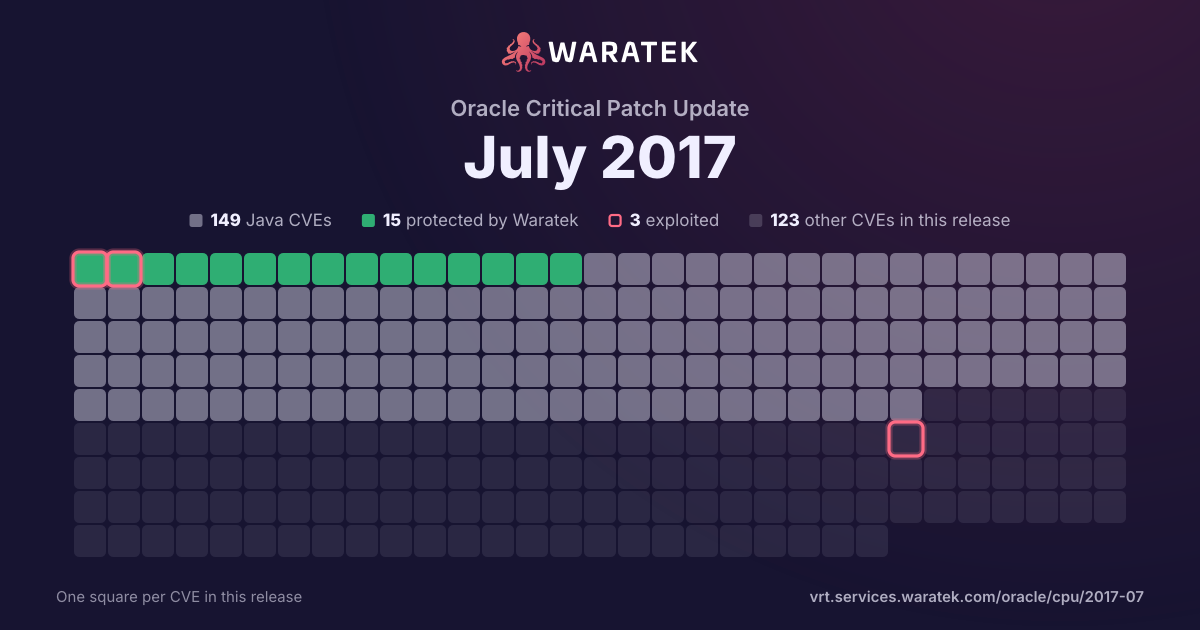
By status
15Protected by Waratek3Mitigation candidate131No exploit published30Outside Waratek scope93Not applicable
3Exploited, marked by the ring
No exploit published. For 126 of them, Oracle's security advisory is the source of public detail.
Protected by Waratek. Waratek RASP can block exploitation of these on systems that have not applied the patch yet.
Overview 10 matches · 2 in Waratek scope · 2 protected · 3 exploited · 2 CISA KEV · 6 public PoC
Protected by Waratek
2
20.0%
Rule in development
0
0.0%
Mitigation candidate
0
0.0%
No exploit published
0
0.0%
Outside Waratek scope
4
40.0%
Not applicable
4
40.0%
Withdrawn CVE
0
0.0%
blocked by ARMR today
2
20.0%
partly blocked
0
0.0%
not blocked
8
80.0%
not established
0
0.0%
unrecorded
0
0.0%
Exploited
3
30.0%
Working exploit published
2
20.0%
Proof of concept only
2
20.0%
Forecast only
3
30.0%
No public exploit
0
0.0%
split by
peak 3 / quarter
Q4 141
Outside Waratek scope1
Low1
not blocked1
Proof of concept only1
Q1 151
Outside Waratek scope1
High1
not blocked1
Working exploit published1
Q2 150
Q3 150
Q4 150
Q1 160
Q2 161
Not applicable1
Medium1
not blocked1
Working exploit published1
Q3 163
Outside Waratek scope2
Not applicable1
High3
not blocked3
Proof of concept only1
Forecast only2
Q4 160
Q1 171
Protected by Waratek1
Critical1
blocked by ARMR today1
Exploited1
Q2 172
Not applicable2
Critical1
High1
not blocked2
Exploited1
Forecast only1
Q3 170
Q4 171
Protected by Waratek1
Critical1
blocked by ARMR today1
Exploited1
Q4 14Q2 15Q4 15Q2 16Q4 16Q2 17Q4 17
| CVE | Severity | Published▾ | Status | Exploitation | Description |
|---|---|---|---|---|---|
| CVE-2015-7501 | Critical | 2017-11-09 | Protected by Waratek | Exploited | Red Hat JBoss A-MQ 6.x; BPM Suite (BPMS) 6.x; BRMS 6.x and 5.x; Data Grid (JDG) 6.x; Data Virtualization (JDV) 6.x and 5.x; Enterprise Application Platform 6.x, 5.x, and 4.3.x; Fuse 6.x; Fuse Service Works (FSW) 6.x; Operations Network (JBoss ON) 3.x; Portal 6.x; SOA Platform (SOA-P) 5.x; Web Server (JWS) 3.x; Red Hat OpenShift/xPAAS 3.x; and Red Hat Subscription Asset Manager 1.3 allow remote attackers to execute arbitrary commands via a crafted serialized Java object, related to the Apache Commons Collections (ACC) library. |
| CVE-2017-3731 | High | 2017-05-04 | Not applicable | Forecast only | If an SSL/TLS server or client is running on a 32-bit host, and a specific cipher is being used, then a truncated packet can cause that server or client to perform an out-of-bounds read, usually resulting in a crash. For OpenSSL 1.1.0, the crash can be triggered when using CHACHA20/POLY1305; users should upgrade to 1.1.0d. For Openssl 1.0.2, the crash can be triggered when using RC4-MD5; users who have not disabled that algorithm should update to 1.0.2k. |
| CVE-2017-5689 | Critical | 2017-05-02 | Not applicable | Exploited | An unprivileged network attacker could gain system privileges to provisioned Intel manageability SKUs: Intel Active Management Technology (AMT) and Intel Standard Manageability (ISM). An unprivileged local attacker could provision manageability features gaining unprivileged network or local system privileges on Intel manageability SKUs: Intel Active Management Technology (AMT), Intel Standard Manageability (ISM), and Intel Small Business Technology (SBT). |
| CVE-2017-5638 | Critical | 2017-03-11 | Protected by Waratek | Exploited | The Jakarta Multipart parser in Apache Struts 2 2.3.x before 2.3.32 and 2.5.x before 2.5.10.1 has incorrect exception handling and error-message generation during file-upload attempts, which allows remote attackers to execute arbitrary commands via a crafted Content-Type, Content-Disposition, or Content-Length HTTP header, as exploited in the wild in March 2017 with a Content-Type header containing a #cmd= string. |
| CVE-2016-6304 | High | 2016-09-26 | Not applicable | Forecast only | Multiple memory leaks in t1_lib.c in OpenSSL before 1.0.1u, 1.0.2 before 1.0.2i, and 1.1.0 before 1.1.0a allow remote attackers to cause a denial of service (memory consumption) via large OCSP Status Request extensions. |
| CVE-2016-2183 | High | 2016-09-01 | Outside Waratek scope | Proof of concept only | The DES and Triple DES ciphers, as used in the TLS, SSH, and IPSec protocols and other protocols and products, have a birthday bound of approximately four billion blocks, which makes it easier for remote attackers to obtain cleartext data via a birthday attack against a long-duration encrypted session, as demonstrated by an HTTPS session using Triple DES in CBC mode, aka a "Sweet32" attack. |
| CVE-2016-5387 | High | 2016-07-19 | Outside Waratek scope | Forecast only | The Apache HTTP Server through 2.4.23 follows RFC 3875 section 4.1.18 and therefore does not protect applications from the presence of untrusted client data in the HTTP_PROXY environment variable, which might allow remote attackers to redirect an application's outbound HTTP traffic to an arbitrary proxy server via a crafted Proxy header in an HTTP request, aka an "httpoxy" issue. NOTE: the vendor states "This mitigation has been assigned the identifier CVE-2016-5387"; in other words, this is not a CVE ID for a vulnerability. |
| CVE-2016-2107 | Medium | 2016-05-05 | Not applicable | Working exploit published | The AES-NI implementation in OpenSSL before 1.0.1t and 1.0.2 before 1.0.2h does not consider memory allocation during a certain padding check, which allows remote attackers to obtain sensitive cleartext information via a padding-oracle attack against an AES CBC session. NOTE: this vulnerability exists because of an incorrect fix for CVE-2013-0169. |
| CVE-2015-0235 | High | 2015-01-28 | Outside Waratek scope | Working exploit published | Heap-based buffer overflow in the __nss_hostname_digits_dots function in glibc 2.2, and other 2.x versions before 2.18, allows context-dependent attackers to execute arbitrary code via vectors related to the (1) gethostbyname or (2) gethostbyname2 function, aka "GHOST." |
| CVE-2014-3566 | Low | 2014-10-15 | Outside Waratek scope | Proof of concept only | The SSL protocol 3.0, as used in OpenSSL through 1.0.1i and other products, uses nondeterministic CBC padding, which makes it easier for man-in-the-middle attackers to obtain cleartext data via a padding-oracle attack, aka the "POODLE" issue. |