
Oracle Critical Patch Update October 2016
Released October 2016 · Oracle's advisory ↗ · ← Critical Patch Update, July 2016 · Critical Patch Update, January 2017 →
205 CVEs in this release, one square each
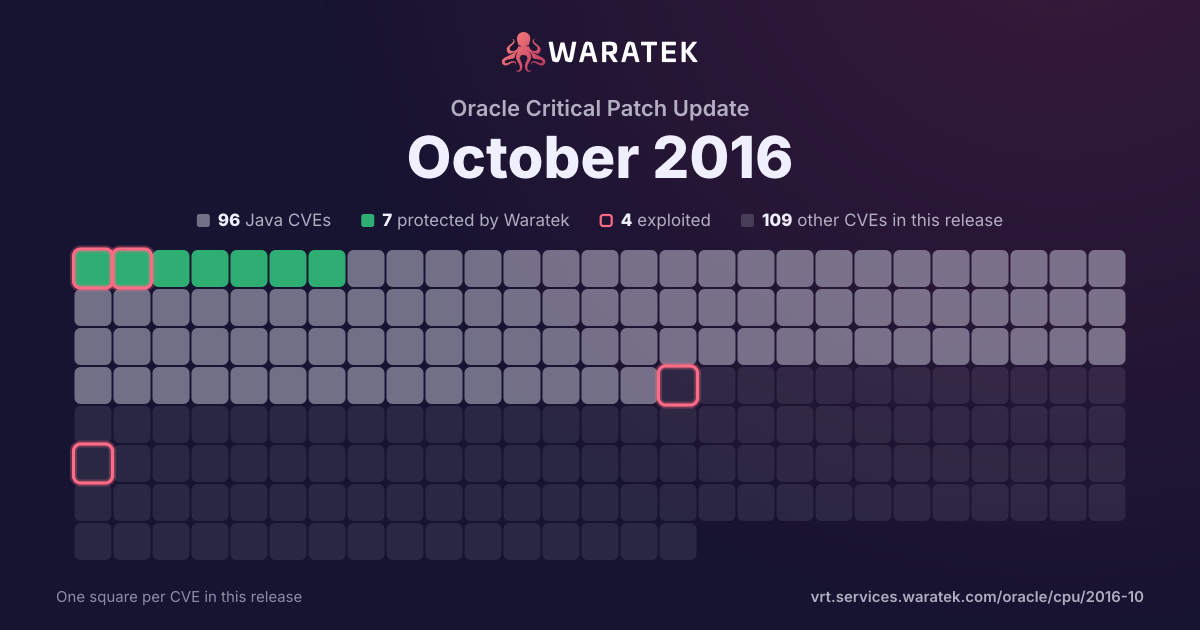
By status
7Protected by Waratek2Mitigation candidate87No exploit published39Outside Waratek scope68Not applicable2Withdrawn CVE
4Exploited, marked by the ring
No exploit published. For 83 of them, Oracle's security advisory is the source of public detail.
Protected by Waratek. Waratek RASP can block exploitation of these on systems that have not applied the patch yet.
Overview 10 matches · 0 in Waratek scope · 0 protected · 1 exploited · 0 CISA KEV · 2 public PoC · 3 EPSS ≥ 0.5
10matches
0in Waratek scope0.0%
0protected0.0%
1exploited10.0%
0CISA KEV0.0%
2public PoC20.0%
3EPSS ≥ 0.530.0%
Protected by Waratek
0
0.0%
Rule in development
0
0.0%
Mitigation candidate
0
0.0%
No exploit published
0
0.0%
Outside Waratek scope
0
0.0%
Not applicable
10
100.0%
Withdrawn CVE
0
0.0%
blocked by ARMR today
0
0.0%
partly blocked
0
0.0%
not blocked
10
100.0%
not established
0
0.0%
unrecorded
0
0.0%
Exploited
1
10.0%
Working exploit published
1
10.0%
Proof of concept only
0
0.0%
Forecast only
1
10.0%
No public exploit
7
70.0%
split by
peak 3 / quarter
Q4 141
Not applicable1
Medium1
not blocked1
No public exploit1
Q1 153
Not applicable3
High1
Medium2
not blocked3
No public exploit3
Q2 151
Not applicable1
Medium1
not blocked1
No public exploit1
Q3 150
Q4 150
Q1 160
Q2 162
Not applicable2
High1
Medium1
not blocked2
Working exploit published1
No public exploit1
Q3 163
Not applicable3
Critical1
High2
not blocked3
Exploited1
Forecast only1
No public exploit1
Q4 14Q1 15Q2 15Q3 15Q4 15Q1 16Q2 16Q3 16
| CVE | Severity | Published▾ | Status | Exploitation | Description |
|---|---|---|---|---|---|
| CVE-2016-6304 | High | 2016-09-26 | Not applicable | Forecast only | Multiple memory leaks in t1_lib.c in OpenSSL before 1.0.1u, 1.0.2 before 1.0.2i, and 1.1.0 before 1.1.0a allow remote attackers to cause a denial of service (memory consumption) via large OCSP Status Request extensions. |
| CVE-2016-6662 | Critical | 2016-09-20 | Not applicable | Exploited | Oracle MySQL through 5.5.52, 5.6.x through 5.6.33, and 5.7.x through 5.7.15; MariaDB before 5.5.51, 10.0.x before 10.0.27, and 10.1.x before 10.1.17; and Percona Server before 5.5.51-38.1, 5.6.x before 5.6.32-78.0, and 5.7.x before 5.7.14-7 allow local users to create arbitrary configurations and bypass certain protection mechanisms by setting general_log_file to a my.cnf configuration. NOTE: this can be leveraged to execute arbitrary code with root privileges by setting malloc_lib. NOTE: the affected MySQL version information is from Oracle's October 2016 CPU. Oracle has not commented on third-party claims that the issue was silently patched in MySQL 5.5.52, 5.6.33, and 5.7.15. |
| CVE-2016-4979 | High | 2016-07-06 | Not applicable | No public exploit | The Apache HTTP Server 2.4.18 through 2.4.20, when mod_http2 and mod_ssl are enabled, does not properly recognize the "SSLVerifyClient require" directive for HTTP/2 request authorization, which allows remote attackers to bypass intended access restrictions by leveraging the ability to send multiple requests over a single connection and aborting a renegotiation. |
| CVE-2016-2176 | High | 2016-05-05 | Not applicable | No public exploit | The X509_NAME_oneline function in crypto/x509/x509_obj.c in OpenSSL before 1.0.1t and 1.0.2 before 1.0.2h allows remote attackers to obtain sensitive information from process stack memory or cause a denial of service (buffer over-read) via crafted EBCDIC ASN.1 data. |
| CVE-2016-2107 | Medium | 2016-05-05 | Not applicable | Working exploit published | The AES-NI implementation in OpenSSL before 1.0.1t and 1.0.2 before 1.0.2h does not consider memory allocation during a certain padding check, which allows remote attackers to obtain sensitive cleartext information via a padding-oracle attack against an AES CBC session. NOTE: this vulnerability exists because of an incorrect fix for CVE-2013-0169. |
| CVE-2015-1791 | Medium | 2015-06-12 | Not applicable | No public exploit | Race condition in the ssl3_get_new_session_ticket function in ssl/s3_clnt.c in OpenSSL before 0.9.8zg, 1.0.0 before 1.0.0s, 1.0.1 before 1.0.1n, and 1.0.2 before 1.0.2b, when used for a multi-threaded client, allows remote attackers to cause a denial of service (double free and application crash) or possibly have unspecified other impact by providing a NewSessionTicket during an attempt to reuse a ticket that had been obtained earlier. |
| CVE-2015-1351 | High | 2015-03-30 | Not applicable | No public exploit | Use-after-free vulnerability in the _zend_shared_memdup function in zend_shared_alloc.c in the OPcache extension in PHP through 5.6.7 allows remote attackers to cause a denial of service or possibly have unspecified other impact via unknown vectors. |
| CVE-2015-0286 | Medium | 2015-03-19 | Not applicable | No public exploit | The ASN1_TYPE_cmp function in crypto/asn1/a_type.c in OpenSSL before 0.9.8zf, 1.0.0 before 1.0.0r, 1.0.1 before 1.0.1m, and 1.0.2 before 1.0.2a does not properly perform boolean-type comparisons, which allows remote attackers to cause a denial of service (invalid read operation and application crash) via a crafted X.509 certificate to an endpoint that uses the certificate-verification feature. |
| CVE-2014-3571 | Medium | 2015-01-09 | Not applicable | No public exploit | OpenSSL before 0.9.8zd, 1.0.0 before 1.0.0p, and 1.0.1 before 1.0.1k allows remote attackers to cause a denial of service (NULL pointer dereference and application crash) via a crafted DTLS message that is processed with a different read operation for the handshake header than for the handshake body, related to the dtls1_get_record function in d1_pkt.c and the ssl3_read_n function in s3_pkt.c. |
| CVE-2014-9296 | Medium | 2014-12-20 | Not applicable | No public exploit | The receive function in ntp_proto.c in ntpd in NTP before 4.2.8 continues to execute after detecting a certain authentication error, which might allow remote attackers to trigger an unintended association change via crafted packets. |