
Oracle Critical Patch Update October 2016
Released October 2016 · Oracle's advisory ↗ · ← Critical Patch Update, July 2016 · Critical Patch Update, January 2017 →
205 CVEs in this release, one square each
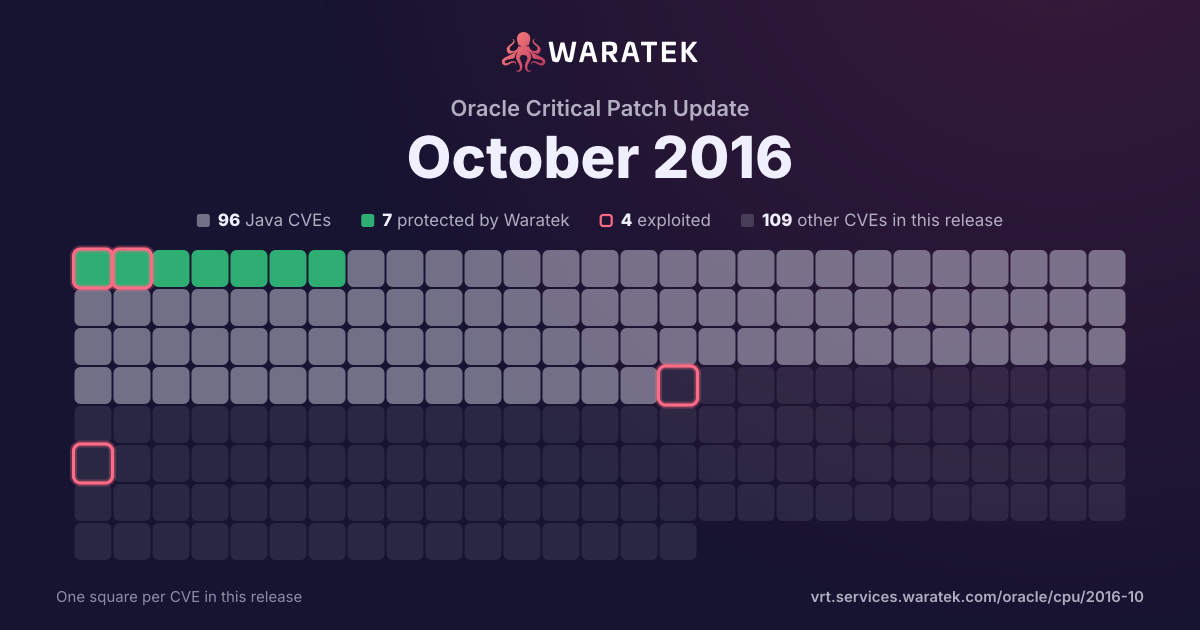
By status
7Protected by Waratek2Mitigation candidate87No exploit published39Outside Waratek scope68Not applicable2Withdrawn CVE
4Exploited, marked by the ring
No exploit published. For 83 of them, Oracle's security advisory is the source of public detail.
Protected by Waratek. Waratek RASP can block exploitation of these on systems that have not applied the patch yet.
Overview 115 matches · 52 in Waratek scope · 4 protected · 0 exploited · 0 CISA KEV · 2 public PoC · 3 EPSS ≥ 0.5
115matches
52in Waratek scope45.2%
4protected3.5%
0exploited0.0%
0CISA KEV0.0%
2public PoC1.7%
3EPSS ≥ 0.52.6%
Protected by Waratek
4
3.5%
Rule in development
0
0.0%
Mitigation candidate
0
0.0%
No exploit published
48
41.7%
Outside Waratek scope
23
20.0%
Not applicable
40
34.8%
Withdrawn CVE
0
0.0%
blocked by ARMR today
4
3.5%
partly blocked
0
0.0%
not blocked
111
96.5%
not established
0
0.0%
unrecorded
0
0.0%
Exploited
0
0.0%
Working exploit published
2
1.7%
Proof of concept only
0
0.0%
Forecast only
1
0.9%
No public exploit
112
97.4%
split by
peak 86 / quarter
Q1 131
Outside Waratek scope1
Medium1
not blocked1
Forecast only1
Q2 131
Outside Waratek scope1
Medium1
not blocked1
No public exploit1
Q3 130
Q4 130
Q1 144
Protected by Waratek1
No exploit published1
Outside Waratek scope2
Medium4
blocked by ARMR today1
not blocked3
No public exploit4
Q2 144
Protected by Waratek2
No exploit published2
Medium4
blocked by ARMR today2
not blocked2
No public exploit4
Q3 141
No exploit published1
Medium1
not blocked1
No public exploit1
Q4 142
Outside Waratek scope1
Not applicable1
Medium2
not blocked2
No public exploit2
Q1 156
Outside Waratek scope4
Not applicable2
Medium6
not blocked6
No public exploit6
Q2 155
Outside Waratek scope4
Not applicable1
Medium5
not blocked5
No public exploit5
Q3 151
Outside Waratek scope1
Medium1
not blocked1
Working exploit published1
Q4 152
Outside Waratek scope2
Medium2
not blocked2
No public exploit2
Q1 161
Outside Waratek scope1
Medium1
not blocked1
No public exploit1
Q2 161
Not applicable1
Medium1
not blocked1
Working exploit published1
Q3 160
Q4 1686
Protected by Waratek1
No exploit published44
Outside Waratek scope6
Not applicable35
Medium86
blocked by ARMR today1
not blocked85
No public exploit86
Q2 13Q4 13Q2 14Q4 14Q2 15Q4 15Q2 16Q4 16
| CVE | Severity | Published▾ | Status | Exploitation | Description |
|---|---|---|---|---|---|
| CVE-2015-0381 | Medium | 2015-01-21 | Outside Waratek scope | No public exploit | Unspecified vulnerability in Oracle MySQL Server 5.5.40 and earlier and 5.6.21 and earlier allows remote attackers to affect availability via unknown vectors related to Server : Replication, a different vulnerability than CVE-2015-0382. |
| CVE-2014-3571 | Medium | 2015-01-09 | Not applicable | No public exploit | OpenSSL before 0.9.8zd, 1.0.0 before 1.0.0p, and 1.0.1 before 1.0.1k allows remote attackers to cause a denial of service (NULL pointer dereference and application crash) via a crafted DTLS message that is processed with a different read operation for the handshake header than for the handshake body, related to the dtls1_get_record function in d1_pkt.c and the ssl3_read_n function in s3_pkt.c. |
| CVE-2014-9296 | Medium | 2014-12-20 | Not applicable | No public exploit | The receive function in ntp_proto.c in ntpd in NTP before 4.2.8 continues to execute after detecting a certain authentication error, which might allow remote attackers to trigger an unintended association change via crafted packets. |
| CVE-2010-5312 | Medium | 2014-11-24 | Outside Waratek scope | No public exploit | Cross-site scripting (XSS) vulnerability in jquery.ui.dialog.js in the Dialog widget in jQuery UI before 1.10.0 allows remote attackers to inject arbitrary web script or HTML via the title option. |
| CVE-2013-4444 | Medium | 2014-09-12 | No exploit published | No public exploit | Unrestricted file upload vulnerability in Apache Tomcat 7.x before 7.0.40, in certain situations involving outdated java.io.File code and a custom JMX configuration, allows remote attackers to execute arbitrary code by uploading and accessing a JSP file. |
| CVE-2014-0119 | Medium | 2014-05-31 | Protected by Waratek | No public exploit | Apache Tomcat before 6.0.40, 7.x before 7.0.54, and 8.x before 8.0.6 does not properly constrain the class loader that accesses the XML parser used with an XSLT stylesheet, which allows remote attackers to (1) read arbitrary files via a crafted web application that provides an XML external entity declaration in conjunction with an entity reference, related to an XML External Entity (XXE) issue, or (2) read files associated with different web applications on a single Tomcat instance via a crafted web application. |
| CVE-2014-0099 | Medium | 2014-05-31 | No exploit published | No public exploit | Integer overflow in java/org/apache/tomcat/util/buf/Ascii.java in Apache Tomcat before 6.0.40, 7.x before 7.0.53, and 8.x before 8.0.4, when operated behind a reverse proxy, allows remote attackers to conduct HTTP request smuggling attacks via a crafted Content-Length HTTP header. |
| CVE-2014-0096 | Medium | 2014-05-31 | Protected by Waratek | No public exploit | java/org/apache/catalina/servlets/DefaultServlet.java in the default servlet in Apache Tomcat before 6.0.40, 7.x before 7.0.53, and 8.x before 8.0.4 does not properly restrict XSLT stylesheets, which allows remote attackers to bypass security-manager restrictions and read arbitrary files via a crafted web application that provides an XML external entity declaration in conjunction with an entity reference, related to an XML External Entity (XXE) issue. |
| CVE-2014-0075 | Medium | 2014-05-31 | No exploit published | No public exploit | Integer overflow in the parseChunkHeader function in java/org/apache/coyote/http11/filters/ChunkedInputFilter.java in Apache Tomcat before 6.0.40, 7.x before 7.0.53, and 8.x before 8.0.4 allows remote attackers to cause a denial of service (resource consumption) via a malformed chunk size in chunked transfer coding of a request during the streaming of data. |
| CVE-2014-2532 | Medium | 2014-03-18 | Outside Waratek scope | No public exploit | sshd in OpenSSH before 6.6 does not properly support wildcards on AcceptEnv lines in sshd_config, which allows remote attackers to bypass intended environment restrictions by using a substring located before a wildcard character. |
| CVE-2013-4590 | Medium | 2014-02-26 | Protected by Waratek | No public exploit | Apache Tomcat before 6.0.39, 7.x before 7.0.50, and 8.x before 8.0.0-RC10 allows attackers to obtain "Tomcat internals" information by leveraging the presence of an untrusted web application with a context.xml, web.xml, *.jspx, *.tagx, or *.tld XML document containing an external entity declaration in conjunction with an entity reference, related to an XML External Entity (XXE) issue. |
| CVE-2013-4322 | Medium | 2014-02-26 | No exploit published | No public exploit | Apache Tomcat before 6.0.39, 7.x before 7.0.50, and 8.x before 8.0.0-RC10 processes chunked transfer coding without properly handling (1) a large total amount of chunked data or (2) whitespace characters in an HTTP header value within a trailer field, which allows remote attackers to cause a denial of service by streaming data. NOTE: this vulnerability exists because of an incomplete fix for CVE-2012-3544. |
| CVE-2013-4286 | Medium | 2014-02-26 | Outside Waratek scope | No public exploit | Apache Tomcat before 6.0.39, 7.x before 7.0.47, and 8.x before 8.0.0-RC3, when an HTTP connector or AJP connector is used, does not properly handle certain inconsistent HTTP request headers, which allows remote attackers to trigger incorrect identification of a request's length and conduct request-smuggling attacks via (1) multiple Content-Length headers or (2) a Content-Length header and a "Transfer-Encoding: chunked" header. NOTE: this vulnerability exists because of an incomplete fix for CVE-2005-2090. |
| CVE-2013-2067 | Medium | 2013-06-01 | Outside Waratek scope | No public exploit | java/org/apache/catalina/authenticator/FormAuthenticator.java in the form authentication feature in Apache Tomcat 6.0.21 through 6.0.36 and 7.x before 7.0.33 does not properly handle the relationships between authentication requirements and sessions, which allows remote attackers to inject a request into a session by sending this request during completion of the login form, a variant of a session fixation attack. |
| CVE-2013-2566 | Medium | 2013-03-15 | Outside Waratek scope | Forecast only | The RC4 algorithm, as used in the TLS protocol and SSL protocol, has many single-byte biases, which makes it easier for remote attackers to conduct plaintext-recovery attacks via statistical analysis of ciphertext in a large number of sessions that use the same plaintext. |