
Oracle Critical Patch Update October 2016
Released October 2016 · Oracle's advisory ↗ · ← Critical Patch Update, July 2016 · Critical Patch Update, January 2017 →
205 CVEs in this release, one square each
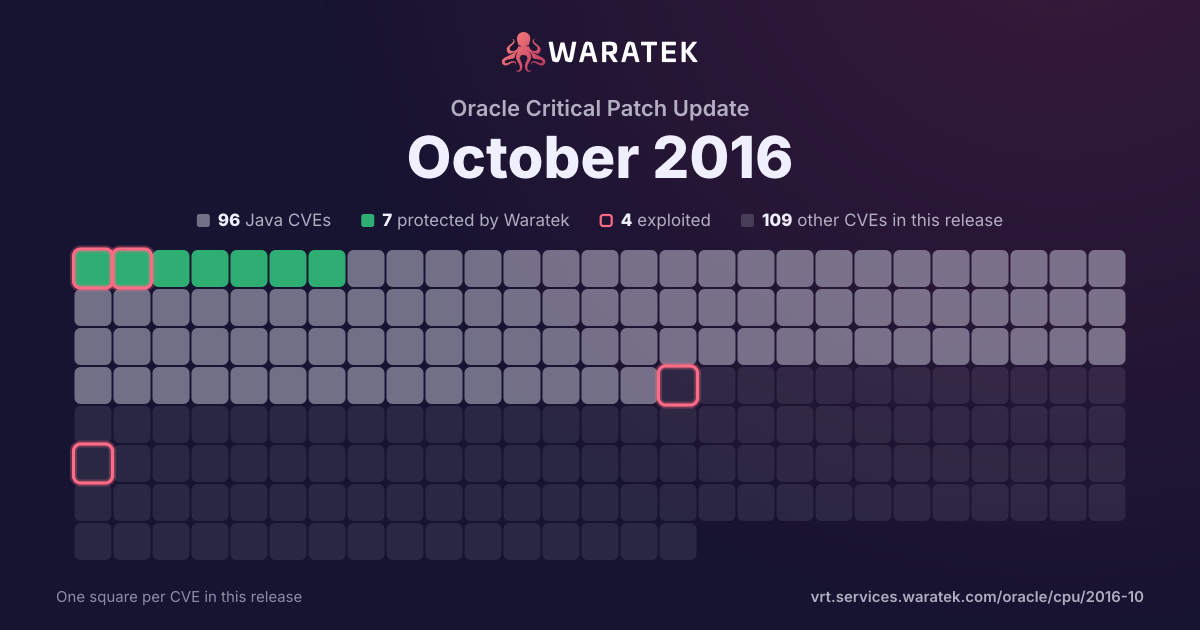
By status
7Protected by Waratek2Mitigation candidate104No exploit published15Outside Waratek scope75Not applicable2Withdrawn CVE
4Exploited, marked by the ring
No exploit published. For 93 of them, Oracle's security advisory is the source of public detail.
Protected by Waratek. Waratek RASP can block exploitation of these on systems that have not applied the patch yet.
Overview 11 matches · 0 protected · 0 exploited · 0 CISA KEV · 0 public PoC · 0 EPSS ≥ 0.5
11matches
0protected0.0%
0exploited0.0%
0CISA KEV0.0%
0public PoC0.0%
0EPSS ≥ 0.50.0%
Protected by Waratek
0
0.0%
Rule in development
0
0.0%
Mitigation candidate
0
0.0%
No exploit published
11
100.0%
blocked by ARMR today
0
0.0%
partly blocked
0
0.0%
not blocked
11
100.0%
not established
0
0.0%
unrecorded
0
0.0%
Exploited
0
0.0%
Working exploit published
0
0.0%
Proof of concept only
0
0.0%
Forecast only
0
0.0%
No public exploit
11
100.0%
split by
peak 4 / quarter
Q2 131
No exploit published1
Medium1
not blocked1
No public exploit1
Q3 130
Q4 130
Q1 142
No exploit published2
Medium2
not blocked2
No public exploit2
Q2 142
No exploit published2
Medium2
not blocked2
No public exploit2
Q3 141
No exploit published1
Medium1
not blocked1
No public exploit1
Q4 141
No exploit published1
Medium1
not blocked1
No public exploit1
Q1 154
No exploit published4
High1
Medium3
not blocked4
No public exploit4
Q2 13Q3 13Q4 13Q1 14Q2 14Q3 14Q4 14Q1 15
| CVE | Severity | Published▾ | Status | Exploitation | Description |
|---|---|---|---|---|---|
| CVE-2015-0411 | High | 2015-01-21 | No exploit published | No public exploit | Unspecified vulnerability in Oracle MySQL Server 5.5.40 and earlier, and 5.6.21 and earlier, allows remote attackers to affect confidentiality, integrity, and availability via unknown vectors related to Server : Security : Encryption. |
| CVE-2015-0409 | Medium | 2015-01-21 | No exploit published | No public exploit | Unspecified vulnerability in Oracle MySQL Server 5.6.21 and earlier allows remote authenticated users to affect availability via unknown vectors related to Optimizer. |
| CVE-2015-0382 | Medium | 2015-01-21 | No exploit published | No public exploit | Unspecified vulnerability in Oracle MySQL Server 5.5.40 and earlier and 5.6.21 and earlier allows remote attackers to affect availability via unknown vectors related to Server : Replication, a different vulnerability than CVE-2015-0381. |
| CVE-2015-0381 | Medium | 2015-01-21 | No exploit published | No public exploit | Unspecified vulnerability in Oracle MySQL Server 5.5.40 and earlier and 5.6.21 and earlier allows remote attackers to affect availability via unknown vectors related to Server : Replication, a different vulnerability than CVE-2015-0382. |
| CVE-2010-5312 | Medium | 2014-11-24 | No exploit published | No public exploit | Cross-site scripting (XSS) vulnerability in jquery.ui.dialog.js in the Dialog widget in jQuery UI before 1.10.0 allows remote attackers to inject arbitrary web script or HTML via the title option. |
| CVE-2013-4444 | Medium | 2014-09-12 | No exploit published | No public exploit | Unrestricted file upload vulnerability in Apache Tomcat 7.x before 7.0.40, in certain situations involving outdated java.io.File code and a custom JMX configuration, allows remote attackers to execute arbitrary code by uploading and accessing a JSP file. |
| CVE-2014-0099 | Medium | 2014-05-31 | No exploit published | No public exploit | Integer overflow in java/org/apache/tomcat/util/buf/Ascii.java in Apache Tomcat before 6.0.40, 7.x before 7.0.53, and 8.x before 8.0.4, when operated behind a reverse proxy, allows remote attackers to conduct HTTP request smuggling attacks via a crafted Content-Length HTTP header. |
| CVE-2014-0075 | Medium | 2014-05-31 | No exploit published | No public exploit | Integer overflow in the parseChunkHeader function in java/org/apache/coyote/http11/filters/ChunkedInputFilter.java in Apache Tomcat before 6.0.40, 7.x before 7.0.53, and 8.x before 8.0.4 allows remote attackers to cause a denial of service (resource consumption) via a malformed chunk size in chunked transfer coding of a request during the streaming of data. |
| CVE-2013-4322 | Medium | 2014-02-26 | No exploit published | No public exploit | Apache Tomcat before 6.0.39, 7.x before 7.0.50, and 8.x before 8.0.0-RC10 processes chunked transfer coding without properly handling (1) a large total amount of chunked data or (2) whitespace characters in an HTTP header value within a trailer field, which allows remote attackers to cause a denial of service by streaming data. NOTE: this vulnerability exists because of an incomplete fix for CVE-2012-3544. |
| CVE-2013-4286 | Medium | 2014-02-26 | No exploit published | No public exploit | Apache Tomcat before 6.0.39, 7.x before 7.0.47, and 8.x before 8.0.0-RC3, when an HTTP connector or AJP connector is used, does not properly handle certain inconsistent HTTP request headers, which allows remote attackers to trigger incorrect identification of a request's length and conduct request-smuggling attacks via (1) multiple Content-Length headers or (2) a Content-Length header and a "Transfer-Encoding: chunked" header. NOTE: this vulnerability exists because of an incomplete fix for CVE-2005-2090. |
| CVE-2013-2067 | Medium | 2013-06-01 | No exploit published | No public exploit | java/org/apache/catalina/authenticator/FormAuthenticator.java in the form authentication feature in Apache Tomcat 6.0.21 through 6.0.36 and 7.x before 7.0.33 does not properly handle the relationships between authentication requirements and sessions, which allows remote attackers to inject a request into a session by sending this request during completion of the login form, a variant of a session fixation attack. |