
Oracle Critical Patch Update October 2016
Released October 2016 · Oracle's advisory ↗ · ← Critical Patch Update, July 2016 · Critical Patch Update, January 2017 →
205 CVEs in this release, one square each
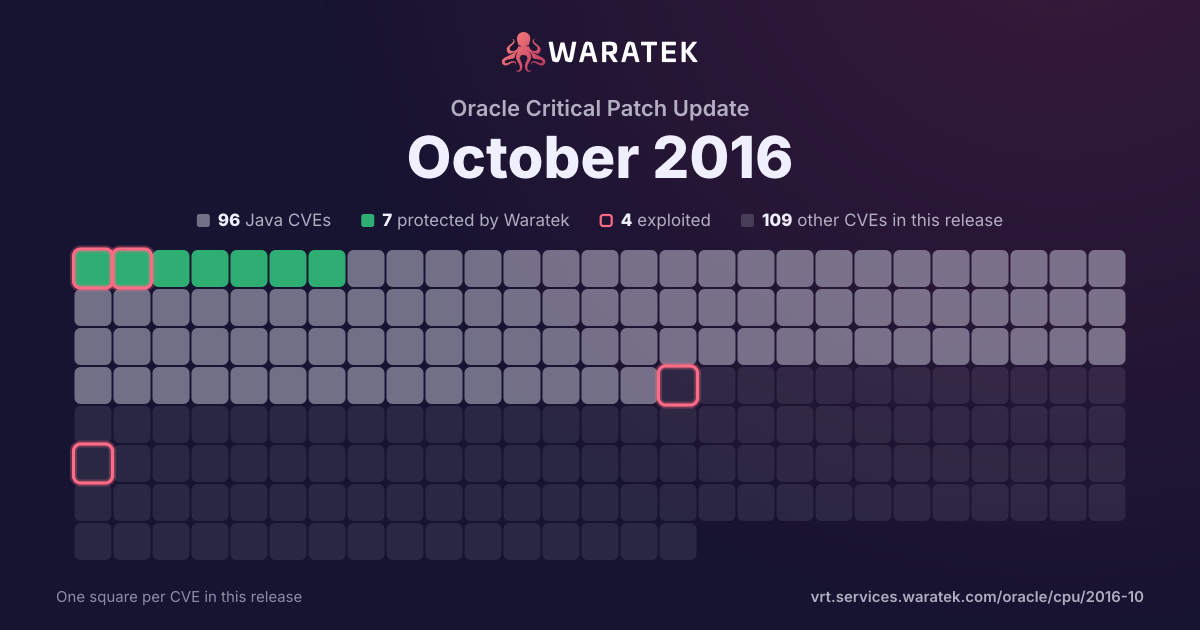
By status
7Protected by Waratek2Mitigation candidate104No exploit published15Outside Waratek scope75Not applicable2Withdrawn CVE
4Exploited, marked by the ring
No exploit published. For 93 of them, Oracle's security advisory is the source of public detail.
Protected by Waratek. Waratek RASP can block exploitation of these on systems that have not applied the patch yet.
Overview 2 matches · 1 protected · 0 exploited · 0 CISA KEV · 1 public PoC · 1 EPSS ≥ 0.5
Protected by Waratek
1
50.0%
Rule in development
0
0.0%
Mitigation candidate
1
50.0%
No exploit published
0
0.0%
blocked by ARMR today
1
50.0%
partly blocked
0
0.0%
not blocked
1
50.0%
not established
0
0.0%
unrecorded
0
0.0%
Exploited
0
0.0%
Working exploit published
1
50.0%
Proof of concept only
0
0.0%
Forecast only
0
0.0%
No public exploit
1
50.0%
| CVE | Severity | Published▾ | Status | Exploitation | Description |
|---|---|---|---|---|---|
| CVE-2014-0119 | Medium | 2014-05-31 | Protected by Waratek | No public exploit | Apache Tomcat before 6.0.40, 7.x before 7.0.54, and 8.x before 8.0.6 does not properly constrain the class loader that accesses the XML parser used with an XSLT stylesheet, which allows remote attackers to (1) read arbitrary files via a crafted web application that provides an XML external entity declaration in conjunction with an entity reference, related to an XML External Entity (XXE) issue, or (2) read files associated with different web applications on a single Tomcat instance via a crafted web application. |
| CVE-2014-0050 | High | 2014-04-01 | Mitigation candidate | Working exploit published | MultipartStream.java in Apache Commons FileUpload before 1.3.1, as used in Apache Tomcat, JBoss Web, and other products, allows remote attackers to cause a denial of service (infinite loop and CPU consumption) via a crafted Content-Type header that bypasses a loop's intended exit conditions. |