
Oracle Critical Patch Update April 2016
Released April 2016 · Oracle's advisory ↗ · ← Critical Patch Update, January 2016 · Critical Patch Update, July 2016 →
121 CVEs in this release, one square each
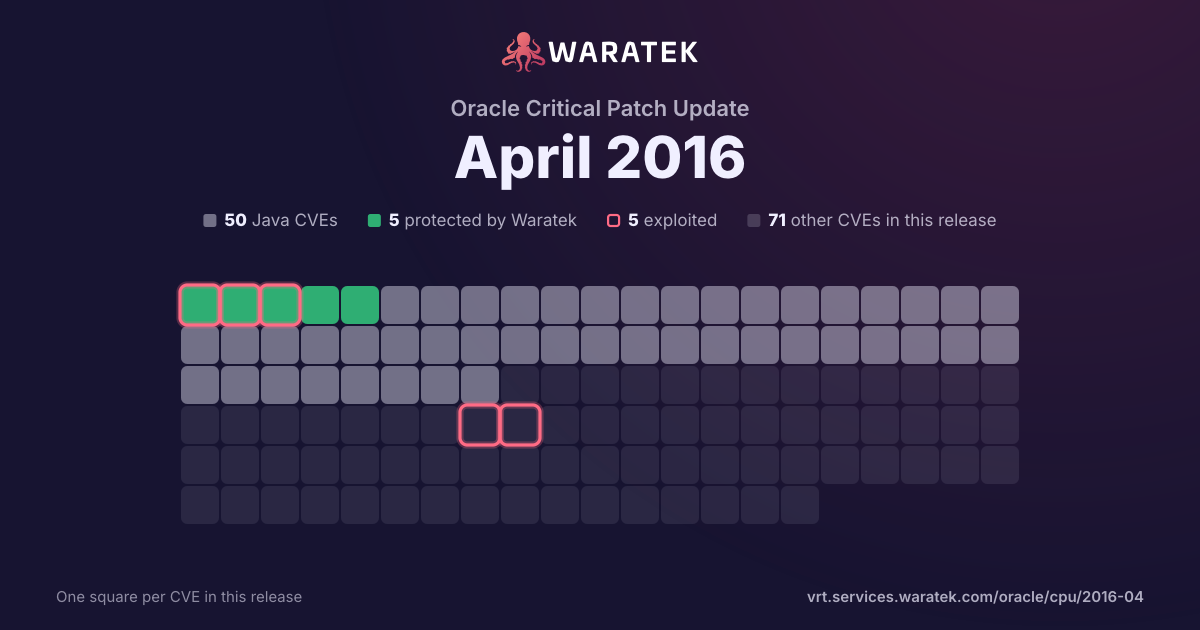
By status
5Protected by Waratek45No exploit published20Outside Waratek scope51Not applicable
5Exploited, marked by the ring
No exploit published. For 43 of them, Oracle's security advisory is the source of public detail.
Protected by Waratek. Waratek RASP can block exploitation of these on systems that have not applied the patch yet.
Overview 2 matches · 0 in Waratek scope · 0 protected · 1 exploited · 0 CISA KEV · 1 public PoC · 1 EPSS ≥ 0.5
2matches
0in Waratek scope0.0%
0protected0.0%
1exploited50.0%
0CISA KEV0.0%
1public PoC50.0%
1EPSS ≥ 0.550.0%
Protected by Waratek
0
0.0%
Rule in development
0
0.0%
Mitigation candidate
0
0.0%
No exploit published
0
0.0%
Outside Waratek scope
1
50.0%
Not applicable
1
50.0%
Withdrawn CVE
0
0.0%
blocked by ARMR today
0
0.0%
partly blocked
0
0.0%
not blocked
2
100.0%
not established
0
0.0%
unrecorded
0
0.0%
Exploited
1
50.0%
Working exploit published
0
0.0%
Proof of concept only
0
0.0%
Forecast only
0
0.0%
No public exploit
1
50.0%
split by
peak 2 / month
Feb 16
| CVE | Severity | Published▾ | Status | Exploitation | Description |
|---|---|---|---|---|---|
| CVE-2015-7547 | High | 2016-02-18 | Not applicable | Exploited | Multiple stack-based buffer overflows in the (1) send_dg and (2) send_vc functions in the libresolv library in the GNU C Library (aka glibc or libc6) before 2.23 allow remote attackers to cause a denial of service (crash) or possibly execute arbitrary code via a crafted DNS response that triggers a call to the getaddrinfo function with the AF_UNSPEC or AF_INET6 address family, related to performing "dual A/AAAA DNS queries" and the libnss_dns.so.2 NSS module. |
| CVE-2015-3197 | Medium | 2016-02-15 | Outside Waratek scope | No public exploit | ssl/s2_srvr.c in OpenSSL 1.0.1 before 1.0.1r and 1.0.2 before 1.0.2f does not prevent use of disabled ciphers, which makes it easier for man-in-the-middle attackers to defeat cryptographic protection mechanisms by performing computations on SSLv2 traffic, related to the get_client_master_key and get_client_hello functions. |