
Oracle Critical Patch Update April 2016
Released April 2016 · Oracle's advisory ↗ · ← Critical Patch Update, January 2016 · Critical Patch Update, July 2016 →
121 CVEs in this release, one square each
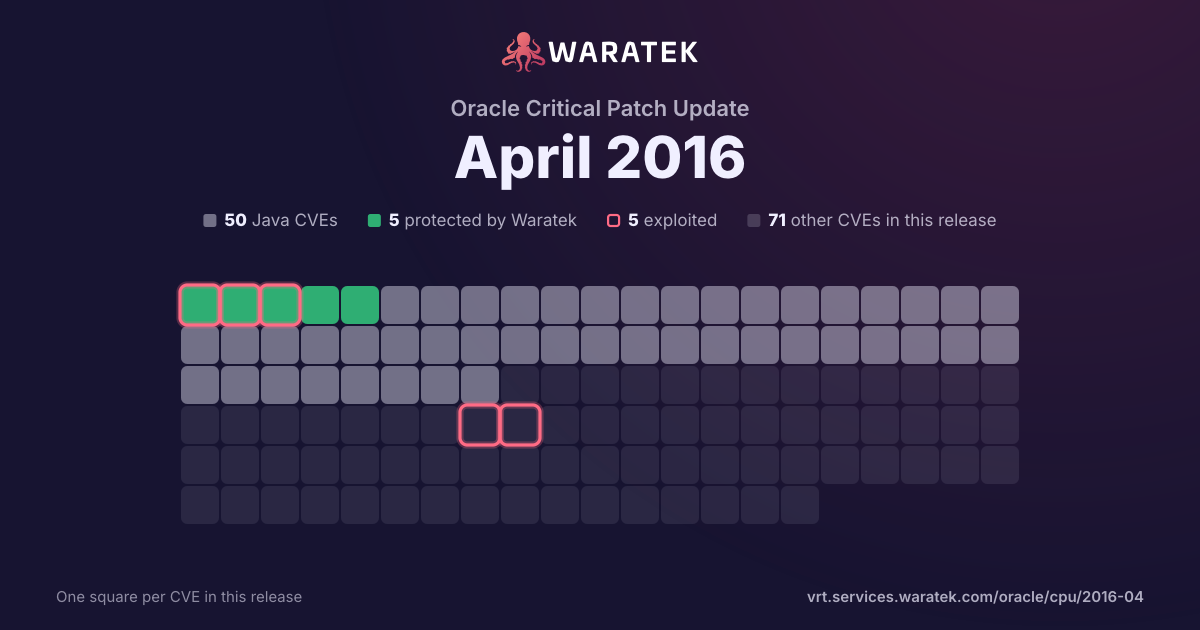
By status
5Protected by Waratek45No exploit published20Outside Waratek scope51Not applicable
5Exploited, marked by the ring
No exploit published. For 43 of them, Oracle's security advisory is the source of public detail.
Protected by Waratek. Waratek RASP can block exploitation of these on systems that have not applied the patch yet.
Overview 2 matches · 0 in Waratek scope · 0 protected · 0 exploited · 0 CISA KEV · 0 public PoC
2matches
0in Waratek scope0.0%
0protected0.0%
0exploited0.0%
0CISA KEV0.0%
0public PoC0.0%
Protected by Waratek
0
0.0%
Rule in development
0
0.0%
Mitigation candidate
0
0.0%
No exploit published
0
0.0%
Outside Waratek scope
1
50.0%
Not applicable
1
50.0%
Withdrawn CVE
0
0.0%
blocked by ARMR today
0
0.0%
partly blocked
0
0.0%
not blocked
2
100.0%
not established
0
0.0%
unrecorded
0
0.0%
Exploited
0
0.0%
Working exploit published
0
0.0%
Proof of concept only
0
0.0%
Forecast only
2
100.0%
No public exploit
0
0.0%
split by
peak 1 / quarter
Q1 13Q2 13Q3 13Q4 13Q1 14Q2 14Q3 14Q4 14Q1 15Q2 15
| CVE | Severity | Published▾ | Status | Exploitation | Description |
|---|---|---|---|---|---|
| CVE-2015-1789 | High | 2015-06-12 | Not applicable | Forecast only | The X509_cmp_time function in crypto/x509/x509_vfy.c in OpenSSL before 0.9.8zg, 1.0.0 before 1.0.0s, 1.0.1 before 1.0.1n, and 1.0.2 before 1.0.2b allows remote attackers to cause a denial of service (out-of-bounds read and application crash) via a crafted length field in ASN1_TIME data, as demonstrated by an attack against a server that supports client authentication with a custom verification callback. |
| CVE-2013-2566 | Medium | 2013-03-15 | Outside Waratek scope | Forecast only | The RC4 algorithm, as used in the TLS protocol and SSL protocol, has many single-byte biases, which makes it easier for remote attackers to conduct plaintext-recovery attacks via statistical analysis of ciphertext in a large number of sessions that use the same plaintext. |