
Oracle Critical Patch Update January 2016
Released January 2016 · Oracle's advisory ↗ · ← Critical Patch Update, October 2015 · Critical Patch Update, April 2016 →
237 CVEs in this release, one square each
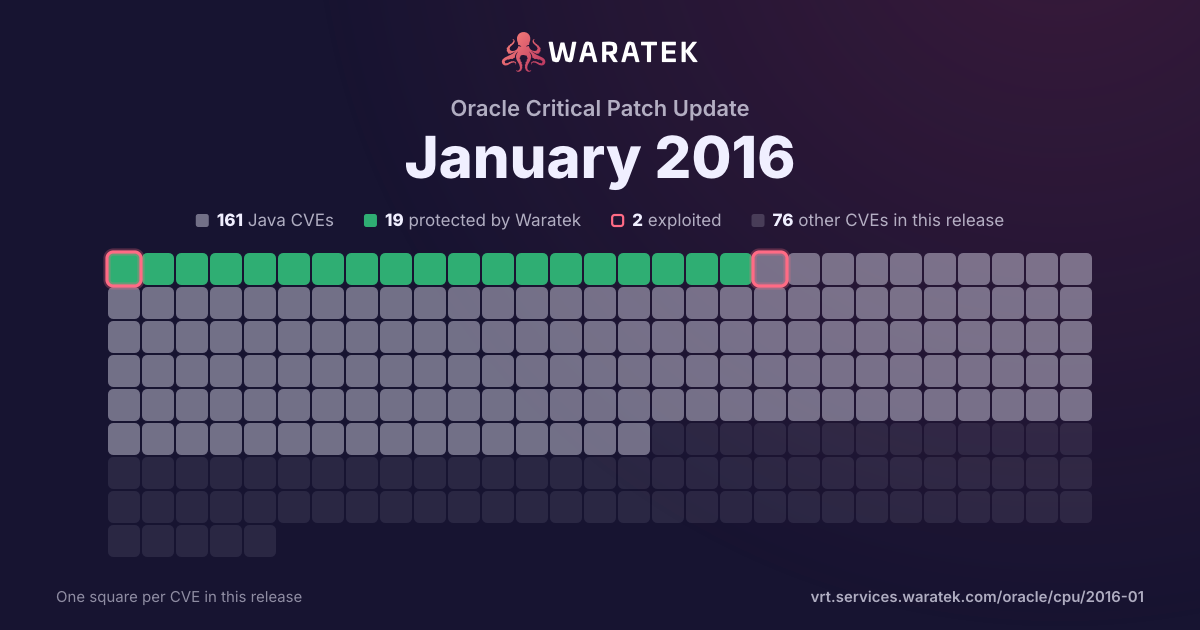
By status
19Protected by Waratek3Mitigation candidate139No exploit published14Outside Waratek scope62Not applicable
2Exploited, marked by the ring
No exploit published. For 137 of them, Oracle's security advisory is the source of public detail.
Protected by Waratek. Waratek RASP can block exploitation of these on systems that have not applied the patch yet.
Overview 22 matches · 11 in Waratek scope · 0 protected · 0 exploited · 0 CISA KEV · 0 public PoC · 0 EPSS ≥ 0.5
22matches
11in Waratek scope50.0%
0protected0.0%
0exploited0.0%
0CISA KEV0.0%
0public PoC0.0%
0EPSS ≥ 0.50.0%
Protected by Waratek
0
0.0%
Rule in development
0
0.0%
Mitigation candidate
0
0.0%
No exploit published
11
50.0%
Outside Waratek scope
2
9.1%
Not applicable
9
40.9%
Withdrawn CVE
0
0.0%
blocked by ARMR today
0
0.0%
partly blocked
0
0.0%
not blocked
22
100.0%
not established
0
0.0%
unrecorded
0
0.0%
Exploited
0
0.0%
Working exploit published
0
0.0%
Proof of concept only
0
0.0%
Forecast only
0
0.0%
No public exploit
22
100.0%
split by
peak 22 / month
Jan 16
| CVE | Severity | Published▾ | Status | Exploitation | Description |
|---|---|---|---|---|---|
| CVE-2015-6015 | High | 2016-01-22 | Not applicable | No public exploit | Unspecified vulnerability in the Oracle Outside In Technology component in Oracle Fusion Middleware 8.5.0, 8.5.1, and 8.5.2 allows local users to affect availability via unknown vectors related to Outside In Filters, a different vulnerability than CVE-2015-4808, CVE-2015-6013, CVE-2015-6014, and CVE-2016-0432. NOTE: the previous information is from the January 2016 CPU. Oracle has not commented on third-party claims that this issue is a stack-based buffer overflow in Oracle Outside In 8.5.2 and earlier, which allows remote attackers to execute arbitrary code via a crafted Paradox DB file. |
| CVE-2015-6014 | High | 2016-01-22 | Not applicable | No public exploit | Unspecified vulnerability in the Oracle Outside In Technology component in Oracle Fusion Middleware 8.5.0, 8.5.1, and 8.5.2 allows local users to affect availability via unknown vectors related to Outside In Filters, a different vulnerability than CVE-2015-4808, CVE-2015-6013, CVE-2015-6015, and CVE-2016-0432. NOTE: the previous information is from the January 2016 CPU. Oracle has not commented on third-party claims that this issue is a stack-based buffer overflow in Oracle Outside In 8.5.2 and earlier, which allows remote attackers to execute arbitrary code via a crafted DOC file. |
| CVE-2015-6013 | High | 2016-01-22 | Not applicable | No public exploit | Unspecified vulnerability in the Oracle Outside In Technology component in Oracle Fusion Middleware 8.5.0, 8.5.1, and 8.5.2 allows local users to affect availability via unknown vectors related to Outside In Filters, a different vulnerability than CVE-2015-4808, CVE-2015-6014, CVE-2015-6015, and CVE-2016-0432. NOTE: the previous information is from the January 2016 CPU. Oracle has not commented on third-party claims that this issue is a stack-based buffer overflow in Oracle Outside In 8.5.2 and earlier, which allows remote attackers to execute arbitrary code via a crafted WK4 file. |
| CVE-2016-0577 | High | 2016-01-21 | No exploit published | No public exploit | Unspecified vulnerability in the Oracle WebLogic Server component in Oracle Fusion Middleware 10.3.6, 12.1.2, 12.1.3, and 12.2.1 allows remote attackers to affect confidentiality, integrity, and availability via vectors related to WLS Core Components, a different vulnerability than CVE-2016-0574. |
| CVE-2016-0574 | High | 2016-01-21 | No exploit published | No public exploit | Unspecified vulnerability in the Oracle WebLogic Server component in Oracle Fusion Middleware 10.3.6, 12.1.2, 12.1.3, and 12.2.1 allows remote attackers to affect confidentiality, integrity, and availability via vectors related to WLS Core Components, a different vulnerability than CVE-2016-0577. |
| CVE-2016-0573 | High | 2016-01-21 | No exploit published | No public exploit | Unspecified vulnerability in the Oracle WebLogic Server component in Oracle Fusion Middleware 10.3.6, 12.1.2, 12.1.3, and 12.2.1 allows remote attackers to affect confidentiality, integrity, and availability via vectors related to WLS Java Messaging Service. |
| CVE-2016-0572 | High | 2016-01-21 | No exploit published | No public exploit | Unspecified vulnerability in the Oracle WebLogic Server component in Oracle Fusion Middleware 10.3.6, 12.1.2, 12.1.3, and 12.2.1 allows remote attackers to affect confidentiality, integrity, and availability via unknown vectors related to Coherence Container. |
| CVE-2016-0546 | High | 2016-01-21 | Not applicable | No public exploit | Unspecified vulnerability in Oracle MySQL 5.5.46 and earlier, 5.6.27 and earlier, and 5.7.9 and MariaDB before 5.5.47, 10.0.x before 10.0.23, and 10.1.x before 10.1.10 allows local users to affect confidentiality, integrity, and availability via unknown vectors related to Client. NOTE: the previous information is from the January 2016 CPU. Oracle has not commented on third-party claims that these are multiple buffer overflows in the mysqlshow tool that allow remote database servers to have unspecified impact via a long table or database name. |
| CVE-2016-0522 | High | 2016-01-21 | No exploit published | No public exploit | Unspecified vulnerability in the Oracle Retail Open Commerce Platform Cloud Service component in Oracle Retail Applications 3.5, 4.5, 4.7, and 5.0 allows remote attackers to affect confidentiality, integrity, and availability via unknown vectors related to Framework. |
| CVE-2016-0500 | High | 2016-01-21 | No exploit published | No public exploit | Unspecified vulnerability in the Oracle Retail Order Broker Cloud Service component in Oracle Retail Applications 4.0 and 4.1 allows remote attackers to affect confidentiality, integrity, and availability via unknown vectors related to System Administration. |
| CVE-2016-0499 | High | 2016-01-21 | Outside Waratek scope | No public exploit | Unspecified vulnerability in the Java VM component in Oracle Database Server 11.2.0.4, 12.1.0.1, and 12.1.0.2 allows remote authenticated users to affect confidentiality, integrity, and availability via unknown vectors, a different vulnerability than CVE-2015-4794. |
| CVE-2016-0494 | High | 2016-01-21 | Outside Waratek scope | No public exploit | Unspecified vulnerability in the Java SE and Java SE Embedded components in Oracle Java SE 6u105, 7u91, and 8u66 and Java SE Embedded 8u65 allows remote attackers to affect confidentiality, integrity, and availability via unknown vectors related to 2D. |
| CVE-2016-0483 | High | 2016-01-21 | No exploit published | No public exploit | Unspecified vulnerability in Oracle Java SE 6u105, 7u91, and 8u66; Java SE Embedded 8u65; and JRockit R28.3.8 allows remote attackers to affect confidentiality, integrity, and availability via vectors related to AWT. NOTE: the previous information is from the January 2016 CPU. Oracle has not commented on third-party claims that this is a heap-based buffer overflow in the readImage function, which allows remote attackers to execute arbitrary code via crafted image data. |
| CVE-2016-0452 | High | 2016-01-21 | Not applicable | No public exploit | Unspecified vulnerability in the Oracle GoldenGate component in Oracle GoldenGate 11.2 and 12.1.2 allows remote attackers to affect confidentiality, integrity, and availability via unknown vectors, a different vulnerability than CVE-2016-0451. |
| CVE-2016-0451 | High | 2016-01-21 | Not applicable | No public exploit | Unspecified vulnerability in the Oracle GoldenGate component in Oracle GoldenGate 11.2 and 12.1.2 allows remote attackers to affect confidentiality, integrity, and availability via unknown vectors, a different vulnerability than CVE-2016-0452. |
| CVE-2016-0440 | High | 2016-01-21 | Not applicable | No public exploit | Unspecified vulnerability in Oracle Sun Solaris 11 allows remote attackers to affect availability via vectors related to NFSv4. |
| CVE-2016-0424 | High | 2016-01-21 | No exploit published | No public exploit | Unspecified vulnerability in the JD Edwards EnterpriseOne Tools component in Oracle JD Edwards Products 9.1 and 9.2 allows remote attackers to affect availability via vectors related to Enterprise Infrastructure SEC, a different vulnerability than CVE-2016-0422. |
| CVE-2016-0423 | High | 2016-01-21 | No exploit published | No public exploit | Unspecified vulnerability in the JD Edwards EnterpriseOne Tools component in Oracle JD Edwards Products 9.1 and 9.2 allows remote attackers to affect confidentiality, integrity, and availability via vectors related to Enterprise Infrastructure SEC. |
| CVE-2016-0422 | High | 2016-01-21 | No exploit published | No public exploit | Unspecified vulnerability in the JD Edwards EnterpriseOne Tools component in Oracle JD Edwards Products 9.1 and 9.2 allows remote attackers to affect availability via vectors related to Enterprise Infrastructure SEC, a different vulnerability than CVE-2016-0424. |
| CVE-2016-0420 | High | 2016-01-21 | No exploit published | No public exploit | Unspecified vulnerability in the JD Edwards EnterpriseOne Tools component in Oracle JD Edwards Products 9.1 and 9.2 allows remote attackers to affect availability via unknown vectors related to Monitoring and Diagnostics. |
| CVE-2016-0414 | High | 2016-01-21 | Not applicable | No public exploit | Unspecified vulnerability in Oracle Sun Solaris 11 allows local users to affect confidentiality, integrity, and availability via unknown vectors related to Solaris Kernel Zones, a different vulnerability than CVE-2016-0418. |
| CVE-2016-0403 | High | 2016-01-21 | Not applicable | No public exploit | Unspecified vulnerability in Oracle Sun Solaris 11 allows remote attackers to affect availability via vectors related to SMB Utilities. |