
Oracle Critical Patch Update January 2016
Released January 2016 · Oracle's advisory ↗ · ← Critical Patch Update, October 2015 · Critical Patch Update, April 2016 →
237 CVEs in this release, one square each
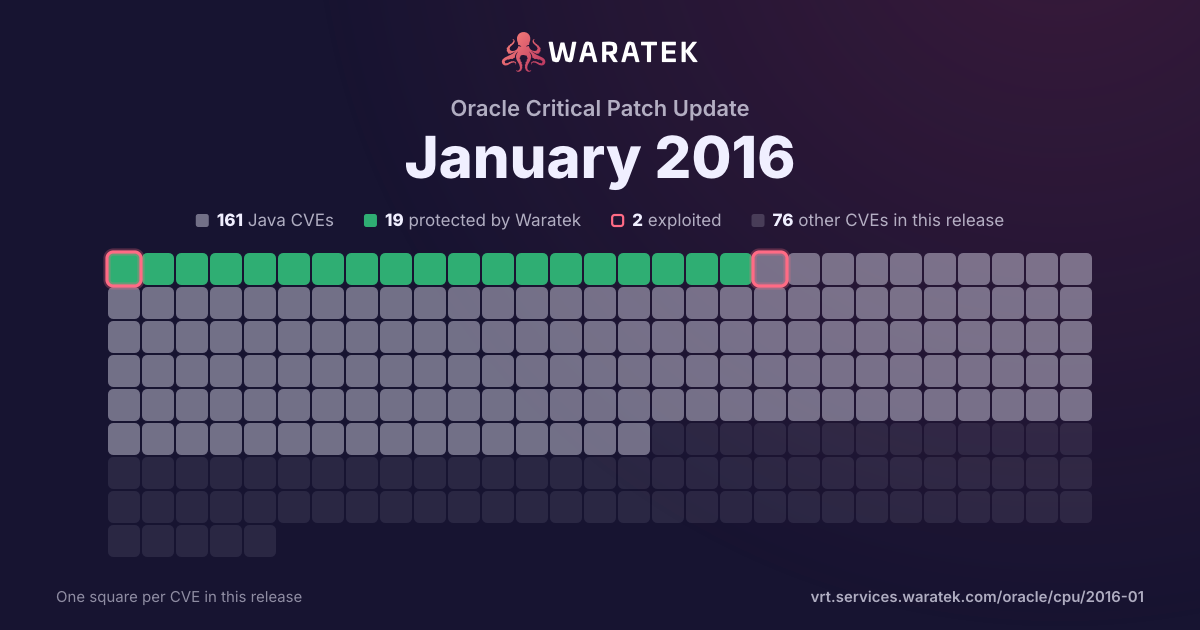
By status
19Protected by Waratek3Mitigation candidate139No exploit published14Outside Waratek scope62Not applicable
2Exploited, marked by the ring
No exploit published. For 137 of them, Oracle's security advisory is the source of public detail.
Protected by Waratek. Waratek RASP can block exploitation of these on systems that have not applied the patch yet.
Overview 5 matches · 2 in Waratek scope · 1 protected · 0 exploited · 0 CISA KEV
Protected by Waratek
1
20.0%
Rule in development
0
0.0%
Mitigation candidate
1
20.0%
No exploit published
0
0.0%
Outside Waratek scope
3
60.0%
Not applicable
0
0.0%
Withdrawn CVE
0
0.0%
blocked by ARMR today
1
20.0%
partly blocked
0
0.0%
not blocked
4
80.0%
not established
0
0.0%
unrecorded
0
0.0%
Exploited
0
0.0%
Working exploit published
4
80.0%
Proof of concept only
1
20.0%
Forecast only
0
0.0%
No public exploit
0
0.0%
split by
peak 2 / month
Jan 151
Outside Waratek scope1
High1
not blocked1
Working exploit published1
Feb 150
Mar 150
Apr 150
May 151
Outside Waratek scope1
Low1
not blocked1
Proof of concept only1
Jun 150
Jul 151
Outside Waratek scope1
Medium1
not blocked1
Working exploit published1
Aug 150
Sep 150
Oct 150
Nov 150
Dec 150
Jan 162
Protected by Waratek1
Mitigation candidate1
Medium2
blocked by ARMR today1
not blocked1
Working exploit published2
Jan 15Mar 15May 15Jul 15Sep 15Nov 15Jan 16
| CVE | Severity | Published▾ | Status | Exploitation | Description |
|---|---|---|---|---|---|
| CVE-2016-0492 | Medium | 2016-01-21 | Protected by Waratek | Working exploit published | Unspecified vulnerability in the Oracle Application Testing Suite component in Oracle Enterprise Manager Grid Control 12.4.0.2 and 12.5.0.2 allows remote attackers to affect confidentiality and integrity via unknown vectors related to Load Testing for Web Apps, a different vulnerability than CVE-2016-0488. NOTE: the previous information is from the January 2016 CPU. Oracle has not commented on third-party claims that this is a directory traversal vulnerability in the isAllowedUrl function, which allows remote attackers to bypass authentication via directory traversal sequences following a URI entry that does not require authentication, as demonstrated by olt/Login.do/../../olt/UploadFileUpload.do. |
| CVE-2016-0491 | Medium | 2016-01-21 | Mitigation candidate | Working exploit published | Unspecified vulnerability in the Oracle Application Testing Suite component in Oracle Enterprise Manager Grid Control 12.4.0.2 and 12.5.0.2 allows remote attackers to affect integrity and availability via unknown vectors related to Load Testing for Web Apps. NOTE: the previous information is from the January 2016 CPU. Oracle has not commented on third-party claims that the UploadFileAction servlet allows remote authenticated users to upload and execute arbitrary files via an * (asterisk) character in the fileType parameter. |
| CVE-2015-1793 | Medium | 2015-07-09 | Outside Waratek scope | Working exploit published | The X509_verify_cert function in crypto/x509/x509_vfy.c in OpenSSL 1.0.1n, 1.0.1o, 1.0.2b, and 1.0.2c does not properly process X.509 Basic Constraints cA values during identification of alternative certificate chains, which allows remote attackers to spoof a Certification Authority role and trigger unintended certificate verifications via a valid leaf certificate. |
| CVE-2015-4000 | Low | 2015-05-21 | Outside Waratek scope | Proof of concept only | The TLS protocol 1.2 and earlier, when a DHE_EXPORT ciphersuite is enabled on a server but not on a client, does not properly convey a DHE_EXPORT choice, which allows man-in-the-middle attackers to conduct cipher-downgrade attacks by rewriting a ClientHello with DHE replaced by DHE_EXPORT and then rewriting a ServerHello with DHE_EXPORT replaced by DHE, aka the "Logjam" issue. |
| CVE-2015-0235 | High | 2015-01-28 | Outside Waratek scope | Working exploit published | Heap-based buffer overflow in the __nss_hostname_digits_dots function in glibc 2.2, and other 2.x versions before 2.18, allows context-dependent attackers to execute arbitrary code via vectors related to the (1) gethostbyname or (2) gethostbyname2 function, aka "GHOST." |