
Oracle Critical Patch Update January 2016
Released January 2016 · Oracle's advisory ↗ · ← Critical Patch Update, October 2015 · Critical Patch Update, April 2016 →
237 CVEs in this release, one square each
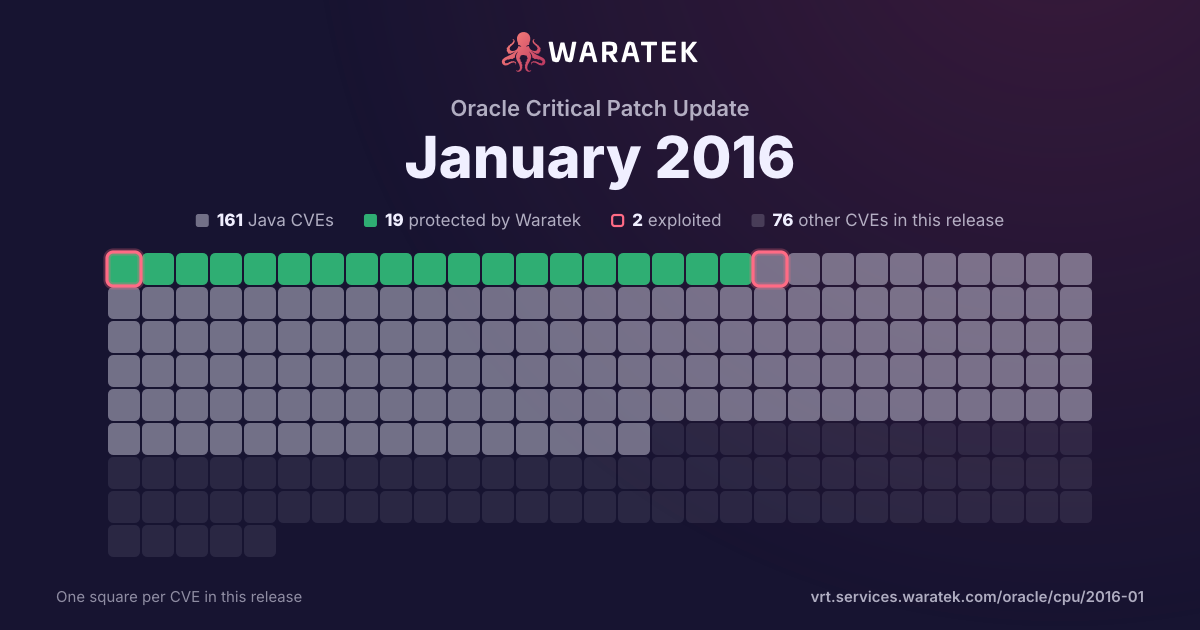
By status
19Protected by Waratek3Mitigation candidate139No exploit published14Outside Waratek scope62Not applicable
2Exploited, marked by the ring
No exploit published. For 137 of them, Oracle's security advisory is the source of public detail.
Protected by Waratek. Waratek RASP can block exploitation of these on systems that have not applied the patch yet.
Overview 131 matches · 17 protected · 2 exploited · 0 CISA KEV · 2 public PoC · 5 EPSS ≥ 0.5
Protected by Waratek
17
13.0%
Rule in development
0
0.0%
Mitigation candidate
2
1.5%
No exploit published
112
85.5%
blocked by ARMR today
17
13.0%
partly blocked
0
0.0%
not blocked
113
86.3%
not established
1
0.8%
unrecorded
0
0.0%
Exploited
2
1.5%
Working exploit published
2
1.5%
Proof of concept only
0
0.0%
Forecast only
3
2.3%
No public exploit
124
94.7%
| CVE | Severity | Published▾ | Status | Exploitation | Description |
|---|---|---|---|---|---|
| CVE-2016-0466 | Medium | 2016-01-21 | No exploit published | No public exploit | Unspecified vulnerability in the Java SE, Java SE Embedded, and JRockit components in Oracle Java SE 6u105, 7u91, and 8u66; Java SE Embedded 8u65; and JRockit R28.3.8 allows remote attackers to affect availability via vectors related to JAXP. |
| CVE-2016-0464 | Medium | 2016-01-21 | No exploit published | No public exploit | Unspecified vulnerability in the Oracle WebLogic Server component in Oracle Fusion Middleware 10.3.6, 12.1.2, and 12.1.3 allows remote attackers to affect integrity via vectors related to WLS-Console. |
| CVE-2016-0463 | Medium | 2016-01-21 | No exploit published | No public exploit | Unspecified vulnerability in the PeopleSoft Enterprise PeopleTools component in Oracle PeopleSoft Products 8.53, 8.54, and 8.55 allows remote attackers to affect confidentiality via unknown vectors related to Portal. |
| CVE-2016-0462 | Medium | 2016-01-21 | No exploit published | No public exploit | Unspecified vulnerability in the PeopleSoft Enterprise PeopleTools component in Oracle PeopleSoft Products 8.53 and 8.54 allows remote authenticated users to affect confidentiality via unknown vectors related to Multichannel Framework, a different vulnerability than CVE-2015-2650. |
| CVE-2016-0460 | Medium | 2016-01-21 | No exploit published | No public exploit | Unspecified vulnerability in the PeopleSoft Enterprise PeopleTools component in Oracle PeopleSoft Products 8.55 allows remote attackers to affect integrity via unknown vectors related to Fluid Homepage and NavBar. |
| CVE-2016-0459 | Medium | 2016-01-21 | No exploit published | No public exploit | Unspecified vulnerability in the Oracle Applications Framework component in Oracle E-Business Suite 11.5.10.2, 12.1.3, 12.2.3, 12.2.4, and 12.2.5 allows remote authenticated users to affect integrity via unknown vectors related to Popup Windows. |
| CVE-2016-0457 | Medium | 2016-01-21 | Protected by Waratek | Exploited | Unspecified vulnerability in the Application Mgmt Pack for E-Business Suite component in Oracle E-Business Suite 12.1 and 12.2 allows remote attackers to affect confidentiality via vectors related to REST Framework, a different vulnerability than CVE-2016-0456. NOTE: the previous information is from the January 2016 CPU. Oracle has not commented on third-party claims that this issue is an XML External Entity (XXE) vulnerability, which allows remote attackers to read arbitrary files, cause a denial of service, conduct server-side request forgery (SSRF) attacks, or conduct SMB Relay attacks via a crafted DTD in an XML request to OA_HTML/lcmServiceController.jsp. |
| CVE-2016-0456 | Medium | 2016-01-21 | Protected by Waratek | No public exploit | Unspecified vulnerability in the Application Mgmt Pack for E-Business Suite component in Oracle E-Business Suite 12.1 and 12.2 allows remote attackers to affect confidentiality via vectors related to REST Framework, a different vulnerability than CVE-2016-0457. NOTE: the previous information is from the January 2016 CPU. Oracle has not commented on third-party claims that this issue is an XML External Entity (XXE) vulnerability, which allows remote attackers to read arbitrary files, cause a denial of service, conduct server-side request forgery (SSRF) attacks, or conduct SMB Relay attacks via a crafted DTD in an XML request to OA_HTML/copxmllcmservicecontroller.js. |
| CVE-2016-0455 | Medium | 2016-01-21 | No exploit published | No public exploit | Unspecified vulnerability in the Enterprise Manager Base Platform component in Oracle Enterprise Manager Grid Control 11.1.0.1, 11.2.0.4, 12.1.0.4, and 12.1.0.5 allows local users to affect confidentiality and availability via unknown vectors related to Agent Next Gen. |
| CVE-2016-0449 | Medium | 2016-01-21 | No exploit published | No public exploit | Unspecified vulnerability in the Enterprise Manager Base Platform component in Oracle Enterprise Manager Grid Control 11.1.0.1, 11.2.0.4, 12.1.0.4, and 12.1.0.5 allows local users to affect confidentiality, integrity, and availability via unknown vectors related to Agent Next Gen, a different vulnerability than CVE-2016-0444 and CVE-2016-0447. |
| CVE-2016-0447 | Medium | 2016-01-21 | No exploit published | No public exploit | Unspecified vulnerability in the Enterprise Manager Base Platform component in Oracle Enterprise Manager Grid Control 11.1.0.1, 11.2.0.4, 12.1.0.4, and 12.1.0.5 allows local users to affect confidentiality, integrity, and availability via unknown vectors related to Agent Next Gen, a different vulnerability than CVE-2016-0444 and CVE-2016-0449. |
| CVE-2016-0445 | Medium | 2016-01-21 | No exploit published | No public exploit | Unspecified vulnerability in the Enterprise Manager Base Platform component in Oracle Enterprise Manager Grid Control 11.1.0.1, 11.2.0.4, 12.1.0.4, and 12.1.0.5 allows local users to affect confidentiality, integrity, and availability via unknown vectors related to Agent Next Gen. |
| CVE-2016-0444 | Medium | 2016-01-21 | No exploit published | No public exploit | Unspecified vulnerability in the Enterprise Manager Base Platform component in Oracle Enterprise Manager Grid Control 11.1.0.1, 11.2.0.4, 12.1.0.4, and 12.1.0.5 allows local users to affect confidentiality, integrity, and availability via unknown vectors related to Agent Next Gen, a different vulnerability than CVE-2016-0447 and CVE-2016-0449. |
| CVE-2016-0443 | Medium | 2016-01-21 | No exploit published | No public exploit | Unspecified vulnerability in the Enterprise Manager Base Platform component in Oracle Enterprise Manager Grid Control 11.1.0.1, 12.1.0.4, and 12.1.0.5 allows remote attackers to affect confidentiality via unknown vectors related to Agent Next Gen. |
| CVE-2016-0442 | Medium | 2016-01-21 | No exploit published | No public exploit | Unspecified vulnerability in the Enterprise Manager Base Platform component in Oracle Enterprise Manager Grid Control 12.1.0.4 and 12.1.0.5 allows remote authenticated users to affect confidentiality, integrity, and availability via unknown vectors related to Loader Service. |
| CVE-2016-0441 | Medium | 2016-01-21 | No exploit published | No public exploit | Unspecified vulnerability in the Oracle GlassFish Server component in Oracle Fusion Middleware 3.1.2 allows remote authenticated users to affect confidentiality, integrity, and availability via unknown vectors related to Embedded Server. |
| CVE-2016-0439 | Medium | 2016-01-21 | No exploit published | No public exploit | Unspecified vulnerability in the Web Cache component in Oracle Fusion Middleware 11.1.1.7.0 and 11.1.1.9.0 allows remote attackers to affect confidentiality via vectors related to SSL support, a different vulnerability than CVE-2016-0430. |
| CVE-2016-0433 | Medium | 2016-01-21 | No exploit published | No public exploit | Unspecified vulnerability in the Web Cache component in Oracle Fusion Middleware 11.1.1.9.0 allows remote attackers to affect confidentiality via vectors related to SSL support. |
| CVE-2016-0430 | Medium | 2016-01-21 | No exploit published | No public exploit | Unspecified vulnerability in the Web Cache component in Oracle Fusion Middleware 11.1.1.7.0 and 11.1.1.9.0 allows remote attackers to affect confidentiality via vectors related to SSL support, a different vulnerability than CVE-2016-0439. |
| CVE-2016-0429 | Medium | 2016-01-21 | No exploit published | No public exploit | Unspecified vulnerability in the Oracle BI Publisher component in Oracle Fusion Middleware 11.1.1.7.0 and 11.1.1.9.0 allows remote attackers to affect integrity via unknown vectors related to Scheduler, a different vulnerability than CVE-2016-0401. |
| CVE-2016-0427 | Medium | 2016-01-21 | No exploit published | No public exploit | Unspecified vulnerability in the Enterprise Manager Base Platform component in Oracle Enterprise Manager Grid Control 11.1.0.1, 11.2.0.4, 12.1.0.4, and 12.1.0.5 allows remote authenticated users to affect confidentiality via unknown vectors related to UI Framework. |
| CVE-2016-0425 | Medium | 2016-01-21 | No exploit published | No public exploit | Unspecified vulnerability in the JD Edwards EnterpriseOne Tools component in Oracle JD Edwards Products 9.1 and 9.2 allows remote authenticated users to affect confidentiality, integrity, and availability via unknown vectors related to Monitoring and Diagnostics. |
| CVE-2016-0421 | Medium | 2016-01-21 | No exploit published | No public exploit | Unspecified vulnerability in the JD Edwards EnterpriseOne Tools component in Oracle JD Edwards Products 9.1 and 9.2 allows remote attackers to affect availability via vectors related to Monitoring and Diagnostics SEC. |
| CVE-2016-0415 | Medium | 2016-01-21 | No exploit published | No public exploit | Unspecified vulnerability in the Enterprise Manager Base Platform component in Oracle Enterprise Manager Grid Control 11.1.0.1, 12.1.0.4, and 12.1.0.5 allows remote attackers to affect confidentiality, integrity, and availability via unknown vectors related to UI Framework. |
| CVE-2016-0413 | Medium | 2016-01-21 | No exploit published | No public exploit | Unspecified vulnerability in the Oracle Identity Federation component in Oracle Fusion Middleware 11.1.1.7 allows remote authenticated users to affect integrity via vectors related to Federation protocol support. |
| CVE-2016-0411 | Medium | 2016-01-21 | No exploit published | No public exploit | Unspecified vulnerability in the Enterprise Manager Base Platform component in Oracle Enterprise Manager Grid Control 11.1.0.1 and 11.2.0.4 allows local users to affect confidentiality, integrity, and availability via vectors related to Agent Next Gen. |
| CVE-2016-0409 | Medium | 2016-01-21 | No exploit published | No public exploit | Unspecified vulnerability in the PeopleSoft Enterprise HCM Global Payroll Switzerland component in Oracle PeopleSoft Products 9.1 and 9.2 allows remote authenticated users to affect confidentiality via vectors related to Security. |
| CVE-2016-0404 | Medium | 2016-01-21 | No exploit published | No public exploit | Unspecified vulnerability in the Oracle Identity Federation component in Oracle Fusion Middleware 11.1.2.2 allows remote attackers to affect integrity via vectors related to Admin. |
| CVE-2016-0401 | Medium | 2016-01-21 | No exploit published | No public exploit | Unspecified vulnerability in the Oracle BI Publisher component in Oracle Fusion Middleware 11.1.1.7.0 and 11.1.1.9.0 allows remote attackers to affect integrity via unknown vectors related to Scheduler, a different vulnerability than CVE-2016-0429. |
| CVE-2015-4919 | Medium | 2016-01-21 | No exploit published | No public exploit | Unspecified vulnerability in the JD Edwards EnterpriseOne Tools component in Oracle JD Edwards Products 9.1 and 9.2 allows remote attackers to affect confidentiality, integrity, and availability via vectors related to Monitoring and Diagnostics SEC. |
| CVE-2015-4885 | Medium | 2016-01-21 | No exploit published | No public exploit | Unspecified vulnerability in the Enterprise Manager Base Platform component in Oracle Enterprise Manager Grid Control 12.1.0.4 allows remote attackers to affect confidentiality via vectors related to Agent Next Gen. |