
Oracle Critical Patch Update January 2016
Released January 2016 · Oracle's advisory ↗ · ← Critical Patch Update, October 2015 · Critical Patch Update, April 2016 →
237 CVEs in this release, one square each
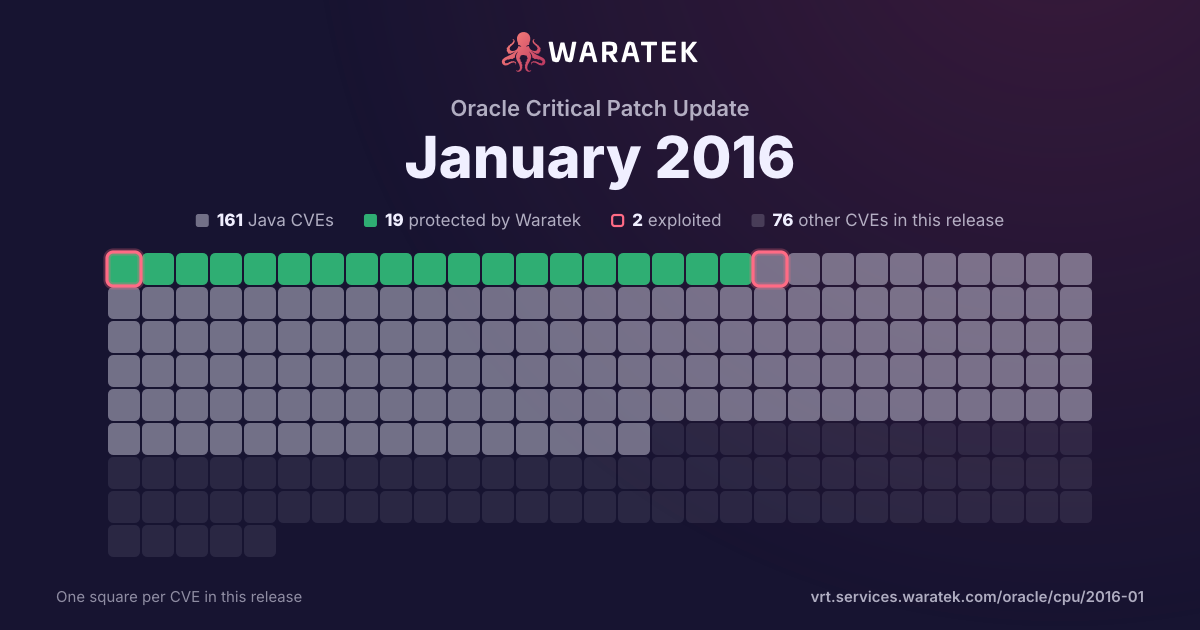
By status
19Protected by Waratek3Mitigation candidate139No exploit published14Outside Waratek scope62Not applicable
2Exploited, marked by the ring
No exploit published. For 137 of them, Oracle's security advisory is the source of public detail.
Protected by Waratek. Waratek RASP can block exploitation of these on systems that have not applied the patch yet.
Overview 60 matches · 0 in Waratek scope · 0 protected · 0 exploited · 0 CISA KEV · 0 public PoC · 0 EPSS ≥ 0.5
60matches
0in Waratek scope0.0%
0protected0.0%
0exploited0.0%
0CISA KEV0.0%
0public PoC0.0%
0EPSS ≥ 0.50.0%
Protected by Waratek
0
0.0%
Rule in development
0
0.0%
Mitigation candidate
0
0.0%
No exploit published
0
0.0%
Outside Waratek scope
0
0.0%
Not applicable
60
100.0%
Withdrawn CVE
0
0.0%
blocked by ARMR today
0
0.0%
partly blocked
0
0.0%
not blocked
60
100.0%
not established
0
0.0%
unrecorded
0
0.0%
Exploited
0
0.0%
Working exploit published
0
0.0%
Proof of concept only
0
0.0%
Forecast only
0
0.0%
No public exploit
60
100.0%
split by
peak 52 / quarter
Q4 131
Not applicable1
High1
not blocked1
No public exploit1
Q1 140
Q2 140
Q3 140
Q4 141
Not applicable1
Medium1
not blocked1
No public exploit1
Q1 151
Not applicable1
Medium1
not blocked1
No public exploit1
Q2 151
Not applicable1
Medium1
not blocked1
No public exploit1
Q3 150
Q4 154
Not applicable4
Critical1
High2
Medium1
not blocked4
No public exploit4
Q1 1652
Not applicable52
High9
Medium24
Low19
not blocked52
No public exploit52
Q4 13Q1 14Q2 14Q3 14Q4 14Q1 15Q2 15Q3 15Q4 15Q1 16
| CVE | Severity | Published▾ | Status | Exploitation | Description |
|---|---|---|---|---|---|
| CVE-2015-7744 | Medium | 2016-01-22 | Not applicable | No public exploit | wolfSSL (formerly CyaSSL) before 3.6.8 does not properly handle faults associated with the Chinese Remainder Theorem (CRT) process when allowing ephemeral key exchange without low memory optimizations on a server, which makes it easier for remote attackers to obtain private RSA keys by capturing TLS handshakes, aka a Lenstra attack. |
| CVE-2015-6015 | High | 2016-01-22 | Not applicable | No public exploit | Unspecified vulnerability in the Oracle Outside In Technology component in Oracle Fusion Middleware 8.5.0, 8.5.1, and 8.5.2 allows local users to affect availability via unknown vectors related to Outside In Filters, a different vulnerability than CVE-2015-4808, CVE-2015-6013, CVE-2015-6014, and CVE-2016-0432. NOTE: the previous information is from the January 2016 CPU. Oracle has not commented on third-party claims that this issue is a stack-based buffer overflow in Oracle Outside In 8.5.2 and earlier, which allows remote attackers to execute arbitrary code via a crafted Paradox DB file. |
| CVE-2015-6014 | High | 2016-01-22 | Not applicable | No public exploit | Unspecified vulnerability in the Oracle Outside In Technology component in Oracle Fusion Middleware 8.5.0, 8.5.1, and 8.5.2 allows local users to affect availability via unknown vectors related to Outside In Filters, a different vulnerability than CVE-2015-4808, CVE-2015-6013, CVE-2015-6015, and CVE-2016-0432. NOTE: the previous information is from the January 2016 CPU. Oracle has not commented on third-party claims that this issue is a stack-based buffer overflow in Oracle Outside In 8.5.2 and earlier, which allows remote attackers to execute arbitrary code via a crafted DOC file. |
| CVE-2015-6013 | High | 2016-01-22 | Not applicable | No public exploit | Unspecified vulnerability in the Oracle Outside In Technology component in Oracle Fusion Middleware 8.5.0, 8.5.1, and 8.5.2 allows local users to affect availability via unknown vectors related to Outside In Filters, a different vulnerability than CVE-2015-4808, CVE-2015-6014, CVE-2015-6015, and CVE-2016-0432. NOTE: the previous information is from the January 2016 CPU. Oracle has not commented on third-party claims that this issue is a stack-based buffer overflow in Oracle Outside In 8.5.2 and earlier, which allows remote attackers to execute arbitrary code via a crafted WK4 file. |
| CVE-2016-0618 | Low | 2016-01-21 | Not applicable | No public exploit | Unspecified vulnerability in Oracle Sun Solaris 11 allows local users to affect confidentiality via unknown vectors related to Zones. |
| CVE-2016-0616 | Medium | 2016-01-21 | Not applicable | No public exploit | Unspecified vulnerability in Oracle MySQL 5.5.46 and earlier and MariaDB before 5.5.47, 10.0.x before 10.0.23, and 10.1.x before 10.1.10 allows remote authenticated users to affect availability via unknown vectors related to Optimizer. |
| CVE-2016-0611 | Medium | 2016-01-21 | Not applicable | No public exploit | Unspecified vulnerability in Oracle MySQL 5.6.27 and earlier and 5.7.9 allows remote authenticated users to affect availability via unknown vectors related to Optimizer. |
| CVE-2016-0610 | Low | 2016-01-21 | Not applicable | No public exploit | Unspecified vulnerability in Oracle MySQL 5.6.27 and earlier and MariaDB before 10.0.22 and 10.1.x before 10.1.9 allows remote authenticated users to affect availability via unknown vectors related to InnoDB. |
| CVE-2016-0609 | Low | 2016-01-21 | Not applicable | No public exploit | Unspecified vulnerability in Oracle MySQL 5.5.46 and earlier, 5.6.27 and earlier, and 5.7.9 and MariaDB before 5.5.47, 10.0.x before 10.0.23, and 10.1.x before 10.1.10 allows remote authenticated users to affect availability via unknown vectors related to privileges. |
| CVE-2016-0608 | Low | 2016-01-21 | Not applicable | No public exploit | Unspecified vulnerability in Oracle MySQL 5.5.46 and earlier, 5.6.27 and earlier, and 5.7.9 and MariaDB before 5.5.47, 10.0.x before 10.0.23, and 10.1.x before 10.1.10 allows remote authenticated users to affect availability via vectors related to UDF. |
| CVE-2016-0607 | Low | 2016-01-21 | Not applicable | No public exploit | Unspecified vulnerability in Oracle MySQL 5.6.27 and earlier and 5.7.9 allows remote authenticated users to affect availability via unknown vectors related to replication. |
| CVE-2016-0606 | Low | 2016-01-21 | Not applicable | No public exploit | Unspecified vulnerability in Oracle MySQL 5.5.46 and earlier, 5.6.27 and earlier, and 5.7.9 and MariaDB before 5.5.47, 10.0.x before 10.0.23, and 10.1.x before 10.1.10 allows remote authenticated users to affect integrity via unknown vectors related to encryption. |
| CVE-2016-0605 | Low | 2016-01-21 | Not applicable | No public exploit | Unspecified vulnerability in Oracle MySQL 5.6.26 and earlier allows remote authenticated users to affect availability via unknown vectors. |
| CVE-2016-0602 | Medium | 2016-01-21 | Not applicable | No public exploit | Unspecified vulnerability in the Oracle VM VirtualBox component in Oracle Virtualization VirtualBox before 5.0.14 allows local users to affect confidentiality, integrity, and availability via unknown vectors related to Windows Installer. NOTE: the previous information is from the January 2016 CPU. Oracle has not commented on third-party claims that this is an untrusted search path issue that allows local users to gain privileges via a Trojan horse dll in the "application directory." |
| CVE-2016-0601 | Low | 2016-01-21 | Not applicable | No public exploit | Unspecified vulnerability in Oracle MySQL 5.7.9 allows remote authenticated users to affect availability via unknown vectors related to Partition. |
| CVE-2016-0600 | Low | 2016-01-21 | Not applicable | No public exploit | Unspecified vulnerability in Oracle MySQL 5.5.46 and earlier, 5.6.27 and earlier, and 5.7.9 and MariaDB before 5.5.47, 10.0.x before 10.0.23, and 10.1.x before 10.1.10 allows remote authenticated users to affect availability via unknown vectors related to InnoDB. |
| CVE-2016-0599 | Low | 2016-01-21 | Not applicable | No public exploit | Unspecified vulnerability in Oracle MySQL 5.7.9 allows remote authenticated users to affect availability via unknown vectors related to Optimizer. |
| CVE-2016-0598 | Low | 2016-01-21 | Not applicable | No public exploit | Unspecified vulnerability in Oracle MySQL 5.5.46 and earlier, 5.6.27 and earlier, and 5.7.9 and MariaDB before 5.5.47, 10.0.x before 10.0.23, and 10.1.x before 10.1.10 allows remote authenticated users to affect availability via vectors related to DML. |
| CVE-2016-0597 | Medium | 2016-01-21 | Not applicable | No public exploit | Unspecified vulnerability in Oracle MySQL 5.5.46 and earlier, 5.6.27 and earlier, and 5.7.9 and MariaDB before 5.5.47, 10.0.x before 10.0.23, and 10.1.x before 10.1.10 allows remote authenticated users to affect availability via unknown vectors related to Optimizer. |
| CVE-2016-0596 | Medium | 2016-01-21 | Not applicable | No public exploit | Unspecified vulnerability in Oracle MySQL 5.5.46 and earlier and 5.6.27 and earlier and MariaDB before 5.5.47, 10.0.x before 10.0.23, and 10.1.x before 10.1.10 allows remote authenticated users to affect availability via vectors related to DML. |
| CVE-2016-0595 | Medium | 2016-01-21 | Not applicable | No public exploit | Unspecified vulnerability in Oracle MySQL 5.6.27 and earlier allows remote authenticated users to affect availability via vectors related to DML. |
| CVE-2016-0594 | Medium | 2016-01-21 | Not applicable | No public exploit | Unspecified vulnerability in Oracle MySQL 5.6.21 and earlier allows remote authenticated users to affect availability via vectors related to DML. |
| CVE-2016-0592 | Low | 2016-01-21 | Not applicable | No public exploit | Unspecified vulnerability in the Oracle VM VirtualBox component in Oracle Virtualization VirtualBox before 4.3.36 and before 5.0.14 allows local users to affect availability via unknown vectors related to Core. |
| CVE-2016-0546 | High | 2016-01-21 | Not applicable | No public exploit | Unspecified vulnerability in Oracle MySQL 5.5.46 and earlier, 5.6.27 and earlier, and 5.7.9 and MariaDB before 5.5.47, 10.0.x before 10.0.23, and 10.1.x before 10.1.10 allows local users to affect confidentiality, integrity, and availability via unknown vectors related to Client. NOTE: the previous information is from the January 2016 CPU. Oracle has not commented on third-party claims that these are multiple buffer overflows in the mysqlshow tool that allow remote database servers to have unspecified impact via a long table or database name. |
| CVE-2016-0535 | Medium | 2016-01-21 | Not applicable | No public exploit | Unspecified vulnerability in Oracle Sun Solaris 10 and 11 allows remote attackers to affect availability via vectors related to RPC. |
| CVE-2016-0505 | Medium | 2016-01-21 | Not applicable | No public exploit | Unspecified vulnerability in Oracle MySQL 5.5.46 and earlier, 5.6.27 and earlier, and 5.7.9 and MariaDB before 5.5.47, 10.0.x before 10.0.23, and 10.1.x before 10.1.10 allows remote authenticated users to affect availability via unknown vectors related to Options. |
| CVE-2016-0504 | Medium | 2016-01-21 | Not applicable | No public exploit | Unspecified vulnerability in Oracle MySQL 5.6.27 and earlier and 5.7.9 allows remote authenticated users to affect availability via vectors related to DML, a different vulnerability than CVE-2016-0503. |
| CVE-2016-0503 | Medium | 2016-01-21 | Not applicable | No public exploit | Unspecified vulnerability in Oracle MySQL 5.6.27 and earlier and 5.7.9 allows remote authenticated users to affect availability via vectors related to DML, a different vulnerability than CVE-2016-0504. |
| CVE-2016-0502 | Medium | 2016-01-21 | Not applicable | No public exploit | Unspecified vulnerability in Oracle MySQL 5.5.31 and earlier and 5.6.11 and earlier allows remote authenticated users to affect availability via unknown vectors related to Optimizer. |
| CVE-2016-0501 | Medium | 2016-01-21 | Not applicable | No public exploit | Unspecified vulnerability in the Oracle Secure Global Desktop component in Oracle Virtualization 5.2 allows remote attackers to affect availability via vectors related to SGD Core. |
| CVE-2016-0495 | Medium | 2016-01-21 | Not applicable | No public exploit | Unspecified vulnerability in the Oracle VM VirtualBox component in Oracle Virtualization VirtualBox before 4.3.36 and 5.0.14 allows remote attackers to affect availability via unknown vectors related to Core. |
| CVE-2016-0493 | Low | 2016-01-21 | Not applicable | No public exploit | Unspecified vulnerability in Oracle Sun Solaris 11 allows local users to affect integrity and availability via unknown vectors related to Kernel Cryptography. |
| CVE-2016-0465 | Medium | 2016-01-21 | Not applicable | No public exploit | Unspecified vulnerability in the Solaris Cluster component in Oracle Sun Systems Products Suite 3.3 and 4 allows local users to affect availability via unknown vectors related to Resource Group Manager. |
| CVE-2016-0458 | Medium | 2016-01-21 | Not applicable | No public exploit | Unspecified vulnerability in Oracle Sun Solaris 11 allows local users to affect availability via vectors related to Kernel DAX. |
| CVE-2016-0452 | High | 2016-01-21 | Not applicable | No public exploit | Unspecified vulnerability in the Oracle GoldenGate component in Oracle GoldenGate 11.2 and 12.1.2 allows remote attackers to affect confidentiality, integrity, and availability via unknown vectors, a different vulnerability than CVE-2016-0451. |
| CVE-2016-0451 | High | 2016-01-21 | Not applicable | No public exploit | Unspecified vulnerability in the Oracle GoldenGate component in Oracle GoldenGate 11.2 and 12.1.2 allows remote attackers to affect confidentiality, integrity, and availability via unknown vectors, a different vulnerability than CVE-2016-0452. |
| CVE-2016-0450 | Medium | 2016-01-21 | Not applicable | No public exploit | Unspecified vulnerability in the Oracle GoldenGate component in Oracle GoldenGate 11.2 and 12.1.2 allows remote attackers to affect availability via unknown vectors. |
| CVE-2016-0440 | High | 2016-01-21 | Not applicable | No public exploit | Unspecified vulnerability in Oracle Sun Solaris 11 allows remote attackers to affect availability via vectors related to NFSv4. |
| CVE-2016-0431 | Low | 2016-01-21 | Not applicable | No public exploit | Unspecified vulnerability in Oracle Sun Solaris 11 allows local users to affect availability via unknown vectors related to Solaris Kernel Zones, a different vulnerability than CVE-2016-0419. |
| CVE-2016-0428 | Medium | 2016-01-21 | Not applicable | No public exploit | Unspecified vulnerability in Oracle Sun Solaris 11 allows local users to affect availability via unknown vectors related to Verified Boot. |
| CVE-2016-0426 | Low | 2016-01-21 | Not applicable | No public exploit | Unspecified vulnerability in Oracle Sun Solaris 11 allows local users to affect confidentiality and availability via unknown vectors related to Solaris Kernel Zones. |
| CVE-2016-0419 | Medium | 2016-01-21 | Not applicable | No public exploit | Unspecified vulnerability in Oracle Sun Solaris 11 allows local users to affect availability via unknown vectors related to Solaris Kernel Zones, a different vulnerability than CVE-2016-0431. |
| CVE-2016-0418 | Medium | 2016-01-21 | Not applicable | No public exploit | Unspecified vulnerability in Oracle Sun Solaris 11 allows local users to affect confidentiality, integrity, and availability via unknown vectors related to Solaris Kernel Zones, a different vulnerability than CVE-2016-0414. |
| CVE-2016-0417 | Medium | 2016-01-21 | Not applicable | No public exploit | Unspecified vulnerability in the Solaris Cluster component in Oracle Sun Systems Products Suite 3.3 and 4.2 allows local users to affect confidentiality, integrity, and availability via vectors related to HA for MySQL. |
| CVE-2016-0416 | Medium | 2016-01-21 | Not applicable | No public exploit | Unspecified vulnerability in Oracle Sun Solaris 11 allows remote attackers to affect integrity via unknown vectors related to System Archive Utility. |
| CVE-2016-0414 | High | 2016-01-21 | Not applicable | No public exploit | Unspecified vulnerability in Oracle Sun Solaris 11 allows local users to affect confidentiality, integrity, and availability via unknown vectors related to Solaris Kernel Zones, a different vulnerability than CVE-2016-0418. |
| CVE-2016-0406 | Low | 2016-01-21 | Not applicable | No public exploit | Unspecified vulnerability in Oracle Sun Solaris 11 allows local users to affect integrity and availability via vectors related to Libc. |
| CVE-2016-0405 | Low | 2016-01-21 | Not applicable | No public exploit | Unspecified vulnerability in the Solaris Cluster component in Oracle Sun Systems Products Suite 3.3 and 4 allows local users to affect confidentiality via vectors related to Cluster Manageability and Serviceability. |
| CVE-2016-0403 | High | 2016-01-21 | Not applicable | No public exploit | Unspecified vulnerability in Oracle Sun Solaris 11 allows remote attackers to affect availability via vectors related to SMB Utilities. |
| CVE-2015-4922 | Low | 2016-01-21 | Not applicable | No public exploit | Unspecified vulnerability in Oracle Sun Solaris 11 allows local users to affect availability via vectors related to Boot. |
| CVE-2015-4920 | Low | 2016-01-21 | Not applicable | No public exploit | Unspecified vulnerability in Oracle Sun Solaris 11 allows local users to affect integrity via vectors related to NDMP Backup Service. |
| CVE-2015-7575 | Medium | 2016-01-09 | Not applicable | No public exploit | Mozilla Network Security Services (NSS) before 3.20.2, as used in Mozilla Firefox before 43.0.2 and Firefox ESR 38.x before 38.5.2, does not reject MD5 signatures in Server Key Exchange messages in TLS 1.2 Handshake Protocol traffic, which makes it easier for man-in-the-middle attackers to spoof servers by triggering a collision. |
| CVE-2015-8104 | Critical | 2015-11-16 | Not applicable | No public exploit | The KVM subsystem in the Linux kernel through 4.2.6, and Xen 4.3.x through 4.6.x, allows guest OS users to cause a denial of service (host OS panic or hang) by triggering many #DB (aka Debug) exceptions, related to svm.c. |
| CVE-2015-5307 | Medium | 2015-11-16 | Not applicable | No public exploit | The KVM subsystem in the Linux kernel through 4.2.6, and Xen 4.3.x through 4.6.x, allows guest OS users to cause a denial of service (host OS panic or hang) by triggering many #AC (aka Alignment Check) exceptions, related to svm.c and vmx.c. |
| CVE-2015-8126 | High | 2015-11-13 | Not applicable | No public exploit | Multiple buffer overflows in the (1) png_set_PLTE and (2) png_get_PLTE functions in libpng before 1.0.64, 1.1.x and 1.2.x before 1.2.54, 1.3.x and 1.4.x before 1.4.17, 1.5.x before 1.5.24, and 1.6.x before 1.6.19 allow remote attackers to cause a denial of service (application crash) or possibly have unspecified other impact via a small bit-depth value in an IHDR (aka image header) chunk in a PNG image. |
| CVE-2015-7183 | High | 2015-11-05 | Not applicable | No public exploit | Integer overflow in the PL_ARENA_ALLOCATE implementation in Netscape Portable Runtime (NSPR) in Mozilla Network Security Services (NSS) before 3.19.2.1 and 3.20.x before 3.20.1, as used in Firefox before 42.0 and Firefox ESR 38.x before 38.4 and other products, allows remote attackers to execute arbitrary code or cause a denial of service (memory corruption and application crash) via unspecified vectors. |
| CVE-2015-3153 | Medium | 2015-05-01 | Not applicable | No public exploit | The default configuration for cURL and libcurl before 7.42.1 sends custom HTTP headers to both the proxy and destination server, which might allow remote proxy servers to obtain sensitive information by reading the header contents. |
| CVE-2015-0286 | Medium | 2015-03-19 | Not applicable | No public exploit | The ASN1_TYPE_cmp function in crypto/asn1/a_type.c in OpenSSL before 0.9.8zf, 1.0.0 before 1.0.0r, 1.0.1 before 1.0.1m, and 1.0.2 before 1.0.2a does not properly perform boolean-type comparisons, which allows remote attackers to cause a denial of service (invalid read operation and application crash) via a crafted X.509 certificate to an endpoint that uses the certificate-verification feature. |
| CVE-2014-3583 | Medium | 2014-12-15 | Not applicable | No public exploit | The handle_headers function in mod_proxy_fcgi.c in the mod_proxy_fcgi module in the Apache HTTP Server 2.4.10 allows remote FastCGI servers to cause a denial of service (buffer over-read and daemon crash) via long response headers. |
| CVE-2013-1741 | High | 2013-11-18 | Not applicable | No public exploit | Integer overflow in Mozilla Network Security Services (NSS) 3.15 before 3.15.3 allows remote attackers to cause a denial of service or possibly have unspecified other impact via a large size value. |