
WaratekVRT Sign in

Oracle Critical Patch Update July 2015

Released July 2015 · Oracle's advisory ↗ · ← Critical Patch Update, April 2015 · Critical Patch Update, October 2015 →

171 CVEs in this release, one square each
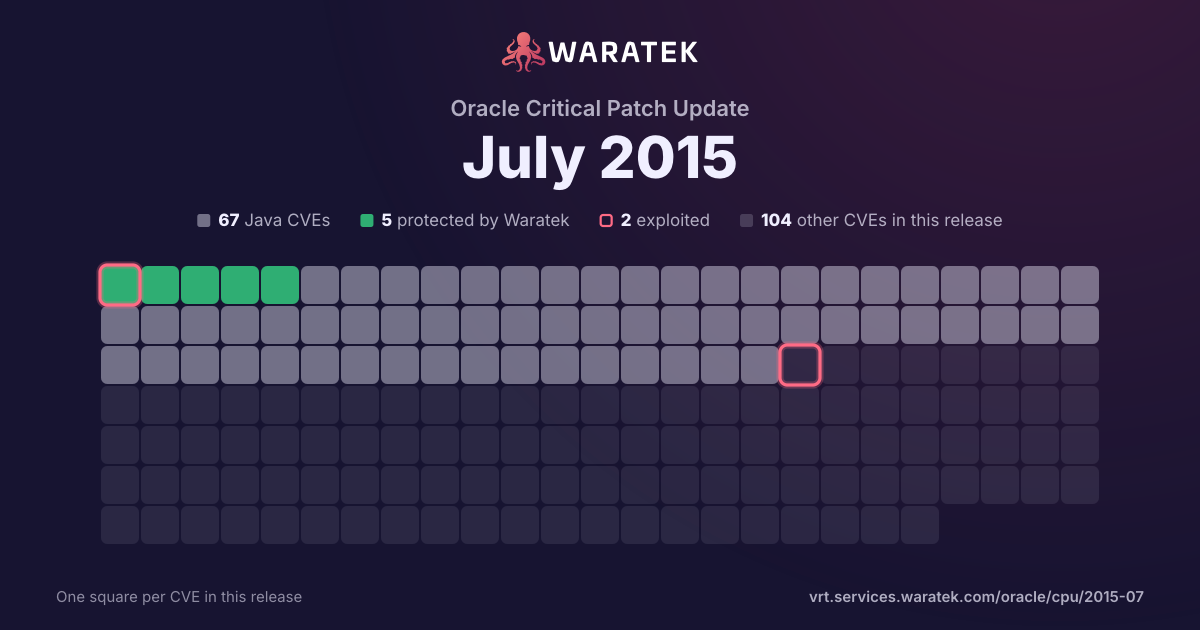
Protected by Waratek, exploitedProtected by WaratekProtected by WaratekProtected by WaratekProtected by WaratekNo exploit publishedNo exploit publishedNo exploit publishedNo exploit publishedNo exploit publishedNo exploit publishedNo exploit publishedNo exploit publishedNo exploit publishedNo exploit publishedNo exploit publishedNo exploit publishedNo exploit publishedNo exploit publishedNo exploit publishedNo exploit publishedNo exploit publishedNo exploit publishedNo exploit publishedNo exploit publishedNo exploit publishedNo exploit publishedNo exploit publishedNo exploit publishedNo exploit publishedNo exploit publishedNo exploit publishedNo exploit publishedNo exploit publishedNo exploit publishedNo exploit publishedNo exploit publishedNo exploit publishedNo exploit publishedNo exploit publishedNo exploit publishedNo exploit publishedNo exploit publishedNo exploit publishedNo exploit publishedNo exploit publishedNo exploit publishedNo exploit publishedNo exploit publishedNo exploit publishedNo exploit publishedNo exploit publishedNo exploit publishedNo exploit publishedNo exploit publishedNo exploit publishedNo exploit publishedNo exploit publishedNo exploit publishedNo exploit publishedNo exploit publishedNo exploit publishedNo exploit publishedNo exploit publishedNo exploit publishedNo exploit publishedNo exploit publishedOutside Waratek scope, exploitedOutside Waratek scopeOutside Waratek scopeOutside Waratek scopeOutside Waratek scopeOutside Waratek scopeOutside Waratek scopeOutside Waratek scopeOutside Waratek scopeOutside Waratek scopeOutside Waratek scopeOutside Waratek scopeOutside Waratek scopeOutside Waratek scopeOutside Waratek scopeOutside Waratek scopeOutside Waratek scopeOutside Waratek scopeOutside Waratek scopeOutside Waratek scopeOutside Waratek scopeOutside Waratek scopeOutside Waratek scopeOutside Waratek scopeOutside Waratek scopeOutside Waratek scopeOutside Waratek scopeOutside Waratek scopeOutside Waratek scopeOutside Waratek scopeOutside Waratek scopeOutside Waratek scopeOutside Waratek scopeOutside Waratek scopeOutside Waratek scopeOutside Waratek scopeNot applicableNot applicableNot applicableNot applicableNot applicableNot applicableNot applicableNot applicableNot applicableNot applicableNot applicableNot applicableNot applicableNot applicableNot applicableNot applicableNot applicableNot applicableNot applicableNot applicableNot applicableNot applicableNot applicableNot applicableNot applicableNot applicableNot applicableNot applicableNot applicableNot applicableNot applicableNot applicableNot applicableNot applicableNot applicableNot applicableNot applicableNot applicableNot applicableNot applicableNot applicableNot applicableNot applicableNot applicableNot applicableNot applicableNot applicableNot applicableNot applicableNot applicableNot applicableNot applicableNot applicableNot applicableNot applicableNot applicableNot applicableNot applicableNot applicableNot applicableNot applicableNot applicableNot applicableNot applicableNot applicableNot applicableNot applicableNot applicable
Share this chart Oracle Critical Patch Update July 2015, one square per CVE: 67 Java CVEs, 5 protected by Waratek, 2 exploited, 104 other CVEs in this release.

Download the image

By status

No exploit published. For 60 of them, Oracle's security advisory is the source of public detail.

Protected by Waratek. Waratek RASP can block exploitation of these on systems that have not applied the patch yet.

Reset
More filters (2)
Columns
Including CVEs outside Waratek scope✕Published from 2015-04-01✕Published to 2015-06-30✕
Overview 4 matches · 1 in Waratek scope · 0 protected · 0 exploited · 0 CISA KEV · 2 public PoC · 2 EPSS ≥ 0.5
4matches 1in Waratek scope25.0% 0protected0.0% 0exploited0.0% 0CISA KEV0.0% 2public PoC50.0% 2EPSS ≥ 0.550.0%
Protected by Waratek 0 0.0% Rule in development 0 0.0% Mitigation candidate 0 0.0% No exploit published 1 25.0% Outside Waratek scope 2 50.0% Not applicable 1 25.0% Withdrawn CVE 0 0.0%
Critical 0 0.0% High 2 50.0% Medium 0 0.0% Low 2 50.0% None 0 0.0% Unknown 0 0.0%
blocked by ARMR today 0 0.0% partly blocked 0 0.0% not blocked 4 100.0% not established 0 0.0% unrecorded 0 0.0%
split by peak 2 / month
Not applicable: 1Outside Waratek scope: 2No exploit published: 1 Low: 2High: 2 not blocked: 4 No public exploit: 1Forecast only: 1Proof of concept only: 1Working exploit published: 1
Apr 15May 15Jun 15
4 matches Sign in to download these CVEs as CSV or JSON, or to follow them in a feed.
CVE Severity Published▾ Status Exploitation Description
CVE-2014-0230 High 2015-06-07 No exploit published No public exploit Apache Tomcat 6.x before 6.0.44, 7.x before 7.0.55, and 8.x before 8.0.9 does not properly handle cases where an HTTP response occurs before finishing the reading of an entire request body, which allows remote attackers to cause a denial of service (thread consumption) via a series of aborted upload attempts.
CVE-2015-4000 Low 2015-05-21 Outside Waratek scope Proof of concept only The TLS protocol 1.2 and earlier, when a DHE_EXPORT ciphersuite is enabled on a server but not on a client, does not properly convey a DHE_EXPORT choice, which allows man-in-the-middle attackers to conduct cipher-downgrade attacks by rewriting a ClientHello with DHE replaced by DHE_EXPORT and then rewriting a ServerHello with DHE_EXPORT replaced by DHE, aka the "Logjam" issue.
CVE-2015-3456 High 2015-05-13 Not applicable Working exploit published The Floppy Disk Controller (FDC) in QEMU, as used in Xen 4.5.x and earlier and KVM, allows local guest users to cause a denial of service (out-of-bounds write and guest crash) or possibly execute arbitrary code via the (1) FD_CMD_READ_ID, (2) FD_CMD_DRIVE_SPECIFICATION_COMMAND, or other unspecified commands, aka VENOM.
CVE-2015-2808 Low 2015-04-01 Outside Waratek scope Forecast only The RC4 algorithm, as used in the TLS protocol and SSL protocol, does not properly combine state data with key data during the initialization phase, which makes it easier for remote attackers to conduct plaintext-recovery attacks against the initial bytes of a stream by sniffing network traffic that occasionally relies on keys affected by the Invariance Weakness, and then using a brute-force approach involving LSB values, aka the "Bar Mitzvah" issue.