
Oracle Critical Patch Update July 2015
Released July 2015 · Oracle's advisory ↗ · ← Critical Patch Update, April 2015 · Critical Patch Update, October 2015 →
171 CVEs in this release, one square each
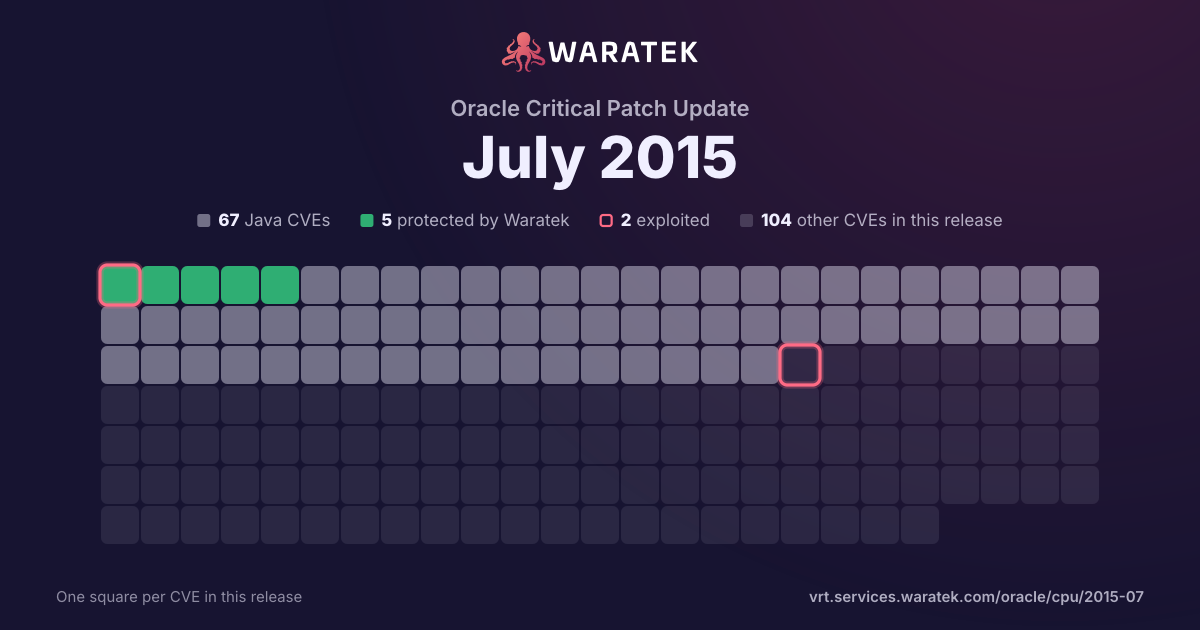
By status
5Protected by Waratek62No exploit published36Outside Waratek scope68Not applicable
2Exploited, marked by the ring
No exploit published. For 60 of them, Oracle's security advisory is the source of public detail.
Protected by Waratek. Waratek RASP can block exploitation of these on systems that have not applied the patch yet.
Overview 5 matches · 0 in Waratek scope · 0 protected · 0 exploited · 0 CISA KEV · 1 public PoC · 1 EPSS ≥ 0.5
5matches
0in Waratek scope0.0%
0protected0.0%
0exploited0.0%
0CISA KEV0.0%
1public PoC20.0%
1EPSS ≥ 0.520.0%
Protected by Waratek
0
0.0%
Rule in development
0
0.0%
Mitigation candidate
0
0.0%
No exploit published
0
0.0%
Outside Waratek scope
2
40.0%
Not applicable
3
60.0%
Withdrawn CVE
0
0.0%
blocked by ARMR today
0
0.0%
partly blocked
0
0.0%
not blocked
5
100.0%
not established
0
0.0%
unrecorded
0
0.0%
Exploited
0
0.0%
Working exploit published
0
0.0%
Proof of concept only
1
20.0%
Forecast only
0
0.0%
No public exploit
4
80.0%
| CVE | Severity | Published▾ | Status | Exploitation | Description |
|---|---|---|---|---|---|
| CVE-2014-1569 | High | 2014-12-15 | Not applicable | No public exploit | The definite_length_decoder function in lib/util/quickder.c in Mozilla Network Security Services (NSS) before 3.16.2.4 and 3.17.x before 3.17.3 does not ensure that the DER encoding of an ASN.1 length is properly formed, which allows remote attackers to conduct data-smuggling attacks by using a long byte sequence for an encoding, as demonstrated by the SEC_QuickDERDecodeItem function's improper handling of an arbitrary-length encoding of 0x00. |
| CVE-2014-8102 | Medium | 2014-12-10 | Not applicable | No public exploit | The SProcXFixesSelectSelectionInput function in the XFixes extension in X.Org X Window System (aka X11 or X) X11R6.8.0 and X.Org Server (aka xserver and xorg-server) before 1.16.3 allows remote authenticated users to cause a denial of service (out-of-bounds read or write) or possibly execute arbitrary code via a crafted length value. |
| CVE-2014-7809 | Medium | 2014-12-10 | Outside Waratek scope | No public exploit | Apache Struts 2.0.0 through 2.3.x before 2.3.20 uses predictable <s:token/> values, which allows remote attackers to bypass the CSRF protection mechanism. |
| CVE-2014-3567 | High | 2014-10-19 | Not applicable | No public exploit | Memory leak in the tls_decrypt_ticket function in t1_lib.c in OpenSSL before 0.9.8zc, 1.0.0 before 1.0.0o, and 1.0.1 before 1.0.1j allows remote attackers to cause a denial of service (memory consumption) via a crafted session ticket that triggers an integrity-check failure. |
| CVE-2014-3566 | Low | 2014-10-15 | Outside Waratek scope | Proof of concept only | The SSL protocol 3.0, as used in OpenSSL through 1.0.1i and other products, uses nondeterministic CBC padding, which makes it easier for man-in-the-middle attackers to obtain cleartext data via a padding-oracle attack, aka the "POODLE" issue. |