
Oracle Critical Patch Update July 2015
Released July 2015 · Oracle's advisory ↗ · ← Critical Patch Update, April 2015 · Critical Patch Update, October 2015 →
171 CVEs in this release, one square each
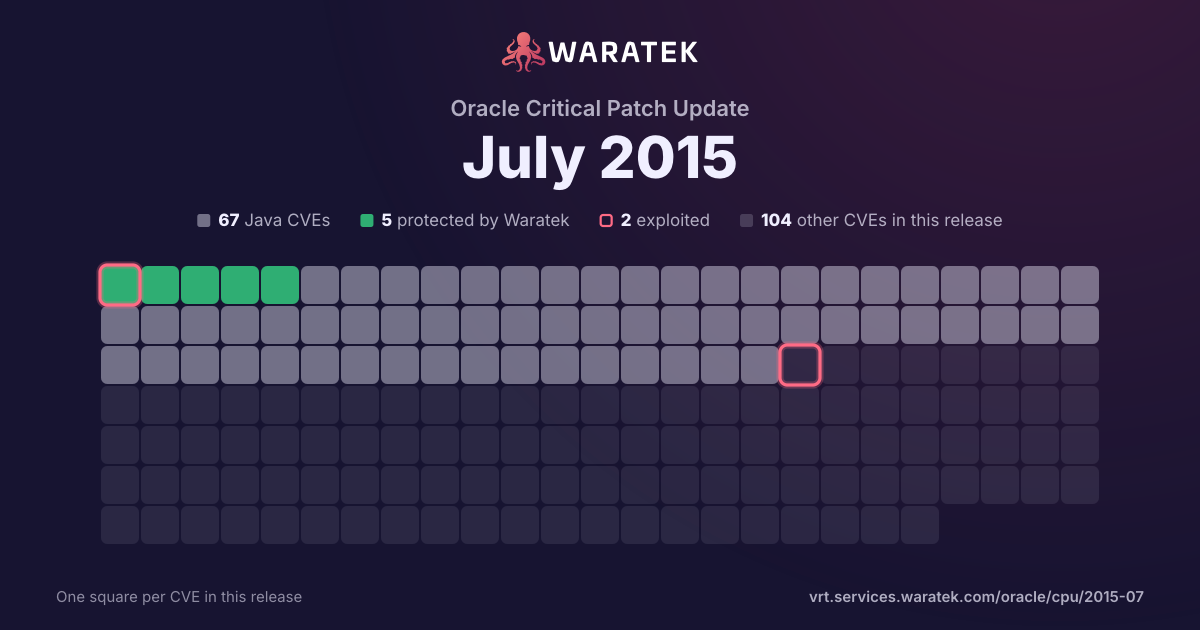
By status
5Protected by Waratek62No exploit published36Outside Waratek scope68Not applicable
2Exploited, marked by the ring
No exploit published. For 60 of them, Oracle's security advisory is the source of public detail.
Protected by Waratek. Waratek RASP can block exploitation of these on systems that have not applied the patch yet.
Overview 3 matches · 0 in Waratek scope · 0 protected · 0 exploited · 0 CISA KEV · 2 public PoC
Protected by Waratek
0
0.0%
Rule in development
0
0.0%
Mitigation candidate
0
0.0%
No exploit published
0
0.0%
Outside Waratek scope
3
100.0%
Not applicable
0
0.0%
Withdrawn CVE
0
0.0%
blocked by ARMR today
0
0.0%
partly blocked
0
0.0%
not blocked
3
100.0%
not established
0
0.0%
unrecorded
0
0.0%
Exploited
0
0.0%
Working exploit published
0
0.0%
Proof of concept only
2
66.7%
Forecast only
1
33.3%
No public exploit
0
0.0%
split by
peak 1 / month
Oct 14Nov 14Dec 14Jan 15Feb 15Mar 15Apr 15May 15
| CVE | Severity | Published▾ | Status | Exploitation | Description |
|---|---|---|---|---|---|
| CVE-2015-4000 | Low | 2015-05-21 | Outside Waratek scope | Proof of concept only | The TLS protocol 1.2 and earlier, when a DHE_EXPORT ciphersuite is enabled on a server but not on a client, does not properly convey a DHE_EXPORT choice, which allows man-in-the-middle attackers to conduct cipher-downgrade attacks by rewriting a ClientHello with DHE replaced by DHE_EXPORT and then rewriting a ServerHello with DHE_EXPORT replaced by DHE, aka the "Logjam" issue. |
| CVE-2015-2808 | Low | 2015-04-01 | Outside Waratek scope | Forecast only | The RC4 algorithm, as used in the TLS protocol and SSL protocol, does not properly combine state data with key data during the initialization phase, which makes it easier for remote attackers to conduct plaintext-recovery attacks against the initial bytes of a stream by sniffing network traffic that occasionally relies on keys affected by the Invariance Weakness, and then using a brute-force approach involving LSB values, aka the "Bar Mitzvah" issue. |
| CVE-2014-3566 | Low | 2014-10-15 | Outside Waratek scope | Proof of concept only | The SSL protocol 3.0, as used in OpenSSL through 1.0.1i and other products, uses nondeterministic CBC padding, which makes it easier for man-in-the-middle attackers to obtain cleartext data via a padding-oracle attack, aka the "POODLE" issue. |