
Oracle Critical Patch Update July 2015
Released July 2015 · Oracle's advisory ↗ · ← Critical Patch Update, April 2015 · Critical Patch Update, October 2015 →
171 CVEs in this release, one square each
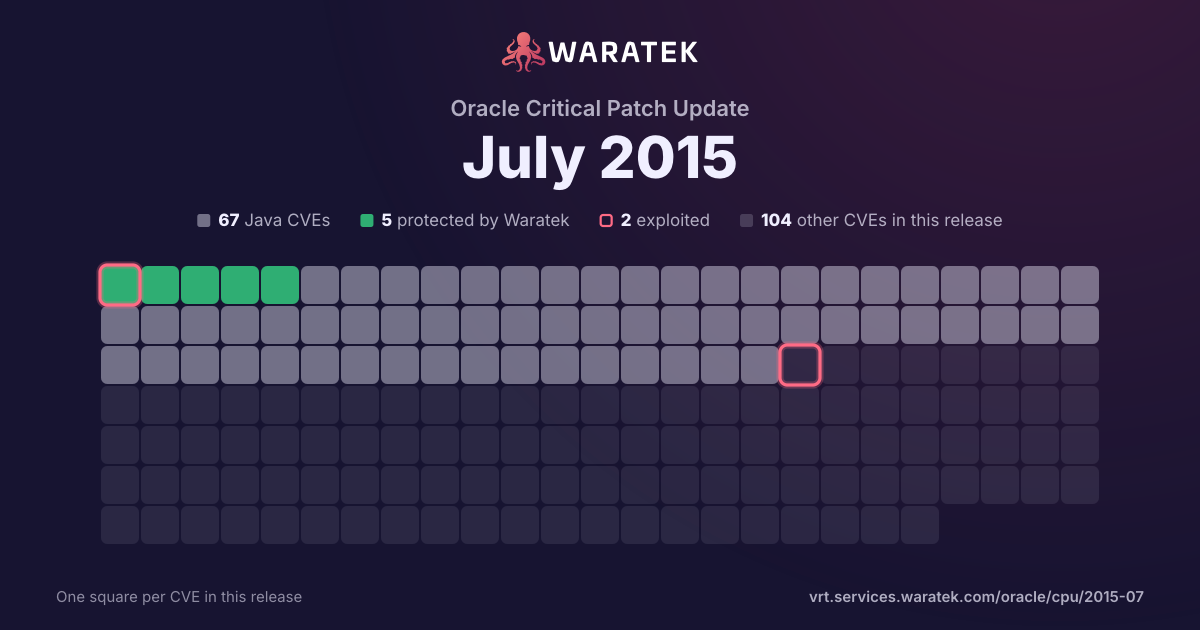
By status
5Protected by Waratek62No exploit published36Outside Waratek scope68Not applicable
2Exploited, marked by the ring
No exploit published. For 60 of them, Oracle's security advisory is the source of public detail.
Protected by Waratek. Waratek RASP can block exploitation of these on systems that have not applied the patch yet.
Overview 35 matches · 12 in Waratek scope · 0 protected · 0 exploited · 0 CISA KEV · 2 public PoC · 3 EPSS ≥ 0.5
35matches
12in Waratek scope34.3%
0protected0.0%
0exploited0.0%
0CISA KEV0.0%
2public PoC5.7%
3EPSS ≥ 0.58.6%
Protected by Waratek
0
0.0%
Rule in development
0
0.0%
Mitigation candidate
0
0.0%
No exploit published
12
34.3%
Outside Waratek scope
7
20.0%
Not applicable
16
45.7%
Withdrawn CVE
0
0.0%
blocked by ARMR today
0
0.0%
partly blocked
0
0.0%
not blocked
35
100.0%
not established
0
0.0%
unrecorded
0
0.0%
Exploited
0
0.0%
Working exploit published
0
0.0%
Proof of concept only
2
5.7%
Forecast only
1
2.9%
No public exploit
32
91.4%
split by
peak 31 / quarter
Q4 101
Not applicable1
Low1
not blocked1
No public exploit1
Q1 110
Q2 110
Q3 110
Q4 110
Q1 120
Q2 120
Q3 120
Q4 120
Q1 130
Q2 130
Q3 130
Q4 130
Q1 140
Q2 140
Q3 140
Q4 141
Outside Waratek scope1
Low1
not blocked1
Proof of concept only1
Q1 150
Q2 152
Outside Waratek scope2
Low2
not blocked2
Proof of concept only1
Forecast only1
Q3 1531
No exploit published12
Outside Waratek scope4
Not applicable15
Low31
not blocked31
No public exploit31
Q1 11Q3 11Q1 12Q3 12Q1 13Q3 13Q1 14Q3 14Q1 15Q3 15
| CVE | Severity | Published▾ | Status | Exploitation | Description |
|---|---|---|---|---|---|
| CVE-2015-4788 | Low | 2015-07-16 | Not applicable | No public exploit | Unspecified vulnerability in the Data Store component in Oracle Berkeley DB 11.2.5.1.29, 11.2.5.2.42, 11.2.5.3.28, and 12.1.6.0.35 allows local users to affect integrity and availability via unknown vectors, a different vulnerability than CVE-2015-4774 and CVE-2015-4779. |
| CVE-2015-4779 | Low | 2015-07-16 | Not applicable | No public exploit | Unspecified vulnerability in the Data Store component in Oracle Berkeley DB 11.2.5.1.29, 11.2.5.2.42, 11.2.5.3.28, and 12.1.6.0.35 allows local users to affect integrity and availability via unknown vectors, a different vulnerability than CVE-2015-4774 and CVE-2015-4788. |
| CVE-2015-4774 | Low | 2015-07-16 | Not applicable | No public exploit | Unspecified vulnerability in the Data Store component in Oracle Berkeley DB 11.2.5.1.29, 11.2.5.2.42, 11.2.5.3.28, and 12.1.6.0.35 allows local users to affect integrity and availability via unknown vectors, a different vulnerability than CVE-2015-4779 and CVE-2015-4788. |
| CVE-2015-4771 | Low | 2015-07-16 | Not applicable | No public exploit | Unspecified vulnerability in Oracle MySQL Server 5.6.24 and earlier allows remote authenticated users to affect availability via vectors related to RBR. |
| CVE-2015-4769 | Low | 2015-07-16 | Not applicable | No public exploit | Unspecified vulnerability in Oracle MySQL Server 5.6.24 and earlier allows remote authenticated users to affect availability via unknown vectors related to Server : Security : Firewall, a different vulnerability than CVE-2015-4767. |
| CVE-2015-4767 | Low | 2015-07-16 | Not applicable | No public exploit | Unspecified vulnerability in Oracle MySQL Server 5.6.24 and earlier allows remote authenticated users to affect availability via unknown vectors related to Server : Security : Firewall, a different vulnerability than CVE-2015-4769. |
| CVE-2015-4765 | Low | 2015-07-16 | No exploit published | No public exploit | Unspecified vulnerability in the Oracle Applications Manager component in Oracle E-Business Suite 12.1.3, 12.2.3, and 12.2.4 allows remote authenticated users to affect integrity via vectors related to OAM Dashboard. |
| CVE-2015-4763 | Low | 2015-07-16 | No exploit published | No public exploit | Unspecified vulnerability in the Oracle Agile PLM component in Oracle Supply Chain Products Suite 9.3.4 allows remote authenticated users to affect confidentiality and integrity via unknown vectors related to Security. |
| CVE-2015-4761 | Low | 2015-07-16 | Not applicable | No public exploit | Unspecified vulnerability in Oracle MySQL Server 5.6.24 and earlier allows remote authenticated users to affect availability via unknown vectors related to Server : Memcached. |
| CVE-2015-4757 | Low | 2015-07-16 | Not applicable | No public exploit | Unspecified vulnerability in Oracle MySQL Server 5.5.42 and earlier and 5.6.23 and earlier allows remote authenticated users to affect availability via unknown vectors related to Server : Optimizer. |
| CVE-2015-4753 | Low | 2015-07-16 | Outside Waratek scope | No public exploit | Unspecified vulnerability in the RDBMS Support Tools component in Oracle Database Server 11.2.0.3, 11.2.0.4, 12.1.0.1, and 12.1.0.2 allows local users to affect confidentiality via unknown vectors. |
| CVE-2015-4744 | Low | 2015-07-16 | No exploit published | No public exploit | Unspecified vulnerability in the Oracle GlassFish Server component in Oracle Fusion Middleware 2.1.1, 3.0.1, and 3.1.2; and the Oracle WebLogic Server component in Oracle Fusion Middleware 10.3.6.0, 12.1.1.0, 12.1.2.0, and 12.1.3.0 allows remote attackers to affect integrity via unknown vectors related to Java Server Faces. |
| CVE-2015-4741 | Low | 2015-07-16 | No exploit published | No public exploit | Unspecified vulnerability in the Oracle Applications Framework component in Oracle E-Business Suite 12.2.4 allows remote authenticated users to affect integrity via unknown vectors related to Dialog popup. |
| CVE-2015-4739 | Low | 2015-07-16 | No exploit published | No public exploit | Unspecified vulnerability in the Oracle Application Object Library component in Oracle E-Business Suite 11.5.10.2 allows remote authenticated users to affect integrity via unknown vectors related to Help screens. |
| CVE-2015-4737 | Low | 2015-07-16 | Not applicable | No public exploit | Unspecified vulnerability in Oracle MySQL Server 5.5.43 and earlier, and 5.6.23 and earlier, allows remote authenticated users to affect confidentiality via unknown vectors related to Server : Pluggable Auth. |
| CVE-2015-2662 | Low | 2015-07-16 | Not applicable | No public exploit | Unspecified vulnerability in Oracle Sun Solaris 10 and 11.2 allows local users to affect availability via vectors related to DHCP Server. |
| CVE-2015-2661 | Low | 2015-07-16 | Not applicable | No public exploit | Unspecified vulnerability in Oracle MySQL Server 5.6.24 and earlier allows local users to affect availability via unknown vectors related to Client. |
| CVE-2015-2660 | Low | 2015-07-16 | No exploit published | No public exploit | Unspecified vulnerability in the Oracle Agile PLM component in Oracle Supply Chain Products Suite 9.3.4 allows remote authenticated users to affect confidentiality and integrity via vectors related to Oracle Agile PLM Framework. |
| CVE-2015-2651 | Low | 2015-07-16 | Not applicable | No public exploit | Unspecified vulnerability in Oracle Sun Solaris 11.2 allows local users to affect availability via vectors related to Kernel Zones virtualized NIC driver. |
| CVE-2015-2649 | Low | 2015-07-16 | No exploit published | No public exploit | Unspecified vulnerability in the Siebel UI Framework component in Oracle Siebel CRM 8.1.1, 8.22, and 15.0 allows remote authenticated users to affect confidentiality via vectors related to UIF Open UI. |
| CVE-2015-2645 | Low | 2015-07-16 | No exploit published | No public exploit | Unspecified vulnerability in the Oracle Web Applications Desktop Integrator component in Oracle E-Business Suite 11.5.10.2, 12.0.6, 12.1.3, 12.2.3, and 12.2.4 allows remote authenticated users to affect integrity via unknown vectors. |
| CVE-2015-2641 | Low | 2015-07-16 | Not applicable | No public exploit | Unspecified vulnerability in Oracle MySQL Server 5.6.24 and earlier allows remote authenticated users to affect availability via unknown vectors related to Server : Security : Privileges. |
| CVE-2015-2639 | Low | 2015-07-16 | Not applicable | No public exploit | Unspecified vulnerability in Oracle MySQL Server 5.6.24 and earlier allows remote authenticated users to affect integrity via unknown vectors related to Server : Security : Firewall. |
| CVE-2015-2627 | Low | 2015-07-16 | Outside Waratek scope | No public exploit | Unspecified vulnerability in Oracle Java SE 6u95, 7u80, and 8u45 allows remote attackers to affect confidentiality via unknown vectors related to installation. |
| CVE-2015-2625 | Low | 2015-07-16 | Outside Waratek scope | No public exploit | Unspecified vulnerability in Oracle Java SE 6u95, 7u80, and 8u45; JRockit R28.3.6; and Java SE Embedded 7u75 and 8u33 allows remote attackers to affect confidentiality via vectors related to JSSE. |
| CVE-2015-2618 | Low | 2015-07-16 | No exploit published | No public exploit | Unspecified vulnerability in the Oracle Application Object Library component in Oracle E-Business Suite 11.5.10.2, 12.0.6, 12.1.3, 12.2.3, and 12.2.4 allows remote authenticated users to affect integrity via unknown vectors related to Input validation. |
| CVE-2015-2600 | Low | 2015-07-16 | No exploit published | No public exploit | Unspecified vulnerability in the Siebel Core - Server OM Svcs component in Oracle Siebel CRM 8.1.1, 8.2.2, and 15.0 allows remote authenticated users to affect confidentiality via unknown vectors related to Security. |
| CVE-2015-2598 | Low | 2015-07-16 | No exploit published | No public exploit | Unspecified vulnerability in the mobile app in Oracle Business Intelligence Enterprise Edition in Oracle Fusion Middleware before 11.1.1.7.0 (11.6.39) allows remote authenticated users to affect integrity via unknown vectors related to Mobile - iPad. |
| CVE-2015-2592 | Low | 2015-07-16 | No exploit published | No public exploit | Unspecified vulnerability in the Hyperion Enterprise Performance Management Architect component in Oracle Hyperion 11.1.2.2 and 11.1.2.3 allows remote authenticated users to affect integrity via unknown vectors related to Security, a different vulnerability than CVE-2015-2584. |
| CVE-2015-2585 | Low | 2015-07-16 | Outside Waratek scope | No public exploit | Unspecified vulnerability in the Application Express component in Oracle Database Server before 5.0 allows remote authenticated users to affect availability via unknown vectors. |
| CVE-2015-2580 | Low | 2015-07-16 | Not applicable | No public exploit | Unspecified vulnerability in Oracle Sun Solaris 10 and 11.2 allows local users to affect availability via vectors related to NFSv4. |
| CVE-2015-4000 | Low | 2015-05-21 | Outside Waratek scope | Proof of concept only | The TLS protocol 1.2 and earlier, when a DHE_EXPORT ciphersuite is enabled on a server but not on a client, does not properly convey a DHE_EXPORT choice, which allows man-in-the-middle attackers to conduct cipher-downgrade attacks by rewriting a ClientHello with DHE replaced by DHE_EXPORT and then rewriting a ServerHello with DHE_EXPORT replaced by DHE, aka the "Logjam" issue. |
| CVE-2015-2808 | Low | 2015-04-01 | Outside Waratek scope | Forecast only | The RC4 algorithm, as used in the TLS protocol and SSL protocol, does not properly combine state data with key data during the initialization phase, which makes it easier for remote attackers to conduct plaintext-recovery attacks against the initial bytes of a stream by sniffing network traffic that occasionally relies on keys affected by the Invariance Weakness, and then using a brute-force approach involving LSB values, aka the "Bar Mitzvah" issue. |
| CVE-2014-3566 | Low | 2014-10-15 | Outside Waratek scope | Proof of concept only | The SSL protocol 3.0, as used in OpenSSL through 1.0.1i and other products, uses nondeterministic CBC padding, which makes it easier for man-in-the-middle attackers to obtain cleartext data via a padding-oracle attack, aka the "POODLE" issue. |
| CVE-2010-1324 | Low | 2010-12-02 | Not applicable | No public exploit | MIT Kerberos 5 (aka krb5) 1.7.x and 1.8.x through 1.8.3 does not properly determine the acceptability of checksums, which might allow remote attackers to forge GSS tokens, gain privileges, or have unspecified other impact via (1) an unkeyed checksum, (2) an unkeyed PAC checksum, or (3) a KrbFastArmoredReq checksum based on an RC4 key. |