
Oracle Critical Patch Update January 2015
Released January 2015 · Oracle's advisory ↗ · ← Critical Patch Update, October 2014 · Critical Patch Update, April 2015 →
155 CVEs in this release, one square each
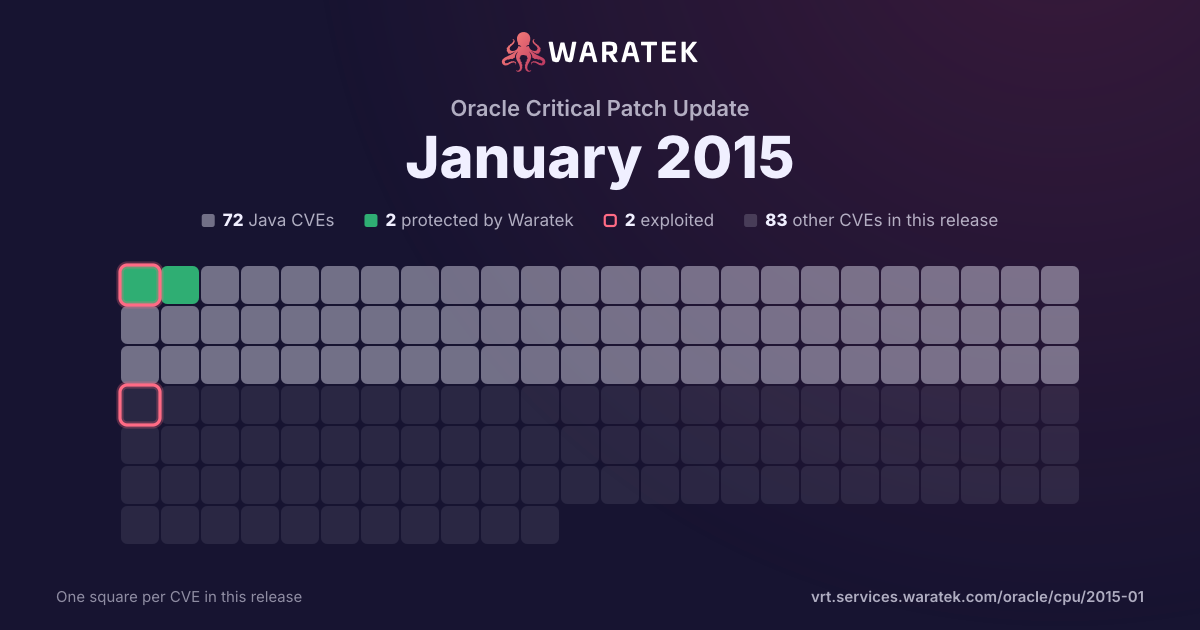
By status
2Protected by Waratek1Mitigation candidate69No exploit published32Outside Waratek scope51Not applicable
2Exploited, marked by the ring
No exploit published. For 67 of them, Oracle's security advisory is the source of public detail.
Protected by Waratek. Waratek RASP can block exploitation of these on systems that have not applied the patch yet.
Overview 35 matches · 0 in Waratek scope · 0 protected · 0 exploited · 0 CISA KEV · 0 public PoC · 1 EPSS ≥ 0.5
35matches
0in Waratek scope0.0%
0protected0.0%
0exploited0.0%
0CISA KEV0.0%
0public PoC0.0%
1EPSS ≥ 0.52.9%
Protected by Waratek
0
0.0%
Rule in development
0
0.0%
Mitigation candidate
0
0.0%
No exploit published
0
0.0%
Outside Waratek scope
0
0.0%
Not applicable
35
100.0%
Withdrawn CVE
0
0.0%
blocked by ARMR today
0
0.0%
partly blocked
0
0.0%
not blocked
35
100.0%
not established
0
0.0%
unrecorded
0
0.0%
Exploited
0
0.0%
Working exploit published
0
0.0%
Proof of concept only
0
0.0%
Forecast only
1
2.9%
No public exploit
34
97.1%
split by
peak 32 / month
Apr 141
Not applicable1
Medium1
not blocked1
Forecast only1
May 140
Jun 140
Jul 140
Aug 140
Sep 141
Not applicable1
High1
not blocked1
No public exploit1
Oct 141
Not applicable1
High1
not blocked1
No public exploit1
Nov 140
Dec 140
Jan 1532
Not applicable32
High5
Medium14
Low13
not blocked32
No public exploit32
Apr 14May 14Jun 14Jul 14Aug 14Sep 14Oct 14Nov 14Dec 14Jan 15
| CVE | Severity | Published▾ | Status | Exploitation | Description |
|---|---|---|---|---|---|
| CVE-2015-0432 | Medium | 2015-01-21 | Not applicable | No public exploit | Unspecified vulnerability in Oracle MySQL Server 5.5.40 and earlier allows remote authenticated users to affect availability via vectors related to Server : InnoDB : DDL : Foreign Key. |
| CVE-2015-0430 | Low | 2015-01-21 | Not applicable | No public exploit | Unspecified vulnerability in Oracle Sun Solaris 10 and 11 allows local users to affect confidentiality via vectors related to RPC Utility. |
| CVE-2015-0429 | Low | 2015-01-21 | Not applicable | No public exploit | Unspecified vulnerability in Oracle Sun Solaris 10 and 11 allows local users to affect integrity and availability via vectors related to RPC Utility. |
| CVE-2015-0428 | Medium | 2015-01-21 | Not applicable | No public exploit | Unspecified vulnerability in Oracle Sun Solaris 10 and 11 allows local users to affect availability via unknown vectors related to Resource Control. |
| CVE-2015-0427 | Low | 2015-01-21 | Not applicable | No public exploit | Unspecified vulnerability in the Oracle VM VirtualBox component in Oracle Virtualization VirtualBox prior to 4.3.20 allows local users to affect integrity and availability via vectors related to VMSVGA virtual graphics device, a different vulnerability than CVE-2014-6588, CVE-2014-6589, CVE-2014-6590, and CVE-2014-6595. |
| CVE-2015-0424 | High | 2015-01-21 | Not applicable | No public exploit | Unspecified vulnerability in the Integrated Lights Out Manager (ILOM) component in Oracle Sun Systems Products Suite ILOM prior to 3.2.4 allows remote authenticated users to affect confidentiality, integrity, and availability via vectors related to IPMI. |
| CVE-2015-0418 | Low | 2015-01-21 | Not applicable | No public exploit | Unspecified vulnerability in the Oracle VM VirtualBox component in Oracle Virtualization VirtualBox prior to 3.2.26, 4.0.28, 4.1.36, and 4.2.28 allows local users to affect availability via unknown vectors related to Core, a different vulnerability than CVE-2015-0377. |
| CVE-2015-0397 | Low | 2015-01-21 | Not applicable | No public exploit | Unspecified vulnerability in Oracle Sun Solaris 11 allows local users to affect availability via unknown vectors related to File System, a different vulnerability than CVE-2014-6570 and CVE-2014-6600. |
| CVE-2015-0391 | Medium | 2015-01-21 | Not applicable | No public exploit | Unspecified vulnerability in Oracle MySQL Server 5.5.38 and earlier, and 5.6.19 and earlier, allows remote authenticated users to affect availability via vectors related to DDL. |
| CVE-2015-0385 | Low | 2015-01-21 | Not applicable | No public exploit | Unspecified vulnerability in Oracle MySQL Server 5.6.21 and earlier allows remote authenticated users to affect availability via unknown vectors related to Pluggable Auth. |
| CVE-2015-0378 | Low | 2015-01-21 | Not applicable | No public exploit | Unspecified vulnerability in Oracle Sun Solaris 11 allows local users to affect availability via unknown vectors related to Libc. |
| CVE-2015-0377 | Medium | 2015-01-21 | Not applicable | No public exploit | Unspecified vulnerability in the Oracle VM VirtualBox component in Oracle Virtualization VirtualBox prior to 3.2.26, 4.0.28, 4.1.36, and 4.2.28 allows local users to affect availability via unknown vectors related to Core, a different vulnerability than CVE-2015-0418. |
| CVE-2015-0375 | Medium | 2015-01-21 | Not applicable | No public exploit | Unspecified vulnerability in Oracle Sun Solaris 10 and 11 allows remote attackers to affect confidentiality via unknown vectors related to Network. |
| CVE-2015-0374 | Low | 2015-01-21 | Not applicable | No public exploit | Unspecified vulnerability in Oracle MySQL Server 5.5.40 and earlier and 5.6.21 and earlier allows remote authenticated users to affect confidentiality via unknown vectors related to Server : Security : Privileges : Foreign Key. |
| CVE-2014-6600 | Medium | 2015-01-21 | Not applicable | No public exploit | Unspecified vulnerability in Oracle Sun Solaris 11 allows local users to affect availability via unknown vectors related to File System, a different vulnerability than CVE-2014-6570 and CVE-2015-0397. |
| CVE-2014-6595 | Low | 2015-01-21 | Not applicable | No public exploit | Unspecified vulnerability in the Oracle VM VirtualBox component in Oracle Virtualization VirtualBox before 4.3.20 allows local users to affect integrity and availability via vectors related to VMSVGA virtual graphics device, a different vulnerability than CVE-2014-6588, CVE-2014-6589, CVE-2014-6590, and CVE-2015-0427. |
| CVE-2014-6590 | Low | 2015-01-21 | Not applicable | No public exploit | Unspecified vulnerability in the Oracle VM VirtualBox component in Oracle Virtualization VirtualBox before 4.3.20 allows local users to affect integrity and availability via vectors related to VMSVGA virtual graphics device, a different vulnerability than CVE-2014-6588, CVE-2014-6589, CVE-2014-6595, and CVE-2015-0427. |
| CVE-2014-6589 | Low | 2015-01-21 | Not applicable | No public exploit | Unspecified vulnerability in the Oracle VM VirtualBox component in Oracle Virtualization VirtualBox before 4.3.20 allows local users to affect integrity and availability via vectors related to VMSVGA virtual graphics device, a different vulnerability than CVE-2014-6588, CVE-2014-6590, CVE-2014-6595, and CVE-2015-0427. |
| CVE-2014-6588 | Low | 2015-01-21 | Not applicable | No public exploit | Unspecified vulnerability in the Oracle VM VirtualBox component in Oracle Virtualization VirtualBox before 4.3.20 allows local users to affect integrity and availability via vectors related to VMSVGA virtual graphics device, a different vulnerability than CVE-2014-6589, CVE-2014-6590, CVE-2014-6595, and CVE-2015-0427. |
| CVE-2014-6584 | Medium | 2015-01-21 | Not applicable | No public exploit | Unspecified vulnerability in the Integrated Lights Out Manager (ILOM) component in Oracle Sun Systems Products Suite ILOM before 3.2.4 allows remote authenticated users to affect confidentiality via unknown vectors related to Backup Restore. |
| CVE-2014-6575 | Medium | 2015-01-21 | Not applicable | No public exploit | Unspecified vulnerability in Oracle Sun Solaris 10 and 11 allows remote attackers to affect availability via unknown vectors related to Network, a different vulnerability than CVE-2004-0230. |
| CVE-2014-6570 | Medium | 2015-01-21 | Not applicable | No public exploit | Unspecified vulnerability in Oracle Sun Solaris 11 allows local users to affect availability via unknown vectors related to File System, a different vulnerability than CVE-2014-6600 and CVE-2015-0397. |
| CVE-2014-6568 | Low | 2015-01-21 | Not applicable | No public exploit | Unspecified vulnerability in Oracle MySQL Server 5.5.40 and earlier, and 5.6.21 and earlier, allows remote authenticated users to affect availability via vectors related to Server : InnoDB : DML. |
| CVE-2014-6524 | High | 2015-01-21 | Not applicable | No public exploit | Unspecified vulnerability in Oracle Solaris 10 allows local users to affect confidentiality, integrity, and availability via unknown vectors related to Kernel. |
| CVE-2014-6521 | High | 2015-01-21 | Not applicable | No public exploit | Unspecified vulnerability in Oracle Solaris 10 allows local users to affect confidentiality, integrity, and availability via vectors related to CDE - Power Management Utility. |
| CVE-2014-6518 | Medium | 2015-01-21 | Not applicable | No public exploit | Unspecified vulnerability in Oracle Solaris 10 and 11 allows local users to affect integrity and availability via vectors related to Unix File System (UFS). |
| CVE-2014-6510 | High | 2015-01-21 | Not applicable | No public exploit | Unspecified vulnerability in Oracle Solaris 11 allows local users to affect confidentiality, integrity, and availability via unknown vectors related to Power Management Utility. |
| CVE-2014-6509 | Medium | 2015-01-21 | Not applicable | No public exploit | Unspecified vulnerability in Oracle Solaris 10 allows local users to affect availability via unknown vectors related to Kernel. |
| CVE-2014-6481 | Medium | 2015-01-21 | Not applicable | No public exploit | Unspecified vulnerability in Oracle Solaris 10 and 11 allows remote attackers to affect confidentiality via vectors related to KSSL. |
| CVE-2014-6480 | Medium | 2015-01-21 | Not applicable | No public exploit | Unspecified vulnerability in the Solaris Cluster component in Oracle Sun Systems Products Suite 3.3 and 4.1 allows local users to affect confidentiality, integrity, and availability via unknown vectors related to System management. |
| CVE-2014-4259 | High | 2015-01-21 | Not applicable | No public exploit | Unspecified vulnerability in the Solaris Cluster component in Oracle Sun Systems Products Suite 3.3 and 4.1 allows remote authenticated users to affect confidentiality, integrity, and availability via unknown vectors related to System management. |
| CVE-2014-0191 | Medium | 2015-01-21 | Not applicable | No public exploit | The xmlParserHandlePEReference function in parser.c in libxml2 before 2.9.2, as used in Web Listener in Oracle HTTP Server in Oracle Fusion Middleware 11.1.1.7.0, 12.1.2.0, and 12.1.3.0 and other products, loads external parameter entities regardless of whether entity substitution or validation is enabled, which allows remote attackers to cause a denial of service (resource consumption) via a crafted XML document. |
| CVE-2014-3567 | High | 2014-10-19 | Not applicable | No public exploit | Memory leak in the tls_decrypt_ticket function in t1_lib.c in OpenSSL before 0.9.8zc, 1.0.0 before 1.0.0o, and 1.0.1 before 1.0.1j allows remote attackers to cause a denial of service (memory consumption) via a crafted session ticket that triggers an integrity-check failure. |
| CVE-2014-1568 | High | 2014-09-25 | Not applicable | No public exploit | Mozilla Network Security Services (NSS) before 3.16.2.1, 3.16.x before 3.16.5, and 3.17.x before 3.17.1, as used in Mozilla Firefox before 32.0.3, Mozilla Firefox ESR 24.x before 24.8.1 and 31.x before 31.1.1, Mozilla Thunderbird before 24.8.1 and 31.x before 31.1.2, Mozilla SeaMonkey before 2.29.1, Google Chrome before 37.0.2062.124 on Windows and OS X, and Google Chrome OS before 37.0.2062.120, does not properly parse ASN.1 values in X.509 certificates, which makes it easier for remote attackers to spoof RSA signatures via a crafted certificate, aka a "signature malleability" issue. |
| CVE-2013-5704 | Medium | 2014-04-15 | Not applicable | Forecast only | The mod_headers module in the Apache HTTP Server 2.2.22 allows remote attackers to bypass "RequestHeader unset" directives by placing a header in the trailer portion of data sent with chunked transfer coding. NOTE: the vendor states "this is not a security issue in httpd as such." |