
Oracle Critical Patch Update January 2015
Released January 2015 · Oracle's advisory ↗ · ← Critical Patch Update, October 2014 · Critical Patch Update, April 2015 →
155 CVEs in this release, one square each
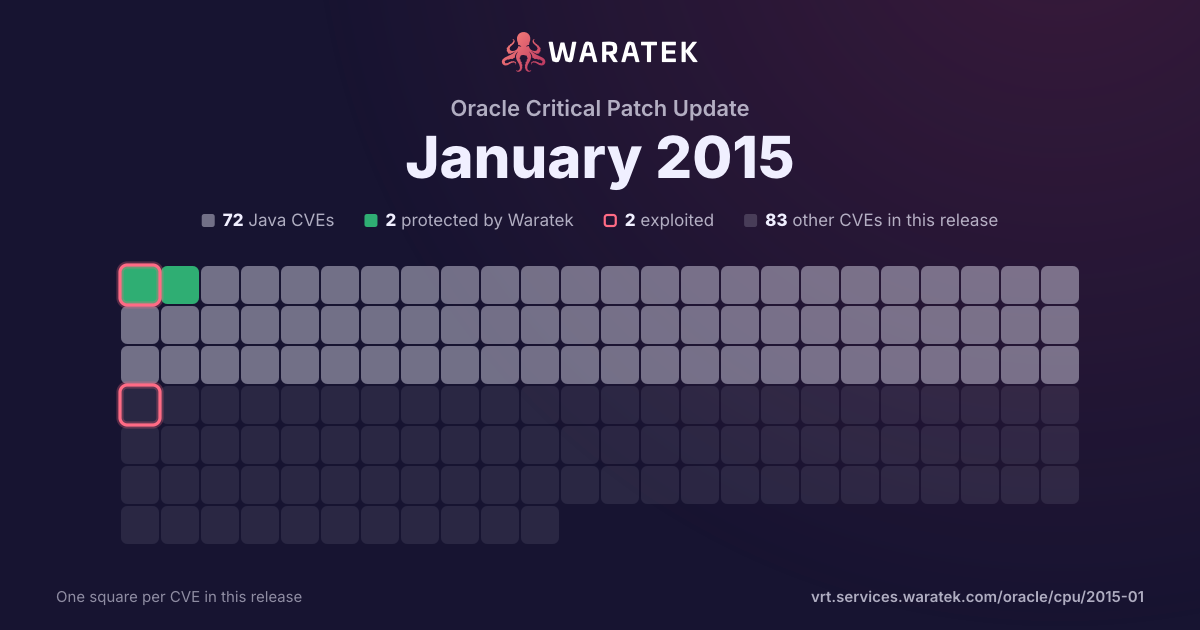
By status
2Protected by Waratek1Mitigation candidate69No exploit published32Outside Waratek scope51Not applicable
2Exploited, marked by the ring
No exploit published. For 67 of them, Oracle's security advisory is the source of public detail.
Protected by Waratek. Waratek RASP can block exploitation of these on systems that have not applied the patch yet.
Overview 5 matches · 1 in Waratek scope · 0 protected · 0 exploited · 0 CISA KEV · 4 public PoC · 2 EPSS ≥ 0.5
5matches
1in Waratek scope20.0%
0protected0.0%
0exploited0.0%
0CISA KEV0.0%
4public PoC80.0%
2EPSS ≥ 0.540.0%
Protected by Waratek
0
0.0%
Rule in development
0
0.0%
Mitigation candidate
0
0.0%
No exploit published
1
20.0%
Outside Waratek scope
0
0.0%
Not applicable
4
80.0%
Withdrawn CVE
0
0.0%
blocked by ARMR today
0
0.0%
partly blocked
0
0.0%
not blocked
5
100.0%
not established
0
0.0%
unrecorded
0
0.0%
Exploited
0
0.0%
Working exploit published
3
60.0%
Proof of concept only
1
20.0%
Forecast only
0
0.0%
No public exploit
1
20.0%
split by
peak 2 / month
Sep 112
Not applicable2
High1
Medium1
not blocked2
Working exploit published1
Proof of concept only1
Oct 111
Not applicable1
Medium1
not blocked1
Working exploit published1
Nov 111
Not applicable1
Medium1
not blocked1
Working exploit published1
Dec 111
No exploit published1
Medium1
not blocked1
No public exploit1
Sep 11Oct 11Nov 11Dec 11
| CVE | Severity | Published▾ | Status | Exploitation | Description |
|---|---|---|---|---|---|
| CVE-2011-4461 | Medium | 2011-12-30 | No exploit published | No public exploit | Jetty 8.1.0.RC2 and earlier computes hash values for form parameters without restricting the ability to trigger hash collisions predictably, which allows remote attackers to cause a denial of service (CPU consumption) by sending many crafted parameters. |
| CVE-2011-3607 | Medium | 2011-11-08 | Not applicable | Working exploit published | Integer overflow in the ap_pregsub function in server/util.c in the Apache HTTP Server 2.0.x through 2.0.64 and 2.2.x through 2.2.21, when the mod_setenvif module is enabled, allows local users to gain privileges via a .htaccess file with a crafted SetEnvIf directive, in conjunction with a crafted HTTP request header, leading to a heap-based buffer overflow. |
| CVE-2011-3368 | Medium | 2011-10-05 | Not applicable | Working exploit published | The mod_proxy module in the Apache HTTP Server 1.3.x through 1.3.42, 2.0.x through 2.0.64, and 2.2.x through 2.2.21 does not properly interact with use of (1) RewriteRule and (2) ProxyPassMatch pattern matches for configuration of a reverse proxy, which allows remote attackers to send requests to intranet servers via a malformed URI containing an initial @ (at sign) character. |
| CVE-2011-3389 | Medium | 2011-09-06 | Not applicable | Proof of concept only | The SSL protocol, as used in certain configurations in Microsoft Windows and Microsoft Internet Explorer, Mozilla Firefox, Google Chrome, Opera, and other products, encrypts data by using CBC mode with chained initialization vectors, which allows man-in-the-middle attackers to obtain plaintext HTTP headers via a blockwise chosen-boundary attack (BCBA) on an HTTPS session, in conjunction with JavaScript code that uses (1) the HTML5 WebSocket API, (2) the Java URLConnection API, or (3) the Silverlight WebClient API, aka a "BEAST" attack. |
| CVE-2011-1944 | High | 2011-09-02 | Not applicable | Working exploit published | Integer overflow in xpath.c in libxml2 2.6.x through 2.6.32 and 2.7.x through 2.7.8, and libxml 1.8.16 and earlier, allows context-dependent attackers to cause a denial of service (crash) and possibly execute arbitrary code via a crafted XML file that triggers a heap-based buffer overflow when adding a new namespace node, related to handling of XPath expressions. |