
Oracle Critical Patch Update January 2015
Released January 2015 · Oracle's advisory ↗ · ← Critical Patch Update, October 2014 · Critical Patch Update, April 2015 →
155 CVEs in this release, one square each
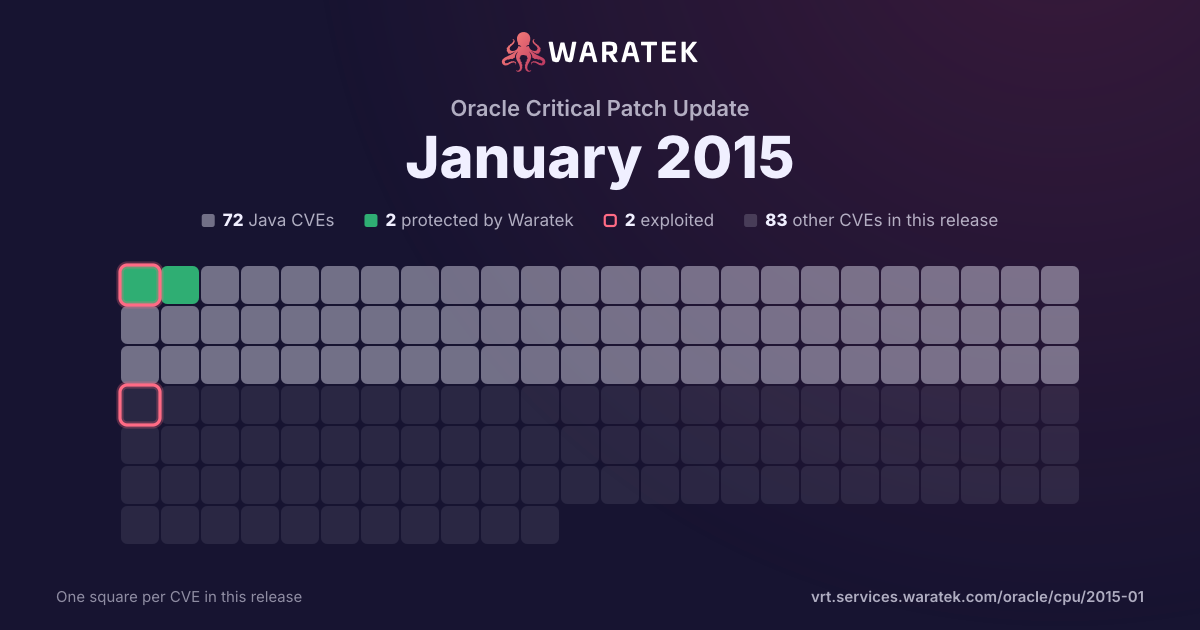
By status
2Protected by Waratek1Mitigation candidate69No exploit published32Outside Waratek scope51Not applicable
2Exploited, marked by the ring
No exploit published. For 67 of them, Oracle's security advisory is the source of public detail.
Protected by Waratek. Waratek RASP can block exploitation of these on systems that have not applied the patch yet.
Overview 103 matches · 58 in Waratek scope · 0 protected · 0 exploited · 0 CISA KEV · 7 public PoC · 7 EPSS ≥ 0.5
103matches
58in Waratek scope56.3%
0protected0.0%
0exploited0.0%
0CISA KEV0.0%
7public PoC6.8%
7EPSS ≥ 0.56.8%
Protected by Waratek
0
0.0%
Rule in development
0
0.0%
Mitigation candidate
0
0.0%
No exploit published
58
56.3%
Outside Waratek scope
18
17.5%
Not applicable
27
26.2%
Withdrawn CVE
0
0.0%
blocked by ARMR today
0
0.0%
partly blocked
0
0.0%
not blocked
103
100.0%
not established
0
0.0%
unrecorded
0
0.0%
split by
peak 86 / year
20031
Not applicable1
Medium1
not blocked1
Working exploit published1
20041
Not applicable1
Medium1
not blocked1
Working exploit published1
20050
20060
20070
20080
20090
20100
20114
No exploit published1
Not applicable3
Medium4
not blocked4
Working exploit published2
Proof of concept only1
No public exploit1
20120
20134
Not applicable4
Medium4
not blocked4
No public exploit4
20147
No exploit published1
Outside Waratek scope2
Not applicable4
Medium7
not blocked7
Working exploit published1
Forecast only1
No public exploit5
201586
No exploit published56
Outside Waratek scope16
Not applicable14
Medium86
not blocked86
Working exploit published1
No public exploit85
2003200520072009201120132015
| CVE | Severity | Published▾ | Status | Exploitation | Description |
|---|---|---|---|---|---|
| CVE-2015-0436 | Medium | 2015-01-21 | No exploit published | No public exploit | Unspecified vulnerability in the Oracle iLearning component in Oracle iLearning 6.0 and 6.1 allows remote attackers to affect confidentiality via unknown vectors related to Login. |
| CVE-2015-0435 | Medium | 2015-01-21 | No exploit published | No public exploit | Unspecified vulnerability in the Oracle Transportation Management component in Oracle Supply Chain Products Suite 6.1, 6.2, 6.3.0, 6.3.1, 6.3.2, 6.3.3, 6.3.4, and 6.3.5 allows remote authenticated users to affect confidentiality via unknown vectors related to Security. |
| CVE-2015-0434 | Medium | 2015-01-21 | No exploit published | No public exploit | Unspecified vulnerability in the Oracle Access Manager component in Oracle Fusion Middleware 11.1.1.5, 11.1.1.7, 11.1.2.1, and 11.1.2.2 allows remote attackers to affect confidentiality via vectors related to Integration with OAM. |
| CVE-2015-0432 | Medium | 2015-01-21 | Not applicable | No public exploit | Unspecified vulnerability in Oracle MySQL Server 5.5.40 and earlier allows remote authenticated users to affect availability via vectors related to Server : InnoDB : DDL : Foreign Key. |
| CVE-2015-0431 | Medium | 2015-01-21 | No exploit published | No public exploit | Unspecified vulnerability in the Oracle Transportation Management component in Oracle Supply Chain Products Suite 6.1, 6.2, 6.3.0 6.3.1, 6.3.2, 6.3.4, and 6.3.5 allows remote attackers to affect integrity via unknown vectors related to UI Infrastructure. |
| CVE-2015-0428 | Medium | 2015-01-21 | Not applicable | No public exploit | Unspecified vulnerability in Oracle Sun Solaris 10 and 11 allows local users to affect availability via unknown vectors related to Resource Control. |
| CVE-2015-0426 | Medium | 2015-01-21 | No exploit published | No public exploit | Unspecified vulnerability in the Enterprise Manager Base Platform component in Oracle Enterprise Manager Grid Control 12.1.0.3 and 12.1.0.4 allows remote attackers to affect confidentiality via unknown vectors related to UI Framework. |
| CVE-2015-0425 | Medium | 2015-01-21 | No exploit published | No public exploit | Unspecified vulnerability in the Oracle Enterprise Asset Management component in Oracle Siebel CRM 8.1.1 and 8.2.2 allows remote attackers to affect confidentiality via unknown vectors related to Siebel Core - Unix/Windows. |
| CVE-2015-0422 | Medium | 2015-01-21 | No exploit published | No public exploit | Unspecified vulnerability in the Oracle Transportation Management component in Oracle Supply Chain Products Suite 6.1, 6.2, 6.3.0, 6.3.1, 6.3.2, 6.3.3, 6.3.4, and 6.3.5 allows remote authenticated users to affect confidentiality via unknown vectors related to UI Infrastructure. |
| CVE-2015-0421 | Medium | 2015-01-21 | Outside Waratek scope | No public exploit | Unspecified vulnerability in Oracle Java SE 8u25 allows local users to affect confidentiality, integrity, and availability via unknown vectors related to the installation process. |
| CVE-2015-0420 | Medium | 2015-01-21 | No exploit published | No public exploit | Unspecified vulnerability in the Oracle Forms component in Oracle Fusion Middleware 11.1.1.7 and 11.1.2.2 allows remote attackers to affect confidentiality via unknown vectors related to Forms Services. |
| CVE-2015-0419 | Medium | 2015-01-21 | No exploit published | No public exploit | Unspecified vulnerability in the Siebel UI Framework component in Oracle Siebel CRM 8.1.1 and 8.2.2 allows remote attackers to affect confidentiality via unknown vectors related to Portal Framework, a different vulnerability than CVE-2013-1510. |
| CVE-2015-0417 | Medium | 2015-01-21 | No exploit published | No public exploit | Unspecified vulnerability in the Siebel UI Framework component in Oracle Siebel CRM 8.1.1 and 8.2.2 allows remote authenticated users to affect confidentiality via unknown vectors related to Portal Framework, a different vulnerability than CVE-2015-0388. |
| CVE-2015-0415 | Medium | 2015-01-21 | No exploit published | No public exploit | Unspecified vulnerability in the Oracle Application Object Library component in Oracle E-Business Suite 12.1.3 allows remote authenticated users to affect integrity via unknown vectors related to Session Management. |
| CVE-2015-0410 | Medium | 2015-01-21 | No exploit published | No public exploit | Unspecified vulnerability in the Java SE, Java SE Embedded, JRockit component in Oracle Java SE 5.0u75, 6u85, 7u72, and 8u25; Java SE Embedded 7u71 and 8u6; and JRockit R27.8.4 and R28.3.4 allows remote attackers to affect availability via unknown vectors related to Security. |
| CVE-2015-0409 | Medium | 2015-01-21 | Outside Waratek scope | No public exploit | Unspecified vulnerability in Oracle MySQL Server 5.6.21 and earlier allows remote authenticated users to affect availability via unknown vectors related to Optimizer. |
| CVE-2015-0407 | Medium | 2015-01-21 | Outside Waratek scope | No public exploit | Unspecified vulnerability in Oracle Java SE 5.0u75, 6u85, 7u72, and 8u25 allows remote attackers to affect confidentiality via unknown vectors related to Swing. |
| CVE-2015-0406 | Medium | 2015-01-21 | Outside Waratek scope | No public exploit | Unspecified vulnerability in Oracle Java SE 6u85, 7u72, and 8u25 allows remote attackers to affect confidentiality and availability via unknown vectors related to Deployment. |
| CVE-2015-0404 | Medium | 2015-01-21 | No exploit published | No public exploit | Unspecified vulnerability in the Oracle Applications Framework component in Oracle E-Business Suite 11.5.10.2, 12.0.6, 12.1.3, 12.2.2, 12.2.3, and 12.2.4 allows remote attackers to affect integrity via unknown vectors related to Error Messages. |
| CVE-2015-0403 | Medium | 2015-01-21 | Outside Waratek scope | No public exploit | Unspecified vulnerability in Oracle Java SE 6u85, 7u72, and 8u25 allows local users to affect confidentiality, integrity, and availability via unknown vectors related to Deployment. |
| CVE-2015-0402 | Medium | 2015-01-21 | No exploit published | No public exploit | Unspecified vulnerability in the Siebel Core - Server BizLogic Script component in Oracle Siebel CRM 8.1.1 and 8.2.2 allows remote attackers to affect integrity via vectors related to Integration - COM. |
| CVE-2015-0401 | Medium | 2015-01-21 | No exploit published | No public exploit | Unspecified vulnerability in the Oracle Directory Server Enterprise Edition component in Oracle Fusion Middleware 7.0 and 11.1.1.7 allows remote authenticated users to affect integrity via unknown vectors related to Admin Console. |
| CVE-2015-0400 | Medium | 2015-01-21 | Outside Waratek scope | No public exploit | Unspecified vulnerability in Oracle Java SE 6u85, 7u72, and 8u25 allows remote attackers to affect confidentiality via unknown vectors related to Libraries. |
| CVE-2015-0399 | Medium | 2015-01-21 | No exploit published | No public exploit | Unspecified vulnerability in the Oracle Business Intelligence Enterprise Edition component in Oracle Fusion Middleware 10.1.3.4.2 and 11.1.1.7 allows remote authenticated users to affect confidentiality via unknown vectors related to Analytics Web General. |
| CVE-2015-0398 | Medium | 2015-01-21 | No exploit published | No public exploit | Unspecified vulnerability in the Siebel Life Sciences component in Oracle Siebel CRM 8.1.1 and 8.2.2 allows remote authenticated users to affect confidentiality via unknown vectors related to Clinical Trip Report. |
| CVE-2015-0394 | Medium | 2015-01-21 | No exploit published | No public exploit | Unspecified vulnerability in the PeopleSoft Enterprise PeopleTools component in Oracle PeopleSoft Products 8.52 and 8.53 allows remote authenticated users to affect confidentiality via unknown vectors related to Report Distribution. |
| CVE-2015-0393 | Medium | 2015-01-21 | No exploit published | No public exploit | Unspecified vulnerability in the Oracle Applications DBA component in Oracle E-Business Suite 11.5.10.2, 12.0.6, 12.1.3, 12.2.2, 12.2.3, and 12.2.4 allows remote authenticated users to affect confidentiality, integrity, and availability via unknown vectors related to DB Privileges. NOTE: the previous information is from the January 2015 CPU. Oracle has not commented on the researcher's claim that the PUBLIC role is granted the INDEX privilege for the DUAL table during a "seeded install," which allows remote authenticated users to gain SYSDBA privileges and execute arbitrary code. |
| CVE-2015-0392 | Medium | 2015-01-21 | No exploit published | No public exploit | Unspecified vulnerability in the Siebel Core - Server BizLogic Script component in Oracle Siebel CRM 8.1.1 and 8.2.2 allows remote authenticated users to affect confidentiality, integrity, and availability via unknown vectors related to Config - Scripting. |
| CVE-2015-0391 | Medium | 2015-01-21 | Not applicable | No public exploit | Unspecified vulnerability in Oracle MySQL Server 5.5.38 and earlier, and 5.6.19 and earlier, allows remote authenticated users to affect availability via vectors related to DDL. |
| CVE-2015-0390 | Medium | 2015-01-21 | No exploit published | No public exploit | Unspecified vulnerability in the MICROS Retail component in Oracle Retail Applications Xstore: 3.2.1, 3.4.2, 3.5.0, 4.0.1, 4.5.1, 4.8.0, 5.0.3, 5.5.3, 6.0.6, and 6.5.2 allows remote attackers to affect confidentiality, integrity, and availability via unknown vectors related to Xstore Point of Sale. |
| CVE-2015-0388 | Medium | 2015-01-21 | No exploit published | No public exploit | Unspecified vulnerability in the Siebel UI Framework component in Oracle Siebel CRM 8.1.1 and 8.2.2 allows remote authenticated users to affect confidentiality via unknown vectors related to Portal Framework, a different vulnerability than CVE-2015-0417. |
| CVE-2015-0387 | Medium | 2015-01-21 | No exploit published | No public exploit | Unspecified vulnerability in the Siebel Core - Server OM Services component in Oracle Siebel CRM 8.1.1 and 8.2.2 allows remote authenticated users to affect confidentiality via vectors related to Security - LDAP Security Adapter. |
| CVE-2015-0386 | Medium | 2015-01-21 | No exploit published | No public exploit | Unspecified vulnerability in the Oracle HTTP Server component in Oracle Fusion Middleware 11.1.1.7.0, 12.1.2.0, and 12.1.3.0 allows remote attackers to affect availability via unknown vectors related to Web Listener, a different vulnerability than CVE-2013-0338, CVE-2013-2877, and CVE-2014-0191. |
| CVE-2015-0383 | Medium | 2015-01-21 | No exploit published | No public exploit | Unspecified vulnerability in Oracle Java SE 5.0u75, 6u85, 7u72, and 8u25; Java SE Embedded 7u71 and 8u6; and JRockit R27.8.4 and R28.3.4 allows local users to affect integrity and availability via unknown vectors related to Hotspot. |
| CVE-2015-0382 | Medium | 2015-01-21 | Outside Waratek scope | No public exploit | Unspecified vulnerability in Oracle MySQL Server 5.5.40 and earlier and 5.6.21 and earlier allows remote attackers to affect availability via unknown vectors related to Server : Replication, a different vulnerability than CVE-2015-0381. |
| CVE-2015-0381 | Medium | 2015-01-21 | Outside Waratek scope | No public exploit | Unspecified vulnerability in Oracle MySQL Server 5.5.40 and earlier and 5.6.21 and earlier allows remote attackers to affect availability via unknown vectors related to Server : Replication, a different vulnerability than CVE-2015-0382. |
| CVE-2015-0380 | Medium | 2015-01-21 | No exploit published | No public exploit | Unspecified vulnerability in the Oracle Telecommunications Billing Integrator component in Oracle E-Business Suite 11.5.10.2, 12.0.4, 12.0.5, 12.0.6, 12.1.1, 12.1.2, 12.1.3, 12.2.2, 12.2.3, and 12.2.4 allows remote attackers to affect integrity via unknown vectors related to OA Based UI for Bill Summary. |
| CVE-2015-0379 | Medium | 2015-01-21 | No exploit published | No public exploit | Unspecified vulnerability in the PeopleSoft Enterprise PeopleTools component in Oracle PeopleSoft Products 8.54 allows remote attackers to affect integrity via vectors related to PIA Core Technology. |
| CVE-2015-0377 | Medium | 2015-01-21 | Not applicable | No public exploit | Unspecified vulnerability in the Oracle VM VirtualBox component in Oracle Virtualization VirtualBox prior to 3.2.26, 4.0.28, 4.1.36, and 4.2.28 allows local users to affect availability via unknown vectors related to Core, a different vulnerability than CVE-2015-0418. |
| CVE-2015-0376 | Medium | 2015-01-21 | No exploit published | No public exploit | Unspecified vulnerability in the Oracle WebCenter Content component in Oracle Fusion Middleware 11.1.1.8.0 allows remote attackers to affect integrity via unknown vectors related to Content Server. |
| CVE-2015-0375 | Medium | 2015-01-21 | Not applicable | No public exploit | Unspecified vulnerability in Oracle Sun Solaris 10 and 11 allows remote attackers to affect confidentiality via unknown vectors related to Network. |
| CVE-2015-0373 | Medium | 2015-01-21 | Outside Waratek scope | No public exploit | Unspecified vulnerability in the OJVM component in Oracle Database Server 11.1.0.7, 11.2.0.3, 11.2.0.4, 12.1.0.1, and 12.1.0.2 allows remote authenticated users to affect confidentiality, integrity, and availability via unknown vectors. |
| CVE-2015-0372 | Medium | 2015-01-21 | No exploit published | No public exploit | Unspecified vulnerability in the Oracle Containers for J2EE component in Oracle Fusion Middleware 10.1.3.5 allows remote attackers to affect confidentiality via unknown vectors. |
| CVE-2015-0371 | Medium | 2015-01-21 | Outside Waratek scope | No public exploit | Unspecified vulnerability in the Core RDBMS component in Oracle Database Server 11.1.0.7, 11.2.0.3, 11.2.0.4, and 12.1.0.1 allows remote authenticated users to affect integrity and availability via unknown vectors. |
| CVE-2015-0369 | Medium | 2015-01-21 | No exploit published | No public exploit | Unspecified vulnerability in the Siebel UI Framework component in Oracle Siebel CRM 8.1.1 and 8.2.2 allows remote attackers to affect integrity via unknown vectors related to AX/HI Web UI. |
| CVE-2015-0368 | Medium | 2015-01-21 | No exploit published | No public exploit | Unspecified vulnerability in the Oracle Transportation Management component in Oracle Supply Chain Products Suite 6.1, 6.2, 6.3, 6.3.1, 6.3.2, 6.3.3, 6.3.4, and 6.3.5 allows remote attackers to affect availability via unknown vectors related to Security. |
| CVE-2015-0367 | Medium | 2015-01-21 | No exploit published | No public exploit | Unspecified vulnerability in the Oracle Access Manager component in Oracle Fusion Middleware 11.1.1.5, 11.1.1.7, 11.1.2.1, and 11.1.2.2 allows remote attackers to affect integrity via vectors related to SSO Engine. |
| CVE-2015-0366 | Medium | 2015-01-21 | No exploit published | No public exploit | Unspecified vulnerability in the Siebel Core - EAI component in Oracle Siebel CRM 8.1.1 and 8.2.2 allows remote attackers to affect confidentiality via unknown vectors related to Java Integration, a different vulnerability than CVE-2014-0369. |
| CVE-2015-0365 | Medium | 2015-01-21 | No exploit published | No public exploit | Unspecified vulnerability in the Siebel Core - Server Infrastructure component in Oracle Siebel CRM 8.1.1 and 8.2.2 allows remote attackers to affect confidentiality via unknown vectors related to Security. |
| CVE-2015-0363 | Medium | 2015-01-21 | No exploit published | No public exploit | Unspecified vulnerability in the Siebel Core EAI component in Oracle Siebel CRM 8.1.1 and 8.2.2 allows remote authenticated users to affect availability via unknown vectors related to Integration Business Services. |
| CVE-2015-0362 | Medium | 2015-01-21 | No exploit published | No public exploit | Unspecified vulnerability in the BI Publisher (formerly XML Publisher) component in Oracle Fusion Middleware 11.1.1.7 allows remote attackers to affect confidentiality via unknown vectors related to BI Publisher Security. |
| CVE-2014-6600 | Medium | 2015-01-21 | Not applicable | No public exploit | Unspecified vulnerability in Oracle Sun Solaris 11 allows local users to affect availability via unknown vectors related to File System, a different vulnerability than CVE-2014-6570 and CVE-2015-0397. |
| CVE-2014-6597 | Medium | 2015-01-21 | No exploit published | No public exploit | Unspecified vulnerability in the PeopleSoft Enterprise PeopleTools component in Oracle PeopleSoft Products 8.52, 8.53, and 8.54 allows remote authenticated users to affect integrity via vectors related to PIA Core Technology. |
| CVE-2014-6596 | Medium | 2015-01-21 | No exploit published | No public exploit | Unspecified vulnerability in the Siebel UI Framework component in Oracle Siebel CRM 8.1.1 and 8.2.2 allows remote attackers to affect integrity via unknown vectors related to Portal Framework. |
| CVE-2014-6594 | Medium | 2015-01-21 | No exploit published | No public exploit | Unspecified vulnerability in the Oracle iLearning component in Oracle iLearning 6.0 and 6.1 allows remote attackers to affect confidentiality via unknown vectors related to Learner Pages. |
| CVE-2014-6593 | Medium | 2015-01-21 | Outside Waratek scope | Working exploit published | Unspecified vulnerability in Oracle Java SE 5.0u75, 6u85, 7u72, and 8u25; Java SE Embedded 7u71 and 8u6; and JRockit 27.8.4 and 28.3.4 allows remote attackers to affect confidentiality and integrity via vectors related to JSSE. |
| CVE-2014-6587 | Medium | 2015-01-21 | Outside Waratek scope | No public exploit | Unspecified vulnerability in Oracle Java SE 6u85, 7u72, and 8u25 allows local users to affect confidentiality, integrity, and availability via unknown vectors related to Libraries. |
| CVE-2014-6586 | Medium | 2015-01-21 | No exploit published | No public exploit | Unspecified vulnerability in the PeopleSoft Enterprise HRMS component in Oracle PeopleSoft Products 9.1 allows remote authenticated users to affect confidentiality and integrity via unknown vectors related to Time and Labor. |
| CVE-2014-6584 | Medium | 2015-01-21 | Not applicable | No public exploit | Unspecified vulnerability in the Integrated Lights Out Manager (ILOM) component in Oracle Sun Systems Products Suite ILOM before 3.2.4 allows remote authenticated users to affect confidentiality via unknown vectors related to Backup Restore. |
| CVE-2014-6583 | Medium | 2015-01-21 | No exploit published | No public exploit | Unspecified vulnerability in the Oracle Marketing component in Oracle E-Business Suite 11.5.10.2, 12.0.4, 12.0.5, 12.0.6, 12.1.1, 12.1.2, and 12.1.3. allows remote attackers to affect confidentiality and integrity via unknown vectors related to Audience. |
| CVE-2014-6582 | Medium | 2015-01-21 | No exploit published | No public exploit | Unspecified vulnerability in the Oracle HCM Configuration Workbench component in Oracle E-Business Suite 11.5.10.2, 12.0.4, 12.0.5, 12.0.6, 12.1.1, 12.1.2, 12.1.3, 12.2.2, 12.2.3, and 12.2.4 allows remote attackers to affect confidentiality via unknown vectors related to Rapid Implementation. |
| CVE-2014-6581 | Medium | 2015-01-21 | No exploit published | No public exploit | Unspecified vulnerability in the Oracle Customer Intelligence component in Oracle E-Business Suite 11.5.10.2, 12.0.4, 12.0.5, 12.0.6, 12.1.1, 12.1.2, 12.1.3, 12.2.2, 12.2.3, and 12.2.4 allows remote attackers to affect confidentiality and integrity via unknown vectors related to Extract/Load Programs. |
| CVE-2014-6580 | Medium | 2015-01-21 | No exploit published | No public exploit | Unspecified vulnerability in the Oracle Reports Developer component in Oracle Fusion Middleware 11.1.1.7 and 11.1.2.2 allows remote attackers to affect integrity via unknown vectors. |
| CVE-2014-6579 | Medium | 2015-01-21 | No exploit published | No public exploit | Unspecified vulnerability in the PeopleSoft Enterprise PeopleTools component in Oracle PeopleSoft Products 8.52 and 8.53 allows remote authenticated users to affect confidentiality via unknown vectors related to Integration Broker. |
| CVE-2014-6578 | Medium | 2015-01-21 | Outside Waratek scope | No public exploit | Unspecified vulnerability in the Workspace Manager component in Oracle Database Server 11.1.0.7, 11.2.0.3, 11.2.0.4, and 12.1.0.1 allows remote authenticated users to affect confidentiality, integrity, and availability via vectors related to SDO_TOPO and WMSYS.LT. |
| CVE-2014-6577 | Medium | 2015-01-21 | Outside Waratek scope | No public exploit | Unspecified vulnerability in the XML Developer's Kit for C component in Oracle Database Server 11.2.0.3, 11.2.0.4, 12.1.0.1, and 12.1.0.2 allows remote authenticated users to affect confidentiality via unknown vectors. NOTE: the previous information is from the January 2015 CPU. Oracle has not commented on the original researcher's claim that this is an XML external entity (XXE) vulnerability in the XML parser, which allows attackers to conduct internal port scanning, perform SSRF attacks, or cause a denial of service via a crafted (1) http: or (2) ftp: URI. |
| CVE-2014-6576 | Medium | 2015-01-21 | No exploit published | No public exploit | Unspecified vulnerability in the Oracle Adaptive Access Manager component in Oracle Fusion Middleware 11.1.1.5, 11.1.1.7, 11.1.2.1, and 11.1.2.2 allows remote authenticated users to affect confidentiality and integrity via vectors related to OAM Integration. |
| CVE-2014-6575 | Medium | 2015-01-21 | Not applicable | No public exploit | Unspecified vulnerability in Oracle Sun Solaris 10 and 11 allows remote attackers to affect availability via unknown vectors related to Network, a different vulnerability than CVE-2004-0230. |
| CVE-2014-6574 | Medium | 2015-01-21 | No exploit published | No public exploit | Unspecified vulnerability in the Oracle Agile PLM for Process component in Oracle Supply Chain Products Suite 6.1.0.3 allows remote attackers to affect integrity via unknown vectors related to Testing Protocol Library. |
| CVE-2014-6573 | Medium | 2015-01-21 | No exploit published | No public exploit | Unspecified vulnerability in the Enterprise Manager Ops Center component in Oracle Enterprise Manager Grid Control 11.1.3 and 12.1.4 allows remote attackers to affect integrity via unknown vectors related to User Interface Framework. |
| CVE-2014-6572 | Medium | 2015-01-21 | No exploit published | No public exploit | Unspecified vulnerability in the Oracle Customer Interaction History component in Oracle E-Business Suite 12.0.4, 12.0.5, 12.0.6, 12.1.1, 12.1.2, 12.1.3, 12.2.2, 12.2.3, and 12.2.4 allows remote attackers to affect confidentiality and integrity via unknown vectors related to List of Values. |
| CVE-2014-6571 | Medium | 2015-01-21 | No exploit published | No public exploit | Unspecified vulnerability in the Oracle HTTP Server component in Oracle Fusion Middleware 11.1.1.7.0, 12.1.2.0, and 12.1.3.0 allows remote attackers to affect confidentiality, integrity, and availability via unknown vectors related to Web Listener, a different vulnerability than CVE-2011-1944. |
| CVE-2014-6570 | Medium | 2015-01-21 | Not applicable | No public exploit | Unspecified vulnerability in Oracle Sun Solaris 11 allows local users to affect availability via unknown vectors related to File System, a different vulnerability than CVE-2014-6600 and CVE-2015-0397. |
| CVE-2014-6569 | Medium | 2015-01-21 | No exploit published | No public exploit | Unspecified vulnerability in the Oracle WebLogic Server component in Oracle Fusion Middleware 10.0.2.0, 10.3.6.0, 12.1.1.0, and 12.1.2.0 allows remote attackers to affect confidentiality via vectors related to CIE Related Components. |
| CVE-2014-6566 | Medium | 2015-01-21 | No exploit published | No public exploit | Unspecified vulnerability in the PeopleSoft Enterprise PeopleTools component in Oracle PeopleSoft Products 8.53 allows remote authenticated users to affect integrity via unknown vectors related to Portal. |
| CVE-2014-6556 | Medium | 2015-01-21 | No exploit published | No public exploit | Unspecified vulnerability in the Oracle Applications DBA component in Oracle E-Business Suite 11.5.10.2, 12.0.6, 12.1.3, 12.2.2, 12.2.3, and 12.2.4 allows remote authenticated users to affect confidentiality, integrity, and availability via vectors related to AD_DDL. |
| CVE-2014-6548 | Medium | 2015-01-21 | No exploit published | No public exploit | Unspecified vulnerability in the Oracle SOA Suite component in Oracle Fusion Middleware 11.1.1.7 allows local users to affect confidentiality, integrity, and availability via vectors related to B2B Engine. |
| CVE-2014-6541 | Medium | 2015-01-21 | Outside Waratek scope | No public exploit | Unspecified vulnerability in the Recovery component in Oracle Database Server 11.1.0.7, 11.2.0.3, 11.2.0.4, 12.1.0.1, and 12.1.0.2, when running on Windows, allows remote authenticated users to affect confidentiality via vectors related to DBMS_IR. |
| CVE-2014-6528 | Medium | 2015-01-21 | No exploit published | No public exploit | Unspecified vulnerability in the Siebel Core - System Management component in Oracle Siebel CRM 8.1.1 and 8.2.2 allows remote authenticated users to affect confidentiality via unknown vectors related to Server Infrastructure. |
| CVE-2014-6526 | Medium | 2015-01-21 | No exploit published | No public exploit | Unspecified vulnerability in the Oracle Directory Server Enterprise Edition component in Oracle Fusion Middleware 7.0 allows remote attackers to affect integrity via unknown vectors related to Admin Console. |
| CVE-2014-6518 | Medium | 2015-01-21 | Not applicable | No public exploit | Unspecified vulnerability in Oracle Solaris 10 and 11 allows local users to affect integrity and availability via vectors related to Unix File System (UFS). |
| CVE-2014-6514 | Medium | 2015-01-21 | Outside Waratek scope | No public exploit | Unspecified vulnerability in the PL/SQL component in Oracle Database Server 11.1.0.7, 11.2.0.3, 11.2.0.4, and 12.1.0.1 allows remote authenticated users to affect confidentiality via unknown vectors. |
| CVE-2014-6509 | Medium | 2015-01-21 | Not applicable | No public exploit | Unspecified vulnerability in Oracle Solaris 10 allows local users to affect availability via unknown vectors related to Kernel. |
| CVE-2014-6481 | Medium | 2015-01-21 | Not applicable | No public exploit | Unspecified vulnerability in Oracle Solaris 10 and 11 allows remote attackers to affect confidentiality via vectors related to KSSL. |
| CVE-2014-6480 | Medium | 2015-01-21 | Not applicable | No public exploit | Unspecified vulnerability in the Solaris Cluster component in Oracle Sun Systems Products Suite 3.3 and 4.1 allows local users to affect confidentiality, integrity, and availability via unknown vectors related to System management. |
| CVE-2014-0191 | Medium | 2015-01-21 | Not applicable | No public exploit | The xmlParserHandlePEReference function in parser.c in libxml2 before 2.9.2, as used in Web Listener in Oracle HTTP Server in Oracle Fusion Middleware 11.1.1.7.0, 12.1.2.0, and 12.1.3.0 and other products, loads external parameter entities regardless of whether entity substitution or validation is enabled, which allows remote attackers to cause a denial of service (resource consumption) via a crafted XML document. |
| CVE-2014-0226 | Medium | 2014-07-20 | Outside Waratek scope | Working exploit published | Race condition in the mod_status module in the Apache HTTP Server before 2.4.10 allows remote attackers to cause a denial of service (heap-based buffer overflow), or possibly obtain sensitive credential information or execute arbitrary code, via a crafted request that triggers improper scoreboard handling within the status_handler function in modules/generators/mod_status.c and the lua_ap_scoreboard_worker function in modules/lua/lua_request.c. |
| CVE-2014-4212 | Medium | 2014-07-17 | No exploit published | No public exploit | Unspecified vulnerability in the Oracle Fusion Middleware component in Oracle Fusion Middleware 11.1.1.7 allows remote attackers to affect confidentiality via unknown vectors related to Process Mgmt and Notification. |
| CVE-2013-5704 | Medium | 2014-04-15 | Not applicable | Forecast only | The mod_headers module in the Apache HTTP Server 2.2.22 allows remote attackers to bypass "RequestHeader unset" directives by placing a header in the trailer portion of data sent with chunked transfer coding. NOTE: the vendor states "this is not a security issue in httpd as such." |
| CVE-2014-0098 | Medium | 2014-03-18 | Not applicable | No public exploit | The log_cookie function in mod_log_config.c in the mod_log_config module in the Apache HTTP Server before 2.4.8 allows remote attackers to cause a denial of service (segmentation fault and daemon crash) via a crafted cookie that is not properly handled during truncation. |
| CVE-2013-6438 | Medium | 2014-03-18 | Not applicable | No public exploit | The dav_xml_get_cdata function in main/util.c in the mod_dav module in the Apache HTTP Server before 2.4.8 does not properly remove whitespace characters from CDATA sections, which allows remote attackers to cause a denial of service (daemon crash) via a crafted DAV WRITE request. |
| CVE-2013-4286 | Medium | 2014-02-26 | Outside Waratek scope | No public exploit | Apache Tomcat before 6.0.39, 7.x before 7.0.47, and 8.x before 8.0.0-RC3, when an HTTP connector or AJP connector is used, does not properly handle certain inconsistent HTTP request headers, which allows remote attackers to trigger incorrect identification of a request's length and conduct request-smuggling attacks via (1) multiple Content-Length headers or (2) a Content-Length header and a "Transfer-Encoding: chunked" header. NOTE: this vulnerability exists because of an incomplete fix for CVE-2005-2090. |
| CVE-2013-6450 | Medium | 2014-01-01 | Not applicable | No public exploit | The DTLS retransmission implementation in OpenSSL 1.0.0 before 1.0.0l and 1.0.1 before 1.0.1f does not properly maintain data structures for digest and encryption contexts, which might allow man-in-the-middle attackers to trigger the use of a different context and cause a denial of service (application crash) by interfering with packet delivery, related to ssl/d1_both.c and ssl/t1_enc.c. |
| CVE-2013-4545 | Medium | 2013-11-23 | Not applicable | No public exploit | cURL and libcurl 7.18.0 through 7.32.0, when built with OpenSSL, disables the certificate CN and SAN name field verification (CURLOPT_SSL_VERIFYHOST) when the digital signature verification (CURLOPT_SSL_VERIFYPEER) is disabled, which allows man-in-the-middle attackers to spoof SSL servers via an arbitrary valid certificate. |
| CVE-2013-2877 | Medium | 2013-07-10 | Not applicable | No public exploit | parser.c in libxml2 before 2.9.0, as used in Google Chrome before 28.0.1500.71 and other products, allows remote attackers to cause a denial of service (out-of-bounds read) via a document that ends abruptly, related to the lack of certain checks for the XML_PARSER_EOF state. |
| CVE-2013-0338 | Medium | 2013-04-25 | Not applicable | No public exploit | libxml2 2.9.0 and earlier allows context-dependent attackers to cause a denial of service (CPU and memory consumption) via an XML file containing an entity declaration with long replacement text and many references to this entity, aka "internal entity expansion" with linear complexity. |
| CVE-2013-1620 | Medium | 2013-02-08 | Not applicable | No public exploit | The TLS implementation in Mozilla Network Security Services (NSS) does not properly consider timing side-channel attacks on a noncompliant MAC check operation during the processing of malformed CBC padding, which allows remote attackers to conduct distinguishing attacks and plaintext-recovery attacks via statistical analysis of timing data for crafted packets, a related issue to CVE-2013-0169. |
| CVE-2011-4461 | Medium | 2011-12-30 | No exploit published | No public exploit | Jetty 8.1.0.RC2 and earlier computes hash values for form parameters without restricting the ability to trigger hash collisions predictably, which allows remote attackers to cause a denial of service (CPU consumption) by sending many crafted parameters. |
| CVE-2011-3607 | Medium | 2011-11-08 | Not applicable | Working exploit published | Integer overflow in the ap_pregsub function in server/util.c in the Apache HTTP Server 2.0.x through 2.0.64 and 2.2.x through 2.2.21, when the mod_setenvif module is enabled, allows local users to gain privileges via a .htaccess file with a crafted SetEnvIf directive, in conjunction with a crafted HTTP request header, leading to a heap-based buffer overflow. |
| CVE-2011-3368 | Medium | 2011-10-05 | Not applicable | Working exploit published | The mod_proxy module in the Apache HTTP Server 1.3.x through 1.3.42, 2.0.x through 2.0.64, and 2.2.x through 2.2.21 does not properly interact with use of (1) RewriteRule and (2) ProxyPassMatch pattern matches for configuration of a reverse proxy, which allows remote attackers to send requests to intranet servers via a malformed URI containing an initial @ (at sign) character. |