
Oracle Critical Patch Update January 2015
Released January 2015 · Oracle's advisory ↗ · ← Critical Patch Update, October 2014 · Critical Patch Update, April 2015 →
155 CVEs in this release, one square each
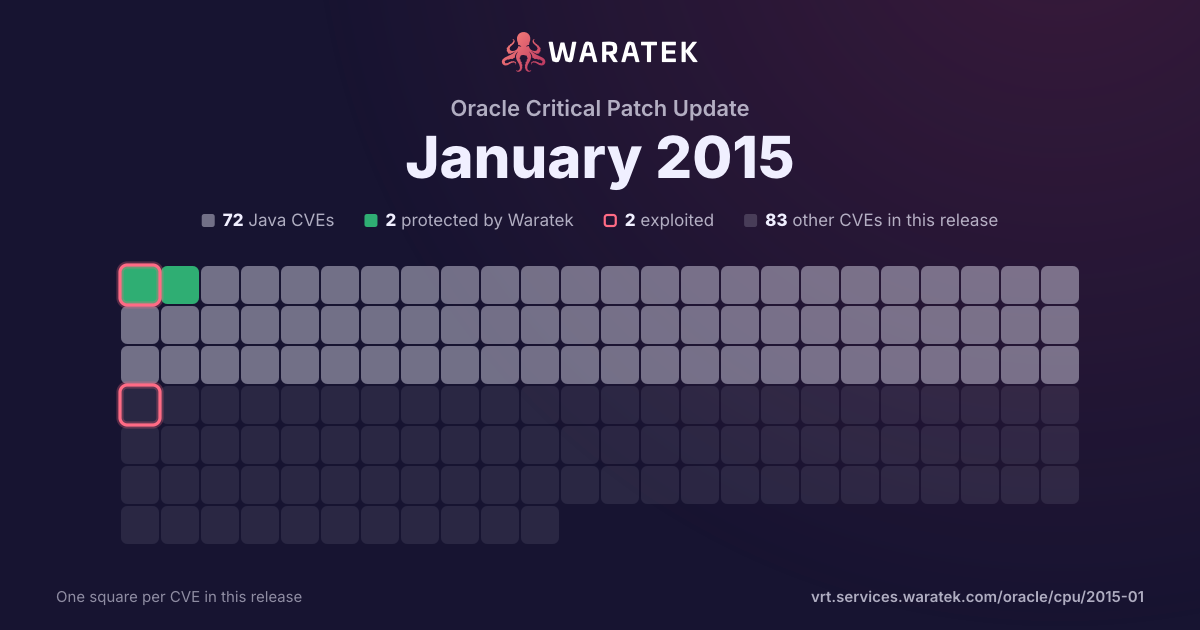
By status
2Protected by Waratek1Mitigation candidate69No exploit published32Outside Waratek scope51Not applicable
2Exploited, marked by the ring
No exploit published. For 67 of them, Oracle's security advisory is the source of public detail.
Protected by Waratek. Waratek RASP can block exploitation of these on systems that have not applied the patch yet.
Overview 6 matches · 0 in Waratek scope · 0 protected · 0 exploited · 0 CISA KEV · 5 EPSS ≥ 0.5
Protected by Waratek
0
0.0%
Rule in development
0
0.0%
Mitigation candidate
0
0.0%
No exploit published
0
0.0%
Outside Waratek scope
2
33.3%
Not applicable
4
66.7%
Withdrawn CVE
0
0.0%
blocked by ARMR today
0
0.0%
partly blocked
0
0.0%
not blocked
6
100.0%
not established
0
0.0%
unrecorded
0
0.0%
Exploited
0
0.0%
Working exploit published
6
100.0%
Proof of concept only
0
0.0%
Forecast only
0
0.0%
No public exploit
0
0.0%
split by
peak 2 / year
20031
Not applicable1
Medium1
not blocked1
Working exploit published1
20041
Not applicable1
Medium1
not blocked1
Working exploit published1
20050
20060
20070
20080
20090
20100
20112
Not applicable2
Medium2
not blocked2
Working exploit published2
20120
20130
20141
Outside Waratek scope1
Medium1
not blocked1
Working exploit published1
20151
Outside Waratek scope1
Medium1
not blocked1
Working exploit published1
2003200520072009201120132015
| CVE | Severity | Published▾ | Status | Exploitation | Description |
|---|---|---|---|---|---|
| CVE-2014-6593 | Medium | 2015-01-21 | Outside Waratek scope | Working exploit published | Unspecified vulnerability in Oracle Java SE 5.0u75, 6u85, 7u72, and 8u25; Java SE Embedded 7u71 and 8u6; and JRockit 27.8.4 and 28.3.4 allows remote attackers to affect confidentiality and integrity via vectors related to JSSE. |
| CVE-2014-0226 | Medium | 2014-07-20 | Outside Waratek scope | Working exploit published | Race condition in the mod_status module in the Apache HTTP Server before 2.4.10 allows remote attackers to cause a denial of service (heap-based buffer overflow), or possibly obtain sensitive credential information or execute arbitrary code, via a crafted request that triggers improper scoreboard handling within the status_handler function in modules/generators/mod_status.c and the lua_ap_scoreboard_worker function in modules/lua/lua_request.c. |
| CVE-2011-3607 | Medium | 2011-11-08 | Not applicable | Working exploit published | Integer overflow in the ap_pregsub function in server/util.c in the Apache HTTP Server 2.0.x through 2.0.64 and 2.2.x through 2.2.21, when the mod_setenvif module is enabled, allows local users to gain privileges via a .htaccess file with a crafted SetEnvIf directive, in conjunction with a crafted HTTP request header, leading to a heap-based buffer overflow. |
| CVE-2011-3368 | Medium | 2011-10-05 | Not applicable | Working exploit published | The mod_proxy module in the Apache HTTP Server 1.3.x through 1.3.42, 2.0.x through 2.0.64, and 2.2.x through 2.2.21 does not properly interact with use of (1) RewriteRule and (2) ProxyPassMatch pattern matches for configuration of a reverse proxy, which allows remote attackers to send requests to intranet servers via a malformed URI containing an initial @ (at sign) character. |
| CVE-2004-0230 | Medium | 2004-08-18 | Not applicable | Working exploit published | TCP, when using a large Window Size, makes it easier for remote attackers to guess sequence numbers and cause a denial of service (connection loss) to persistent TCP connections by repeatedly injecting a TCP RST packet, especially in protocols that use long-lived connections, such as BGP. |
| CVE-2003-0001 | Medium | 2003-01-17 | Not applicable | Working exploit published | Multiple ethernet Network Interface Card (NIC) device drivers do not pad frames with null bytes, which allows remote attackers to obtain information from previous packets or kernel memory by using malformed packets, as demonstrated by Etherleak. |