
Oracle Critical Patch Update January 2015
Released January 2015 · Oracle's advisory ↗ · ← Critical Patch Update, October 2014 · Critical Patch Update, April 2015 →
155 CVEs in this release, one square each
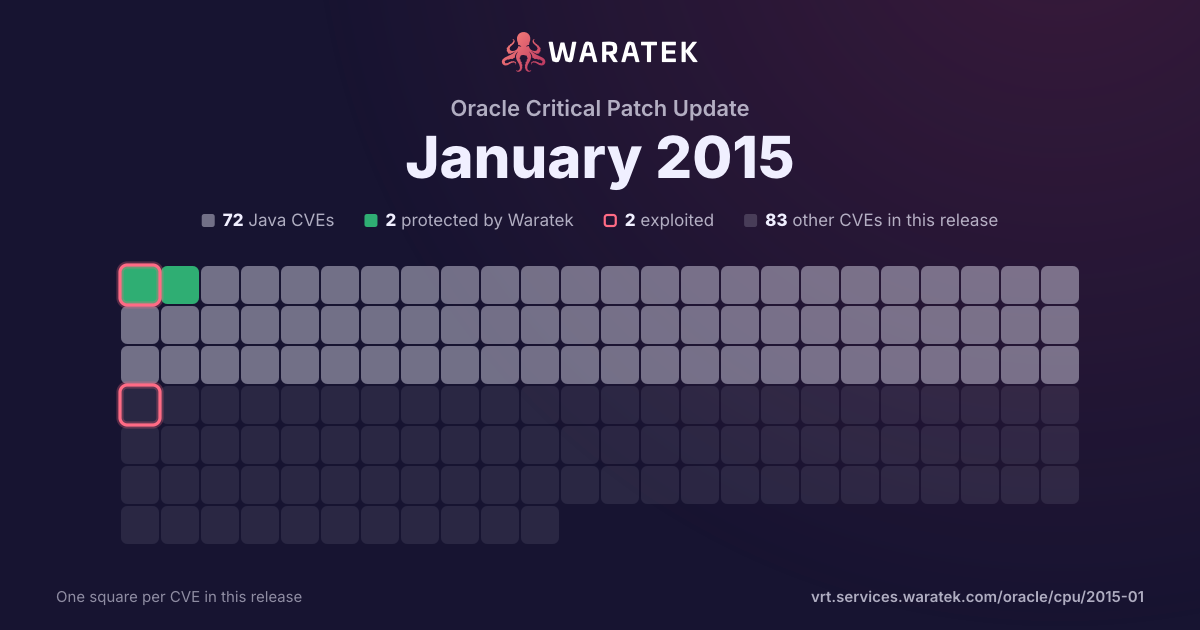
By status
2Protected by Waratek1Mitigation candidate69No exploit published32Outside Waratek scope51Not applicable
2Exploited, marked by the ring
No exploit published. For 67 of them, Oracle's security advisory is the source of public detail.
Protected by Waratek. Waratek RASP can block exploitation of these on systems that have not applied the patch yet.
Overview 44 matches · 0 in Waratek scope · 0 protected · 0 exploited · 0 CISA KEV · 0 public PoC · 0 EPSS ≥ 0.5
44matches
0in Waratek scope0.0%
0protected0.0%
0exploited0.0%
0CISA KEV0.0%
0public PoC0.0%
0EPSS ≥ 0.50.0%
Protected by Waratek
0
0.0%
Rule in development
0
0.0%
Mitigation candidate
0
0.0%
No exploit published
0
0.0%
Outside Waratek scope
0
0.0%
Not applicable
44
100.0%
Withdrawn CVE
0
0.0%
blocked by ARMR today
0
0.0%
partly blocked
0
0.0%
not blocked
44
100.0%
not established
0
0.0%
unrecorded
0
0.0%
Exploited
0
0.0%
Working exploit published
0
0.0%
Proof of concept only
0
0.0%
Forecast only
0
0.0%
No public exploit
44
100.0%
split by
peak 32 / quarter
Q1 132
Not applicable2
High1
Medium1
not blocked2
No public exploit2
Q2 131
Not applicable1
Medium1
not blocked1
No public exploit1
Q3 132
Not applicable2
High1
Medium1
not blocked2
No public exploit2
Q4 132
Not applicable2
High1
Medium1
not blocked2
No public exploit2
Q1 143
Not applicable3
Medium3
not blocked3
No public exploit3
Q2 140
Q3 141
Not applicable1
High1
not blocked1
No public exploit1
Q4 141
Not applicable1
High1
not blocked1
No public exploit1
Q1 1532
Not applicable32
High5
Medium14
Low13
not blocked32
No public exploit32
Q1 13Q2 13Q3 13Q4 13Q1 14Q2 14Q3 14Q4 14Q1 15
| CVE | Severity | Published▾ | Status | Exploitation | Description |
|---|---|---|---|---|---|
| CVE-2015-0432 | Medium | 2015-01-21 | Not applicable | No public exploit | Unspecified vulnerability in Oracle MySQL Server 5.5.40 and earlier allows remote authenticated users to affect availability via vectors related to Server : InnoDB : DDL : Foreign Key. |
| CVE-2015-0430 | Low | 2015-01-21 | Not applicable | No public exploit | Unspecified vulnerability in Oracle Sun Solaris 10 and 11 allows local users to affect confidentiality via vectors related to RPC Utility. |
| CVE-2015-0429 | Low | 2015-01-21 | Not applicable | No public exploit | Unspecified vulnerability in Oracle Sun Solaris 10 and 11 allows local users to affect integrity and availability via vectors related to RPC Utility. |
| CVE-2015-0428 | Medium | 2015-01-21 | Not applicable | No public exploit | Unspecified vulnerability in Oracle Sun Solaris 10 and 11 allows local users to affect availability via unknown vectors related to Resource Control. |
| CVE-2015-0427 | Low | 2015-01-21 | Not applicable | No public exploit | Unspecified vulnerability in the Oracle VM VirtualBox component in Oracle Virtualization VirtualBox prior to 4.3.20 allows local users to affect integrity and availability via vectors related to VMSVGA virtual graphics device, a different vulnerability than CVE-2014-6588, CVE-2014-6589, CVE-2014-6590, and CVE-2014-6595. |
| CVE-2015-0424 | High | 2015-01-21 | Not applicable | No public exploit | Unspecified vulnerability in the Integrated Lights Out Manager (ILOM) component in Oracle Sun Systems Products Suite ILOM prior to 3.2.4 allows remote authenticated users to affect confidentiality, integrity, and availability via vectors related to IPMI. |
| CVE-2015-0418 | Low | 2015-01-21 | Not applicable | No public exploit | Unspecified vulnerability in the Oracle VM VirtualBox component in Oracle Virtualization VirtualBox prior to 3.2.26, 4.0.28, 4.1.36, and 4.2.28 allows local users to affect availability via unknown vectors related to Core, a different vulnerability than CVE-2015-0377. |
| CVE-2015-0397 | Low | 2015-01-21 | Not applicable | No public exploit | Unspecified vulnerability in Oracle Sun Solaris 11 allows local users to affect availability via unknown vectors related to File System, a different vulnerability than CVE-2014-6570 and CVE-2014-6600. |
| CVE-2015-0391 | Medium | 2015-01-21 | Not applicable | No public exploit | Unspecified vulnerability in Oracle MySQL Server 5.5.38 and earlier, and 5.6.19 and earlier, allows remote authenticated users to affect availability via vectors related to DDL. |
| CVE-2015-0385 | Low | 2015-01-21 | Not applicable | No public exploit | Unspecified vulnerability in Oracle MySQL Server 5.6.21 and earlier allows remote authenticated users to affect availability via unknown vectors related to Pluggable Auth. |
| CVE-2015-0378 | Low | 2015-01-21 | Not applicable | No public exploit | Unspecified vulnerability in Oracle Sun Solaris 11 allows local users to affect availability via unknown vectors related to Libc. |
| CVE-2015-0377 | Medium | 2015-01-21 | Not applicable | No public exploit | Unspecified vulnerability in the Oracle VM VirtualBox component in Oracle Virtualization VirtualBox prior to 3.2.26, 4.0.28, 4.1.36, and 4.2.28 allows local users to affect availability via unknown vectors related to Core, a different vulnerability than CVE-2015-0418. |
| CVE-2015-0375 | Medium | 2015-01-21 | Not applicable | No public exploit | Unspecified vulnerability in Oracle Sun Solaris 10 and 11 allows remote attackers to affect confidentiality via unknown vectors related to Network. |
| CVE-2015-0374 | Low | 2015-01-21 | Not applicable | No public exploit | Unspecified vulnerability in Oracle MySQL Server 5.5.40 and earlier and 5.6.21 and earlier allows remote authenticated users to affect confidentiality via unknown vectors related to Server : Security : Privileges : Foreign Key. |
| CVE-2014-6600 | Medium | 2015-01-21 | Not applicable | No public exploit | Unspecified vulnerability in Oracle Sun Solaris 11 allows local users to affect availability via unknown vectors related to File System, a different vulnerability than CVE-2014-6570 and CVE-2015-0397. |
| CVE-2014-6595 | Low | 2015-01-21 | Not applicable | No public exploit | Unspecified vulnerability in the Oracle VM VirtualBox component in Oracle Virtualization VirtualBox before 4.3.20 allows local users to affect integrity and availability via vectors related to VMSVGA virtual graphics device, a different vulnerability than CVE-2014-6588, CVE-2014-6589, CVE-2014-6590, and CVE-2015-0427. |
| CVE-2014-6590 | Low | 2015-01-21 | Not applicable | No public exploit | Unspecified vulnerability in the Oracle VM VirtualBox component in Oracle Virtualization VirtualBox before 4.3.20 allows local users to affect integrity and availability via vectors related to VMSVGA virtual graphics device, a different vulnerability than CVE-2014-6588, CVE-2014-6589, CVE-2014-6595, and CVE-2015-0427. |
| CVE-2014-6589 | Low | 2015-01-21 | Not applicable | No public exploit | Unspecified vulnerability in the Oracle VM VirtualBox component in Oracle Virtualization VirtualBox before 4.3.20 allows local users to affect integrity and availability via vectors related to VMSVGA virtual graphics device, a different vulnerability than CVE-2014-6588, CVE-2014-6590, CVE-2014-6595, and CVE-2015-0427. |
| CVE-2014-6588 | Low | 2015-01-21 | Not applicable | No public exploit | Unspecified vulnerability in the Oracle VM VirtualBox component in Oracle Virtualization VirtualBox before 4.3.20 allows local users to affect integrity and availability via vectors related to VMSVGA virtual graphics device, a different vulnerability than CVE-2014-6589, CVE-2014-6590, CVE-2014-6595, and CVE-2015-0427. |
| CVE-2014-6584 | Medium | 2015-01-21 | Not applicable | No public exploit | Unspecified vulnerability in the Integrated Lights Out Manager (ILOM) component in Oracle Sun Systems Products Suite ILOM before 3.2.4 allows remote authenticated users to affect confidentiality via unknown vectors related to Backup Restore. |
| CVE-2014-6575 | Medium | 2015-01-21 | Not applicable | No public exploit | Unspecified vulnerability in Oracle Sun Solaris 10 and 11 allows remote attackers to affect availability via unknown vectors related to Network, a different vulnerability than CVE-2004-0230. |
| CVE-2014-6570 | Medium | 2015-01-21 | Not applicable | No public exploit | Unspecified vulnerability in Oracle Sun Solaris 11 allows local users to affect availability via unknown vectors related to File System, a different vulnerability than CVE-2014-6600 and CVE-2015-0397. |
| CVE-2014-6568 | Low | 2015-01-21 | Not applicable | No public exploit | Unspecified vulnerability in Oracle MySQL Server 5.5.40 and earlier, and 5.6.21 and earlier, allows remote authenticated users to affect availability via vectors related to Server : InnoDB : DML. |
| CVE-2014-6524 | High | 2015-01-21 | Not applicable | No public exploit | Unspecified vulnerability in Oracle Solaris 10 allows local users to affect confidentiality, integrity, and availability via unknown vectors related to Kernel. |
| CVE-2014-6521 | High | 2015-01-21 | Not applicable | No public exploit | Unspecified vulnerability in Oracle Solaris 10 allows local users to affect confidentiality, integrity, and availability via vectors related to CDE - Power Management Utility. |
| CVE-2014-6518 | Medium | 2015-01-21 | Not applicable | No public exploit | Unspecified vulnerability in Oracle Solaris 10 and 11 allows local users to affect integrity and availability via vectors related to Unix File System (UFS). |
| CVE-2014-6510 | High | 2015-01-21 | Not applicable | No public exploit | Unspecified vulnerability in Oracle Solaris 11 allows local users to affect confidentiality, integrity, and availability via unknown vectors related to Power Management Utility. |
| CVE-2014-6509 | Medium | 2015-01-21 | Not applicable | No public exploit | Unspecified vulnerability in Oracle Solaris 10 allows local users to affect availability via unknown vectors related to Kernel. |
| CVE-2014-6481 | Medium | 2015-01-21 | Not applicable | No public exploit | Unspecified vulnerability in Oracle Solaris 10 and 11 allows remote attackers to affect confidentiality via vectors related to KSSL. |
| CVE-2014-6480 | Medium | 2015-01-21 | Not applicable | No public exploit | Unspecified vulnerability in the Solaris Cluster component in Oracle Sun Systems Products Suite 3.3 and 4.1 allows local users to affect confidentiality, integrity, and availability via unknown vectors related to System management. |
| CVE-2014-4259 | High | 2015-01-21 | Not applicable | No public exploit | Unspecified vulnerability in the Solaris Cluster component in Oracle Sun Systems Products Suite 3.3 and 4.1 allows remote authenticated users to affect confidentiality, integrity, and availability via unknown vectors related to System management. |
| CVE-2014-0191 | Medium | 2015-01-21 | Not applicable | No public exploit | The xmlParserHandlePEReference function in parser.c in libxml2 before 2.9.2, as used in Web Listener in Oracle HTTP Server in Oracle Fusion Middleware 11.1.1.7.0, 12.1.2.0, and 12.1.3.0 and other products, loads external parameter entities regardless of whether entity substitution or validation is enabled, which allows remote attackers to cause a denial of service (resource consumption) via a crafted XML document. |
| CVE-2014-3567 | High | 2014-10-19 | Not applicable | No public exploit | Memory leak in the tls_decrypt_ticket function in t1_lib.c in OpenSSL before 0.9.8zc, 1.0.0 before 1.0.0o, and 1.0.1 before 1.0.1j allows remote attackers to cause a denial of service (memory consumption) via a crafted session ticket that triggers an integrity-check failure. |
| CVE-2014-1568 | High | 2014-09-25 | Not applicable | No public exploit | Mozilla Network Security Services (NSS) before 3.16.2.1, 3.16.x before 3.16.5, and 3.17.x before 3.17.1, as used in Mozilla Firefox before 32.0.3, Mozilla Firefox ESR 24.x before 24.8.1 and 31.x before 31.1.1, Mozilla Thunderbird before 24.8.1 and 31.x before 31.1.2, Mozilla SeaMonkey before 2.29.1, Google Chrome before 37.0.2062.124 on Windows and OS X, and Google Chrome OS before 37.0.2062.120, does not properly parse ASN.1 values in X.509 certificates, which makes it easier for remote attackers to spoof RSA signatures via a crafted certificate, aka a "signature malleability" issue. |
| CVE-2014-0098 | Medium | 2014-03-18 | Not applicable | No public exploit | The log_cookie function in mod_log_config.c in the mod_log_config module in the Apache HTTP Server before 2.4.8 allows remote attackers to cause a denial of service (segmentation fault and daemon crash) via a crafted cookie that is not properly handled during truncation. |
| CVE-2013-6438 | Medium | 2014-03-18 | Not applicable | No public exploit | The dav_xml_get_cdata function in main/util.c in the mod_dav module in the Apache HTTP Server before 2.4.8 does not properly remove whitespace characters from CDATA sections, which allows remote attackers to cause a denial of service (daemon crash) via a crafted DAV WRITE request. |
| CVE-2013-6450 | Medium | 2014-01-01 | Not applicable | No public exploit | The DTLS retransmission implementation in OpenSSL 1.0.0 before 1.0.0l and 1.0.1 before 1.0.1f does not properly maintain data structures for digest and encryption contexts, which might allow man-in-the-middle attackers to trigger the use of a different context and cause a denial of service (application crash) by interfering with packet delivery, related to ssl/d1_both.c and ssl/t1_enc.c. |
| CVE-2013-4545 | Medium | 2013-11-23 | Not applicable | No public exploit | cURL and libcurl 7.18.0 through 7.32.0, when built with OpenSSL, disables the certificate CN and SAN name field verification (CURLOPT_SSL_VERIFYHOST) when the digital signature verification (CURLOPT_SSL_VERIFYPEER) is disabled, which allows man-in-the-middle attackers to spoof SSL servers via an arbitrary valid certificate. |
| CVE-2013-1741 | High | 2013-11-18 | Not applicable | No public exploit | Integer overflow in Mozilla Network Security Services (NSS) 3.15 before 3.15.3 allows remote attackers to cause a denial of service or possibly have unspecified other impact via a large size value. |
| CVE-2013-2877 | Medium | 2013-07-10 | Not applicable | No public exploit | parser.c in libxml2 before 2.9.0, as used in Google Chrome before 28.0.1500.71 and other products, allows remote attackers to cause a denial of service (out-of-bounds read) via a document that ends abruptly, related to the lack of certain checks for the XML_PARSER_EOF state. |
| CVE-2013-4784 | High | 2013-07-08 | Not applicable | No public exploit | The HP Integrated Lights-Out (iLO) BMC implementation allows remote attackers to bypass authentication and execute arbitrary IPMI commands by using cipher suite 0 (aka cipher zero) and an arbitrary password. |
| CVE-2013-0338 | Medium | 2013-04-25 | Not applicable | No public exploit | libxml2 2.9.0 and earlier allows context-dependent attackers to cause a denial of service (CPU and memory consumption) via an XML file containing an entity declaration with long replacement text and many references to this entity, aka "internal entity expansion" with linear complexity. |
| CVE-2010-5107 | High | 2013-03-07 | Not applicable | No public exploit | The default configuration of OpenSSH through 6.1 enforces a fixed time limit between establishing a TCP connection and completing a login, which makes it easier for remote attackers to cause a denial of service (connection-slot exhaustion) by periodically making many new TCP connections. |
| CVE-2013-1620 | Medium | 2013-02-08 | Not applicable | No public exploit | The TLS implementation in Mozilla Network Security Services (NSS) does not properly consider timing side-channel attacks on a noncompliant MAC check operation during the processing of malformed CBC padding, which allows remote attackers to conduct distinguishing attacks and plaintext-recovery attacks via statistical analysis of timing data for crafted packets, a related issue to CVE-2013-0169. |