
Oracle Critical Patch Update January 2015
Released January 2015 · Oracle's advisory ↗ · ← Critical Patch Update, October 2014 · Critical Patch Update, April 2015 →
155 CVEs in this release, one square each
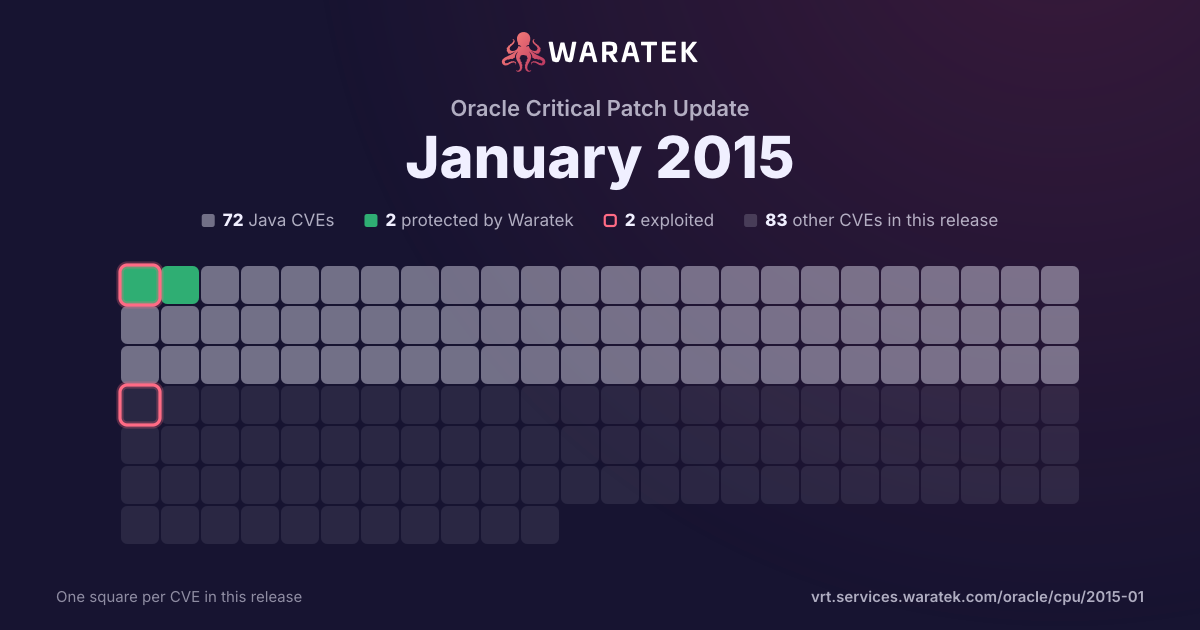
By status
2Protected by Waratek1Mitigation candidate69No exploit published32Outside Waratek scope51Not applicable
2Exploited, marked by the ring
No exploit published. For 67 of them, Oracle's security advisory is the source of public detail.
Protected by Waratek. Waratek RASP can block exploitation of these on systems that have not applied the patch yet.
Overview 25 matches · 5 in Waratek scope · 2 protected · 2 exploited · 0 CISA KEV · 5 public PoC · 2 EPSS ≥ 0.5
25matches
5in Waratek scope20.0%
2protected8.0%
2exploited8.0%
0CISA KEV0.0%
5public PoC20.0%
2EPSS ≥ 0.58.0%
Protected by Waratek
2
8.0%
Rule in development
0
0.0%
Mitigation candidate
1
4.0%
No exploit published
2
8.0%
Outside Waratek scope
9
36.0%
Not applicable
11
44.0%
Withdrawn CVE
0
0.0%
blocked by ARMR today
2
8.0%
partly blocked
0
0.0%
not blocked
23
92.0%
not established
0
0.0%
unrecorded
0
0.0%
split by
peak 16 / quarter
Q3 111
Not applicable1
High1
not blocked1
Working exploit published1
Q4 110
Q1 120
Q2 120
Q3 120
Q4 120
Q1 131
Not applicable1
High1
not blocked1
No public exploit1
Q2 130
Q3 131
Not applicable1
High1
not blocked1
No public exploit1
Q4 132
Protected by Waratek1
Not applicable1
High2
blocked by ARMR today1
not blocked1
Proof of concept only1
No public exploit1
Q1 140
Q2 142
Protected by Waratek1
Outside Waratek scope1
High2
blocked by ARMR today1
not blocked1
Exploited2
Q3 141
Not applicable1
High1
not blocked1
No public exploit1
Q4 141
Not applicable1
High1
not blocked1
No public exploit1
Q1 1516
Mitigation candidate1
No exploit published2
Outside Waratek scope8
Not applicable5
High16
not blocked16
Proof of concept only1
No public exploit15
Q3 11Q1 12Q3 12Q1 13Q3 13Q1 14Q3 14Q1 15
| CVE | Severity | Published▾ | Status | Exploitation | Description |
|---|---|---|---|---|---|
| CVE-2015-0437 | High | 2015-01-21 | Outside Waratek scope | No public exploit | Unspecified vulnerability in Oracle Java SE 8u25 allows remote attackers to affect confidentiality, integrity, and availability via unknown vectors related to Hotspot. |
| CVE-2015-0424 | High | 2015-01-21 | Not applicable | No public exploit | Unspecified vulnerability in the Integrated Lights Out Manager (ILOM) component in Oracle Sun Systems Products Suite ILOM prior to 3.2.4 allows remote authenticated users to affect confidentiality, integrity, and availability via vectors related to IPMI. |
| CVE-2015-0412 | High | 2015-01-21 | Outside Waratek scope | No public exploit | Unspecified vulnerability in Oracle Java SE 6u85, 7u72, and 8u25 allows remote attackers to affect confidentiality, integrity, and availability via vectors related to JAX-WS. |
| CVE-2015-0411 | High | 2015-01-21 | Outside Waratek scope | No public exploit | Unspecified vulnerability in Oracle MySQL Server 5.5.40 and earlier, and 5.6.21 and earlier, allows remote attackers to affect confidentiality, integrity, and availability via unknown vectors related to Server : Security : Encryption. |
| CVE-2015-0408 | High | 2015-01-21 | Outside Waratek scope | No public exploit | Unspecified vulnerability in Oracle Java SE 5.0u75, 6u85, 7u72, and 8u25 allows remote attackers to affect confidentiality, integrity, and availability via vectors related to RMI. |
| CVE-2015-0396 | High | 2015-01-21 | No exploit published | No public exploit | Unspecified vulnerability in the Oracle GlassFish Server component in Oracle Fusion Middleware 3.0.1 and 3.1.2 allows remote attackers to affect confidentiality, integrity, and availability via unknown vectors related to Admin Console. |
| CVE-2015-0395 | High | 2015-01-21 | Outside Waratek scope | No public exploit | Unspecified vulnerability in Oracle Java SE 5.0u75, 6u85, 7u72, and 8u25 allows remote attackers to affect confidentiality, integrity, and availability via unknown vectors related to Hotspot. |
| CVE-2014-6601 | High | 2015-01-21 | Outside Waratek scope | No public exploit | Unspecified vulnerability in Oracle Java SE 6u85, 7u72, and 8u25 allows remote attackers to affect confidentiality, integrity, and availability via unknown vectors related to Hotspot. |
| CVE-2014-6598 | High | 2015-01-21 | Mitigation candidate | Proof of concept only | Unspecified vulnerability in the Oracle Communications Diameter Signaling Router component in Oracle Communications Applications 3.x, 4.x, and 5.0 allows remote attackers to affect confidentiality, integrity, and availability via vectors related to Signaling - DPI. |
| CVE-2014-6567 | High | 2015-01-21 | Outside Waratek scope | No public exploit | Unspecified vulnerability in the Core RDBMS component in Oracle Database Server 11.1.0.7, 11.2.0.3, 11.2.0.4, 12.1.0.1, and 12.1.0.2 allows remote authenticated users to affect confidentiality, integrity, and availability via unknown vectors. NOTE: the previous information is from the January 2015 CPU. Oracle has not commented on the researcher's claim that this is a stack-based buffer overflow in DBMS_AW.EXECUTE, which allows code execution via a long Current Directory Alias (CDA) command. |
| CVE-2014-6565 | High | 2015-01-21 | No exploit published | No public exploit | Unspecified vulnerability in the JD Edwards EnterpriseOne Tools component in Oracle JD Edwards Products 9.1.5 allows remote attackers to affect confidentiality, integrity, and availability via vectors related to Portal SEC. |
| CVE-2014-6549 | High | 2015-01-21 | Outside Waratek scope | No public exploit | Unspecified vulnerability in Oracle Java SE 8u25 allows remote attackers to affect confidentiality, integrity, and availability via unknown vectors related to Libraries. |
| CVE-2014-6524 | High | 2015-01-21 | Not applicable | No public exploit | Unspecified vulnerability in Oracle Solaris 10 allows local users to affect confidentiality, integrity, and availability via unknown vectors related to Kernel. |
| CVE-2014-6521 | High | 2015-01-21 | Not applicable | No public exploit | Unspecified vulnerability in Oracle Solaris 10 allows local users to affect confidentiality, integrity, and availability via vectors related to CDE - Power Management Utility. |
| CVE-2014-6510 | High | 2015-01-21 | Not applicable | No public exploit | Unspecified vulnerability in Oracle Solaris 11 allows local users to affect confidentiality, integrity, and availability via unknown vectors related to Power Management Utility. |
| CVE-2014-4259 | High | 2015-01-21 | Not applicable | No public exploit | Unspecified vulnerability in the Solaris Cluster component in Oracle Sun Systems Products Suite 3.3 and 4.1 allows remote authenticated users to affect confidentiality, integrity, and availability via unknown vectors related to System management. |
| CVE-2014-3567 | High | 2014-10-19 | Not applicable | No public exploit | Memory leak in the tls_decrypt_ticket function in t1_lib.c in OpenSSL before 0.9.8zc, 1.0.0 before 1.0.0o, and 1.0.1 before 1.0.1j allows remote attackers to cause a denial of service (memory consumption) via a crafted session ticket that triggers an integrity-check failure. |
| CVE-2014-1568 | High | 2014-09-25 | Not applicable | No public exploit | Mozilla Network Security Services (NSS) before 3.16.2.1, 3.16.x before 3.16.5, and 3.17.x before 3.17.1, as used in Mozilla Firefox before 32.0.3, Mozilla Firefox ESR 24.x before 24.8.1 and 31.x before 31.1.1, Mozilla Thunderbird before 24.8.1 and 31.x before 31.1.2, Mozilla SeaMonkey before 2.29.1, Google Chrome before 37.0.2062.124 on Windows and OS X, and Google Chrome OS before 37.0.2062.120, does not properly parse ASN.1 values in X.509 certificates, which makes it easier for remote attackers to spoof RSA signatures via a crafted certificate, aka a "signature malleability" issue. |
| CVE-2014-0224 | High | 2014-06-05 | Outside Waratek scope | Exploited | OpenSSL before 0.9.8za, 1.0.0 before 1.0.0m, and 1.0.1 before 1.0.1h does not properly restrict processing of ChangeCipherSpec messages, which allows man-in-the-middle attackers to trigger use of a zero-length master key in certain OpenSSL-to-OpenSSL communications, and consequently hijack sessions or obtain sensitive information, via a crafted TLS handshake, aka the "CCS Injection" vulnerability. |
| CVE-2014-0114 | High | 2014-04-30 | Protected by Waratek | Exploited | Apache Commons BeanUtils, as distributed in lib/commons-beanutils-1.8.0.jar in Apache Struts 1.x through 1.3.10 and in other products requiring commons-beanutils through 1.9.2, does not suppress the class property, which allows remote attackers to "manipulate" the ClassLoader and execute arbitrary code via the class parameter, as demonstrated by the passing of this parameter to the getClass method of the ActionForm object in Struts 1. |
| CVE-2013-1741 | High | 2013-11-18 | Not applicable | No public exploit | Integer overflow in Mozilla Network Security Services (NSS) 3.15 before 3.15.3 allows remote attackers to cause a denial of service or possibly have unspecified other impact via a large size value. |
| CVE-2013-2186 | High | 2013-10-28 | Protected by Waratek | Proof of concept only | The DiskFileItem class in Apache Commons FileUpload, as used in Red Hat JBoss BRMS 5.3.1; JBoss Portal 4.3 CP07, 5.2.2, and 6.0.0; and Red Hat JBoss Web Server 1.0.2 allows remote attackers to write to arbitrary files via a NULL byte in a file name in a serialized instance. |
| CVE-2013-4784 | High | 2013-07-08 | Not applicable | No public exploit | The HP Integrated Lights-Out (iLO) BMC implementation allows remote attackers to bypass authentication and execute arbitrary IPMI commands by using cipher suite 0 (aka cipher zero) and an arbitrary password. |
| CVE-2010-5107 | High | 2013-03-07 | Not applicable | No public exploit | The default configuration of OpenSSH through 6.1 enforces a fixed time limit between establishing a TCP connection and completing a login, which makes it easier for remote attackers to cause a denial of service (connection-slot exhaustion) by periodically making many new TCP connections. |
| CVE-2011-1944 | High | 2011-09-02 | Not applicable | Working exploit published | Integer overflow in xpath.c in libxml2 2.6.x through 2.6.32 and 2.7.x through 2.7.8, and libxml 1.8.16 and earlier, allows context-dependent attackers to cause a denial of service (crash) and possibly execute arbitrary code via a crafted XML file that triggers a heap-based buffer overflow when adding a new namespace node, related to handling of XPath expressions. |