
Oracle Critical Patch Update October 2014
Released October 2014 · Oracle's advisory ↗ · ← Critical Patch Update, July 2014 · Critical Patch Update, January 2015 →
137 CVEs in this release, one square each
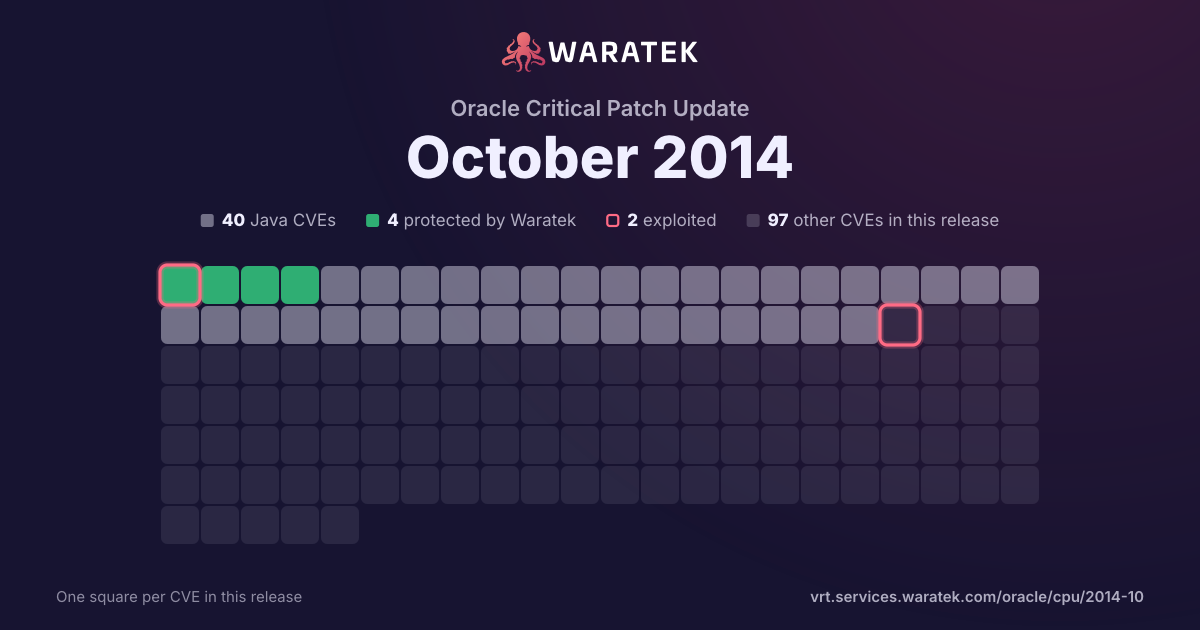
By status
4Protected by Waratek1Mitigation candidate35No exploit published60Outside Waratek scope37Not applicable
2Exploited, marked by the ring
No exploit published. For 32 of them, Oracle's security advisory is the source of public detail.
Protected by Waratek. Waratek RASP can block exploitation of these on systems that have not applied the patch yet.
Overview 135 matches · 40 in Waratek scope · 4 protected · 2 exploited · 0 CISA KEV · 4 public PoC · 3 EPSS ≥ 0.5
135matches
40in Waratek scope29.6%
4protected3.0%
2exploited1.5%
0CISA KEV0.0%
4public PoC3.0%
3EPSS ≥ 0.52.2%
Protected by Waratek
4
3.0%
Rule in development
0
0.0%
Mitigation candidate
1
0.7%
No exploit published
35
25.9%
Outside Waratek scope
60
44.4%
Not applicable
35
25.9%
Withdrawn CVE
0
0.0%
blocked by ARMR today
4
3.0%
partly blocked
0
0.0%
not blocked
131
97.0%
not established
0
0.0%
unrecorded
0
0.0%
Exploited
2
1.5%
Working exploit published
2
1.5%
Proof of concept only
0
0.0%
Forecast only
0
0.0%
No public exploit
131
97.0%
split by
peak 129 / month
Apr 143
Protected by Waratek2
Mitigation candidate1
High2
Medium1
blocked by ARMR today2
not blocked1
Exploited1
Working exploit published2
May 141
Protected by Waratek1
Medium1
blocked by ARMR today1
No public exploit1
Jun 141
Outside Waratek scope1
High1
not blocked1
Exploited1
Jul 140
Aug 140
Sep 140
Oct 14129
Protected by Waratek1
No exploit published35
Outside Waratek scope58
Not applicable35
High22
Medium91
Low16
blocked by ARMR today1
not blocked128
No public exploit129
Nov 141
Outside Waratek scope1
Medium1
not blocked1
No public exploit1
Apr 14May 14Jun 14Jul 14Aug 14Sep 14Oct 14Nov 14
| CVE | Severity | Published▾ | Status | Exploitation | Description |
|---|---|---|---|---|---|
| CVE-2014-4299 | Medium | 2014-10-15 | Outside Waratek scope | No public exploit | Unspecified vulnerability in the SQLJ component in Oracle Database Server 11.1.0.7, 11.2.0.3, 11.2.0.4, 12.1.0.1, and 12.1.0.2 allows remote authenticated users to affect confidentiality via unknown vectors, a different vulnerability than CVE-2014-4298, CVE-2014-4300, CVE-2014-6452, CVE-2014-6454, and CVE-2014-6542. |
| CVE-2014-4298 | Medium | 2014-10-15 | Outside Waratek scope | No public exploit | Unspecified vulnerability in the SQLJ component in Oracle Database Server 11.1.0.7, 11.2.0.3, 11.2.0.4, 12.1.0.1, and 12.1.0.2 allows remote authenticated users to affect confidentiality via unknown vectors, a different vulnerability than CVE-2014-4299, CVE-2014-4300, CVE-2014-6452, CVE-2014-6454, and CVE-2014-6542. |
| CVE-2014-4297 | Medium | 2014-10-15 | Outside Waratek scope | No public exploit | Unspecified vulnerability in the JPublisher component in Oracle Database Server 11.1.0.7, 11.2.0.3, 11.2.0.4, 12.1.0.1, and 12.1.0.2 allows remote authenticated users to affect confidentiality via unknown vectors, a different vulnerability than CVE-2014-4290, CVE-2014-4291, CVE-2014-4292, CVE-2014-4293, CVE-2014-4296, CVE-2014-4310, CVE-2014-6547, and CVE-2014-6477. |
| CVE-2014-4296 | Medium | 2014-10-15 | Outside Waratek scope | No public exploit | Unspecified vulnerability in the JPublisher component in Oracle Database Server 11.1.0.7, 11.2.0.3, 11.2.0.4, 12.1.0.1, and 12.1.0.2 allows remote authenticated users to affect confidentiality via unknown vectors, a different vulnerability than CVE-2014-4290, CVE-2014-4291, CVE-2014-4292, CVE-2014-4293, CVE-2014-4297, CVE-2014-4310, CVE-2014-6547, and CVE-2014-6477. |
| CVE-2014-4295 | Medium | 2014-10-15 | Outside Waratek scope | No public exploit | Unspecified vulnerability in the Java VM component in Oracle Database Server 11.1.0.7, 11.2.0.3, 11.2.0.4, 12.1.0.1, and 12.1.0.2 allows remote authenticated users to affect confidentiality via unknown vectors, a different vulnerability than CVE-2014-4294, CVE-2014-6538, and CVE-2014-6563. |
| CVE-2014-4294 | Medium | 2014-10-15 | Outside Waratek scope | No public exploit | Unspecified vulnerability in the Java VM component in Oracle Database Server 11.1.0.7, 11.2.0.3, 11.2.0.4, 12.1.0.1, and 12.1.0.2 allows remote authenticated users to affect confidentiality via unknown vectors, a different vulnerability than CVE-2014-4295, CVE-2014-6538, and CVE-2014-6563. |
| CVE-2014-4293 | Medium | 2014-10-15 | Outside Waratek scope | No public exploit | Unspecified vulnerability in the JPublisher component in Oracle Database Server 11.1.0.7, 11.2.0.3, 11.2.0.4, 12.1.0.1, and 12.1.0.2 allows remote authenticated users to affect confidentiality via unknown vectors, a different vulnerability than CVE-2014-4290, CVE-2014-4291, CVE-2014-4292, CVE-2014-4296, CVE-2014-4297, CVE-2014-4310, CVE-2014-6547, and CVE-2014-6477. |
| CVE-2014-4292 | Medium | 2014-10-15 | Outside Waratek scope | No public exploit | Unspecified vulnerability in the JPublisher component in Oracle Database Server 11.1.0.7, 11.2.0.3, 11.2.0.4, 12.1.0.1, and 12.1.0.2 allows remote authenticated users to affect confidentiality via unknown vectors, a different vulnerability than CVE-2014-4290, CVE-2014-4291, CVE-2014-4293, CVE-2014-4296, CVE-2014-4297, CVE-2014-4310, CVE-2014-6547, and CVE-2014-6477. |
| CVE-2014-4291 | Medium | 2014-10-15 | Outside Waratek scope | No public exploit | Unspecified vulnerability in the JPublisher component in Oracle Database Server 11.1.0.7, 11.2.0.3, 11.2.0.4, 12.1.0.1, and 12.1.0.2 allows remote authenticated users to affect confidentiality via unknown vectors, a different vulnerability than CVE-2014-4290, CVE-2014-4292, CVE-2014-4293, CVE-2014-4296, CVE-2014-4297, CVE-2014-4310, CVE-2014-6547, and CVE-2014-6477. |
| CVE-2014-4290 | Medium | 2014-10-15 | Outside Waratek scope | No public exploit | Unspecified vulnerability in the JPublisher component in Oracle Database Server 11.1.0.7, 11.2.0.3, 11.2.0.4, 12.1.0.1, and 12.1.0.2 allows remote authenticated users to affect confidentiality via unknown vectors, a different vulnerability than CVE-2014-4291, CVE-2014-4292, CVE-2014-4293, CVE-2014-4296, CVE-2014-4297, CVE-2014-4310, CVE-2014-6547, and CVE-2014-6477. |
| CVE-2014-4289 | Low | 2014-10-15 | Outside Waratek scope | No public exploit | Unspecified vulnerability in the JDBC component in Oracle Database Server 11.1.0.7, 11.2.0.3, 11.2.0.4, and 12.1.0.1 allows remote authenticated users to affect confidentiality and integrity via unknown vectors, a different vulnerability than CVE-2014-6544. |
| CVE-2014-4288 | High | 2014-10-15 | Outside Waratek scope | No public exploit | Unspecified vulnerability in Oracle Java SE 6u81, 7u67, and 8u20 allows remote attackers to affect confidentiality, integrity, and availability via unknown vectors related to Deployment, a different vulnerability than CVE-2014-6493, CVE-2014-6503, and CVE-2014-6532. |
| CVE-2014-4287 | Medium | 2014-10-15 | Not applicable | No public exploit | Unspecified vulnerability in Oracle MySQL Server 5.5.38 and earlier and 5.6.19 and earlier allows remote authenticated users to affect availability via vectors related to SERVER:CHARACTER SETS. |
| CVE-2014-4285 | Medium | 2014-10-15 | No exploit published | No public exploit | Unspecified vulnerability in the Oracle Applications Technology component in Oracle E-Business Suite 11.5.10.2 allows remote attackers to affect integrity via unknown vectors related to Reports Configuration. |
| CVE-2014-4284 | Medium | 2014-10-15 | Not applicable | No public exploit | Unspecified vulnerability in Oracle Sun Solaris 11 allows local users to affect confidentiality, integrity, and availability via vectors related to IPS transfer module, a different vulnerability than CVE-2014-4280. |
| CVE-2014-4283 | Medium | 2014-10-15 | Not applicable | No public exploit | Unspecified vulnerability in Oracle Sun Solaris 11 allows remote attackers to affect confidentiality via unknown vectors related to Automated Install Engine, a different vulnerability than CVE-2014-4277. |
| CVE-2014-4282 | High | 2014-10-15 | Not applicable | No public exploit | Unspecified vulnerability in Oracle Sun Solaris 11 allows local users to affect confidentiality, integrity, and availability via vectors related to Kernel/X86. |
| CVE-2014-4281 | Medium | 2014-10-15 | No exploit published | No public exploit | Unspecified vulnerability in the Oracle Applications Framework component in Oracle E-Business Suite 12.1.3, 12.2.2, 12.2.3, and 12.2.4 allows remote attackers to affect integrity via unknown vectors related to Portal Integration. |
| CVE-2014-4280 | Medium | 2014-10-15 | Not applicable | No public exploit | Unspecified vulnerability in Oracle Sun Solaris 11 allows local users to affect confidentiality, integrity, and availability via vectors related to IPS transfer module, a different vulnerability than CVE-2014-4284. |
| CVE-2014-4278 | High | 2014-10-15 | No exploit published | No public exploit | Unspecified vulnerability in the Oracle Applications Technology Stack component in Oracle E-Business Suite 12.0.6, 12.1.3, 12.2.2, 12.2.3, and 12.2.4 allows remote attackers to affect confidentiality, integrity, and availability via unknown vectors related to Oracle Forms. |
| CVE-2014-4277 | Medium | 2014-10-15 | Not applicable | No public exploit | Unspecified vulnerability in Oracle Sun Solaris 11 allows remote attackers to affect confidentiality via unknown vectors related to Automated Install Engine, a different vulnerability than CVE-2014-4283. |
| CVE-2014-4276 | High | 2014-10-15 | Not applicable | No public exploit | Unspecified vulnerability in Oracle Sun Solaris 11 allows remote attackers to affect confidentiality, integrity, and availability via vectors related to Common Internet File System (CIFS). |
| CVE-2014-4275 | Medium | 2014-10-15 | Not applicable | No public exploit | Unspecified vulnerability in Oracle Sun Solaris 11 allows local users to affect availability via vectors related to SMB server kernel module. |
| CVE-2014-4274 | Medium | 2014-10-15 | Not applicable | No public exploit | Unspecified vulnerability in Oracle MySQL Server 5.5.38 and earlier and 5.6.19 and earlier allows local users to affect confidentiality, integrity, and availability via vectors related to SERVER:MyISAM. |
| CVE-2014-2478 | Low | 2014-10-15 | Outside Waratek scope | No public exploit | Unspecified vulnerability in the Core RDBMS component in Oracle Database Server 11.1.0.7, 11.2.0.3, 11.2.0.4, and 12.1.0.1 allows remote attackers to affect confidentiality via unknown vectors. |
| CVE-2014-2476 | Medium | 2014-10-15 | Not applicable | No public exploit | Unspecified vulnerability in the Oracle Secure Global Desktop component in Oracle Virtualization 5.0 and 5.1 allows remote attackers to affect availability via vectors related to SGD Proxy Server (ttaauxserv), a different vulnerability than CVE-2014-2472, CVE-2014-2474, and CVE-2014-6459. |
| CVE-2014-2475 | Medium | 2014-10-15 | Not applicable | No public exploit | Unspecified vulnerability in the Oracle Secure Global Desktop component in Oracle Virtualization 4.63, 4.71, 5.0, and 5.1 allows remote attackers to affect availability via vectors related to SGD Proxy Server (ttaauxserv). |
| CVE-2014-2474 | Medium | 2014-10-15 | Not applicable | No public exploit | Unspecified vulnerability in the Oracle Secure Global Desktop component in Oracle Virtualization 5.0 and 5.1 allows remote attackers to affect availability via vectors related to SGD Proxy Server (ttaauxserv), a different vulnerability than CVE-2014-2472, CVE-2014-2476, and CVE-2014-6459. |
| CVE-2014-2473 | Medium | 2014-10-15 | Not applicable | No public exploit | Unspecified vulnerability in the Oracle Secure Global Desktop component in Oracle Virtualization 5.0 and 5.1 allows remote attackers to affect availability via vectors related to SGD Proxy Server (ttaauxserv) and SGD SSL Daemon (ttassl). |
| CVE-2014-2472 | Medium | 2014-10-15 | Not applicable | No public exploit | Unspecified vulnerability in the Oracle Secure Global Desktop component in Oracle Virtualization 5.0 and 5.1 allows remote attackers to affect availability via vectors related to SGD Proxy Server (ttaauxserv), a different vulnerability than CVE-2014-2474, CVE-2014-2476, and CVE-2014-6459. |
| CVE-2014-0224 | High | 2014-06-05 | Outside Waratek scope | Exploited | OpenSSL before 0.9.8za, 1.0.0 before 1.0.0m, and 1.0.1 before 1.0.1h does not properly restrict processing of ChangeCipherSpec messages, which allows man-in-the-middle attackers to trigger use of a zero-length master key in certain OpenSSL-to-OpenSSL communications, and consequently hijack sessions or obtain sensitive information, via a crafted TLS handshake, aka the "CCS Injection" vulnerability. |
| CVE-2014-0119 | Medium | 2014-05-31 | Protected by Waratek | No public exploit | Apache Tomcat before 6.0.40, 7.x before 7.0.54, and 8.x before 8.0.6 does not properly constrain the class loader that accesses the XML parser used with an XSLT stylesheet, which allows remote attackers to (1) read arbitrary files via a crafted web application that provides an XML external entity declaration in conjunction with an entity reference, related to an XML External Entity (XXE) issue, or (2) read files associated with different web applications on a single Tomcat instance via a crafted web application. |
| CVE-2014-0114 | High | 2014-04-30 | Protected by Waratek | Exploited | Apache Commons BeanUtils, as distributed in lib/commons-beanutils-1.8.0.jar in Apache Struts 1.x through 1.3.10 and in other products requiring commons-beanutils through 1.9.2, does not suppress the class property, which allows remote attackers to "manipulate" the ClassLoader and execute arbitrary code via the class parameter, as demonstrated by the passing of this parameter to the getClass method of the ActionForm object in Struts 1. |
| CVE-2014-2880 | Medium | 2014-04-17 | Protected by Waratek | Working exploit published | Open redirect vulnerability in the Oracle Identity Manager component in Oracle Fusion Middleware 11.1.1.5, 11.1.1.7, 11.1.2.1, and 11.1.2.2 allows remote attackers to redirect users to arbitrary web sites and conduct phishing attacks via a URL in the backUrl parameter in a changepwd action to identity/faces/firstlogin. |
| CVE-2014-0050 | High | 2014-04-01 | Mitigation candidate | Working exploit published | MultipartStream.java in Apache Commons FileUpload before 1.3.1, as used in Apache Tomcat, JBoss Web, and other products, allows remote attackers to cause a denial of service (infinite loop and CPU consumption) via a crafted Content-Type header that bypasses a loop's intended exit conditions. |