
Oracle Critical Patch Update April 2013
Released April 2013 · Oracle's advisory ↗ · ← Java SE Critical Patch Update, February 2013 · Java SE Critical Patch Update, April 2013 →
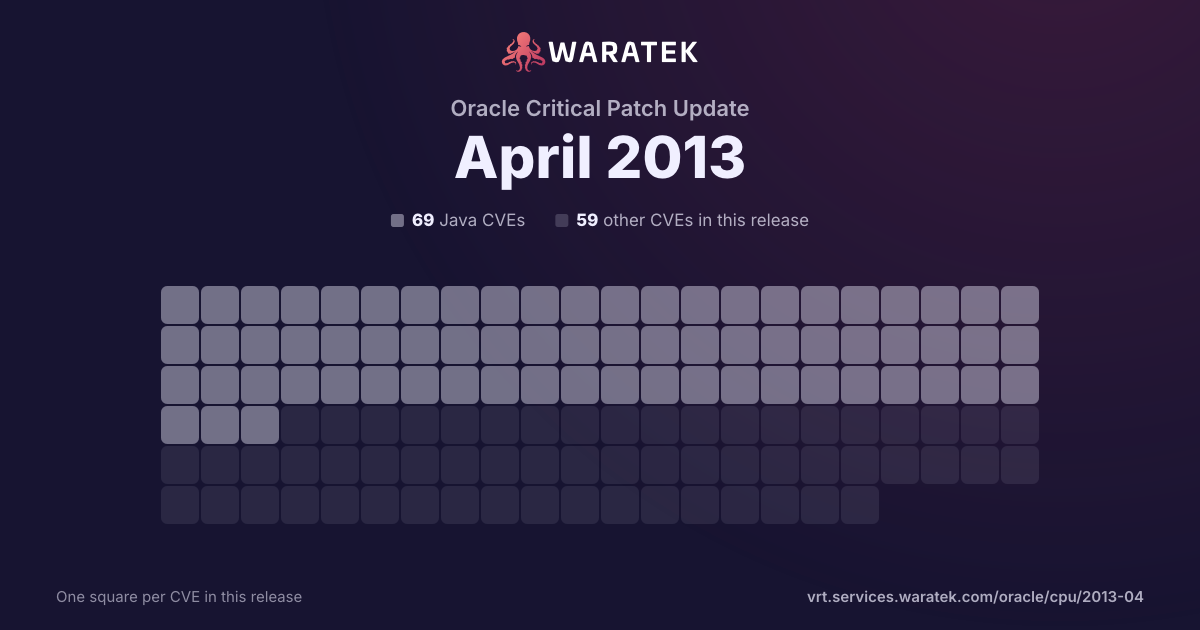
128 CVEs in this release, one square each
By status
No exploit published. For 67 of them, Oracle's security advisory is the source of public detail.
Overview 11 matches · 0 in Waratek scope · 0 protected · 0 exploited · 0 CISA KEV · 1 public PoC · 1 EPSS ≥ 0.5
11matches
0in Waratek scope0.0%
0protected0.0%
0exploited0.0%
0CISA KEV0.0%
1public PoC9.1%
1EPSS ≥ 0.59.1%
Protected by Waratek
0
0.0%
Rule in development
0
0.0%
Mitigation candidate
0
0.0%
No exploit published
0
0.0%
Outside Waratek scope
0
0.0%
Not applicable
11
100.0%
Withdrawn CVE
0
0.0%
blocked by ARMR today
0
0.0%
partly blocked
0
0.0%
not blocked
11
100.0%
not established
0
0.0%
unrecorded
0
0.0%
Exploited
0
0.0%
Working exploit published
1
9.1%
Proof of concept only
0
0.0%
Forecast only
0
0.0%
No public exploit
10
90.9%
split by
peak 4 / quarter
Q2 071
Not applicable1
Medium1
not blocked1
No public exploit1
Q3 070
Q4 070
Q1 080
Q2 080
Q3 080
Q4 080
Q1 090
Q2 094
Not applicable4
High1
Medium3
not blocked4
Working exploit published1
No public exploit3
Q3 091
Not applicable1
High1
not blocked1
No public exploit1
Q4 091
Not applicable1
High1
not blocked1
No public exploit1
Q1 101
Not applicable1
Medium1
not blocked1
No public exploit1
Q2 101
Not applicable1
Medium1
not blocked1
No public exploit1
Q3 101
Not applicable1
Medium1
not blocked1
No public exploit1
Q4 100
Q1 110
Q2 110
Q3 110
Q4 110
Q1 120
Q2 120
Q3 121
Not applicable1
Medium1
not blocked1
No public exploit1
Q3 07Q1 08Q3 08Q1 09Q3 09Q1 10Q3 10Q1 11Q3 11Q1 12Q3 12
| CVE | Severity | Published▾ | Status | Exploitation | Description |
|---|---|---|---|---|---|
| CVE-2012-2751 | Medium | 2012-07-22 | Not applicable | No public exploit | ModSecurity before 2.6.6, when used with PHP, does not properly handle single quotes not at the beginning of a request parameter value in the Content-Disposition field of a request with a multipart/form-data Content-Type header, which allows remote attackers to bypass filtering rules and perform other attacks such as cross-site scripting (XSS) attacks. NOTE: this vulnerability exists because of an incomplete fix for CVE-2009-5031. |
| CVE-2010-2791 | Medium | 2010-08-05 | Not applicable | No public exploit | mod_proxy in httpd in Apache HTTP Server 2.2.9, when running on Unix, does not close the backend connection if a timeout occurs when reading a response from a persistent connection, which allows remote attackers to obtain a potentially sensitive response intended for a different client in opportunistic circumstances via a normal HTTP request. NOTE: this is the same issue as CVE-2010-2068, but for a different OS and set of affected versions. |
| CVE-2010-2068 | Medium | 2010-06-18 | Not applicable | No public exploit | mod_proxy_http.c in mod_proxy_http in the Apache HTTP Server 2.2.9 through 2.2.15, 2.3.4-alpha, and 2.3.5-alpha on Windows, NetWare, and OS/2, in certain configurations involving proxy worker pools, does not properly detect timeouts, which allows remote attackers to obtain a potentially sensitive response intended for a different client in opportunistic circumstances via a normal HTTP request. |
| CVE-2010-0408 | Medium | 2010-03-05 | Not applicable | No public exploit | The ap_proxy_ajp_request function in mod_proxy_ajp.c in mod_proxy_ajp in the Apache HTTP Server 2.2.x before 2.2.15 does not properly handle certain situations in which a client sends no request body, which allows remote attackers to cause a denial of service (backend server outage) via a crafted request, related to use of a 500 error code instead of the appropriate 400 error code. |
| CVE-2009-2699 | High | 2009-10-13 | Not applicable | No public exploit | The Solaris pollset feature in the Event Port backend in poll/unix/port.c in the Apache Portable Runtime (APR) library before 1.3.9, as used in the Apache HTTP Server before 2.2.14 and other products, does not properly handle errors, which allows remote attackers to cause a denial of service (daemon hang) via unspecified HTTP requests, related to the prefork and event MPMs. |
| CVE-2009-1890 | High | 2009-07-05 | Not applicable | No public exploit | The stream_reqbody_cl function in mod_proxy_http.c in the mod_proxy module in the Apache HTTP Server before 2.3.3, when a reverse proxy is configured, does not properly handle an amount of streamed data that exceeds the Content-Length value, which allows remote attackers to cause a denial of service (CPU consumption) via crafted requests. |
| CVE-2009-1956 | Medium | 2009-06-08 | Not applicable | No public exploit | Off-by-one error in the apr_brigade_vprintf function in Apache APR-util before 1.3.5 on big-endian platforms allows remote attackers to obtain sensitive information or cause a denial of service (application crash) via crafted input. |
| CVE-2009-1955 | High | 2009-06-08 | Not applicable | Working exploit published | The expat XML parser in the apr_xml_* interface in xml/apr_xml.c in Apache APR-util before 1.3.7, as used in the mod_dav and mod_dav_svn modules in the Apache HTTP Server, allows remote attackers to cause a denial of service (memory consumption) via a crafted XML document containing a large number of nested entity references, as demonstrated by a PROPFIND request, a similar issue to CVE-2003-1564. |
| CVE-2009-0023 | Medium | 2009-06-08 | Not applicable | No public exploit | The apr_strmatch_precompile function in strmatch/apr_strmatch.c in Apache APR-util before 1.3.5 allows remote attackers to cause a denial of service (daemon crash) via crafted input involving (1) a .htaccess file used with the Apache HTTP Server, (2) the SVNMasterURI directive in the mod_dav_svn module in the Apache HTTP Server, (3) the mod_apreq2 module for the Apache HTTP Server, or (4) an application that uses the libapreq2 library, which triggers a heap-based buffer underflow. |
| CVE-2009-1191 | Medium | 2009-04-23 | Not applicable | No public exploit | mod_proxy_ajp.c in the mod_proxy_ajp module in the Apache HTTP Server 2.2.11 allows remote attackers to obtain sensitive response data, intended for a client that sent an earlier POST request with no request body, via an HTTP request. |
| CVE-2007-1862 | Medium | 2007-06-04 | Not applicable | No public exploit | The recall_headers function in mod_mem_cache in Apache 2.2.4 does not properly copy all levels of header data, which can cause Apache to return HTTP headers containing previously used data, which could be used by remote attackers to obtain potentially sensitive information. |