
Oracle Critical Patch Update April 2013
Released April 2013 · Oracle's advisory ↗ · ← Java SE Critical Patch Update, February 2013 · Java SE Critical Patch Update, April 2013 →
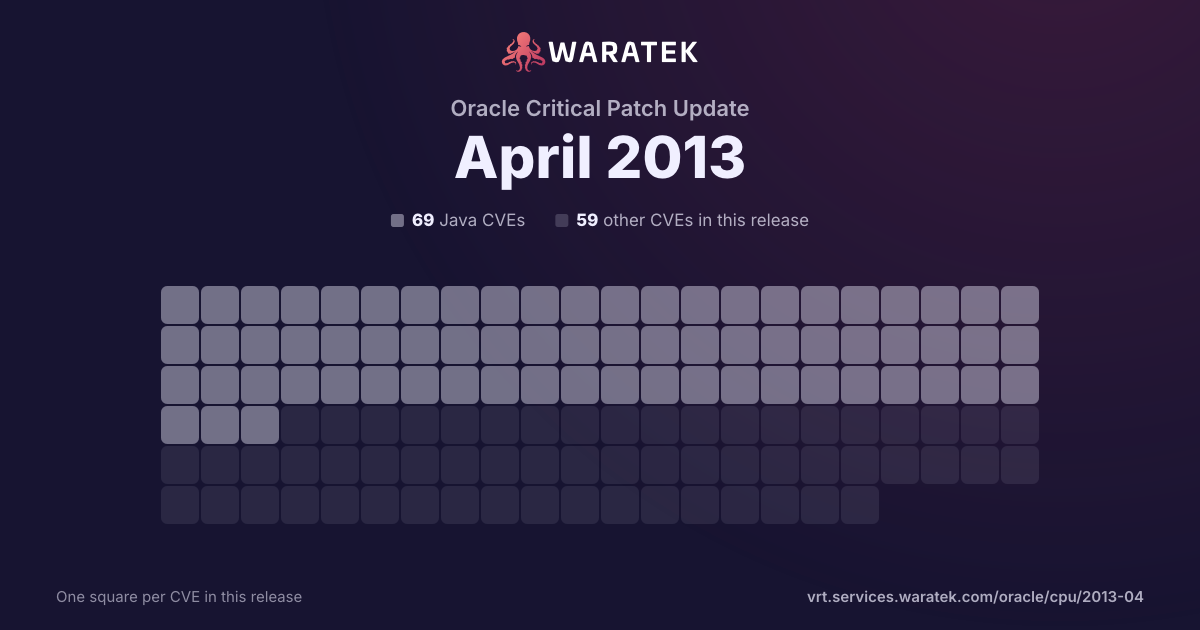
128 CVEs in this release, one square each
By status
No exploit published. For 67 of them, Oracle's security advisory is the source of public detail.
Overview 6 matches · 0 in Waratek scope · 0 protected · 0 exploited · 0 CISA KEV · 1 public PoC · 1 EPSS ≥ 0.5
6matches
0in Waratek scope0.0%
0protected0.0%
0exploited0.0%
0CISA KEV0.0%
1public PoC16.7%
1EPSS ≥ 0.516.7%
Protected by Waratek
0
0.0%
Rule in development
0
0.0%
Mitigation candidate
0
0.0%
No exploit published
0
0.0%
Outside Waratek scope
0
0.0%
Not applicable
6
100.0%
Withdrawn CVE
0
0.0%
blocked by ARMR today
0
0.0%
partly blocked
0
0.0%
not blocked
6
100.0%
not established
0
0.0%
unrecorded
0
0.0%
Exploited
0
0.0%
Working exploit published
1
16.7%
Proof of concept only
0
0.0%
Forecast only
0
0.0%
No public exploit
5
83.3%
split by
peak 4 / quarter
Q2 07Q3 07Q4 07Q1 08Q2 08Q3 08Q4 08Q1 09Q2 09Q3 09
| CVE | Severity | Published▾ | Status | Exploitation | Description |
|---|---|---|---|---|---|
| CVE-2009-1890 | High | 2009-07-05 | Not applicable | No public exploit | The stream_reqbody_cl function in mod_proxy_http.c in the mod_proxy module in the Apache HTTP Server before 2.3.3, when a reverse proxy is configured, does not properly handle an amount of streamed data that exceeds the Content-Length value, which allows remote attackers to cause a denial of service (CPU consumption) via crafted requests. |
| CVE-2009-1956 | Medium | 2009-06-08 | Not applicable | No public exploit | Off-by-one error in the apr_brigade_vprintf function in Apache APR-util before 1.3.5 on big-endian platforms allows remote attackers to obtain sensitive information or cause a denial of service (application crash) via crafted input. |
| CVE-2009-1955 | High | 2009-06-08 | Not applicable | Working exploit published | The expat XML parser in the apr_xml_* interface in xml/apr_xml.c in Apache APR-util before 1.3.7, as used in the mod_dav and mod_dav_svn modules in the Apache HTTP Server, allows remote attackers to cause a denial of service (memory consumption) via a crafted XML document containing a large number of nested entity references, as demonstrated by a PROPFIND request, a similar issue to CVE-2003-1564. |
| CVE-2009-0023 | Medium | 2009-06-08 | Not applicable | No public exploit | The apr_strmatch_precompile function in strmatch/apr_strmatch.c in Apache APR-util before 1.3.5 allows remote attackers to cause a denial of service (daemon crash) via crafted input involving (1) a .htaccess file used with the Apache HTTP Server, (2) the SVNMasterURI directive in the mod_dav_svn module in the Apache HTTP Server, (3) the mod_apreq2 module for the Apache HTTP Server, or (4) an application that uses the libapreq2 library, which triggers a heap-based buffer underflow. |
| CVE-2009-1191 | Medium | 2009-04-23 | Not applicable | No public exploit | mod_proxy_ajp.c in the mod_proxy_ajp module in the Apache HTTP Server 2.2.11 allows remote attackers to obtain sensitive response data, intended for a client that sent an earlier POST request with no request body, via an HTTP request. |
| CVE-2007-1862 | Medium | 2007-06-04 | Not applicable | No public exploit | The recall_headers function in mod_mem_cache in Apache 2.2.4 does not properly copy all levels of header data, which can cause Apache to return HTTP headers containing previously used data, which could be used by remote attackers to obtain potentially sensitive information. |