
Oracle Critical Patch Update January 2013
Released January 2013 · Oracle's advisory ↗ · ← Java SE Critical Patch Update, October 2012 · Java SE Critical Patch Update, February 2013 →
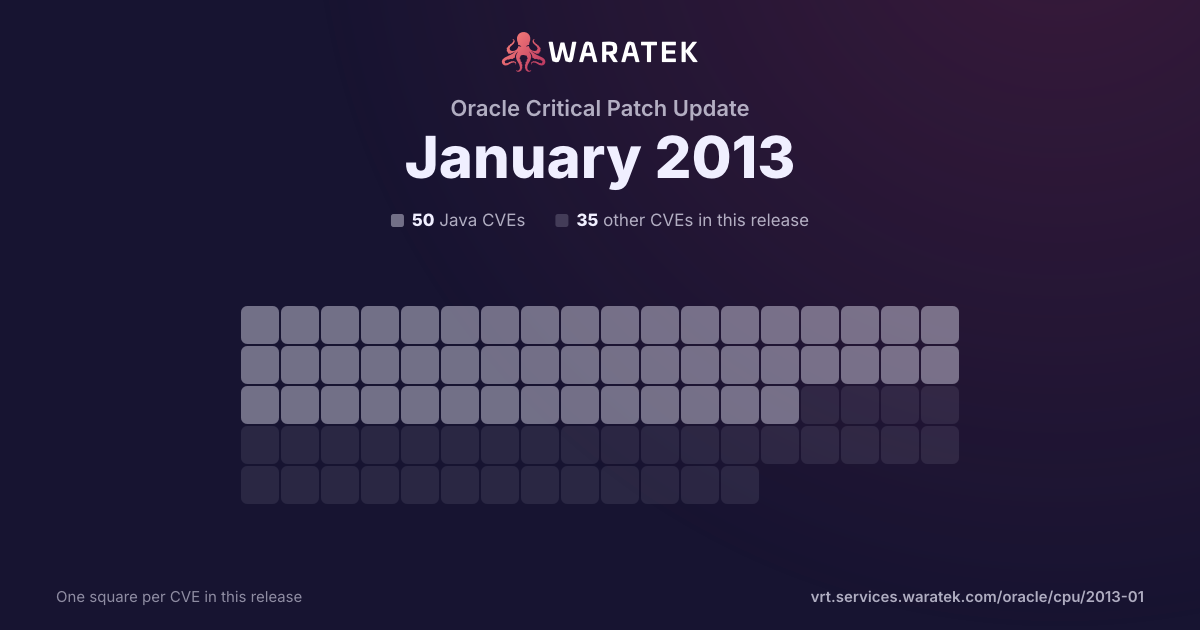
85 CVEs in this release, one square each
By status
No exploit published. For 48 of them, Oracle's security advisory is the source of public detail.
Overview 32 matches · 0 in Waratek scope · 0 protected · 0 exploited · 0 CISA KEV · 2 public PoC · 0 EPSS ≥ 0.5
32matches
0in Waratek scope0.0%
0protected0.0%
0exploited0.0%
0CISA KEV0.0%
2public PoC6.2%
0EPSS ≥ 0.50.0%
Protected by Waratek
0
0.0%
Rule in development
0
0.0%
Mitigation candidate
0
0.0%
No exploit published
0
0.0%
Outside Waratek scope
0
0.0%
Not applicable
32
100.0%
Withdrawn CVE
0
0.0%
blocked by ARMR today
0
0.0%
partly blocked
0
0.0%
not blocked
32
100.0%
not established
0
0.0%
unrecorded
0
0.0%
Exploited
0
0.0%
Working exploit published
2
6.2%
Proof of concept only
0
0.0%
Forecast only
0
0.0%
No public exploit
30
93.8%
split by
peak 30 / month
Dec 12Jan 13
| CVE | Severity | Published▾ | Status | Exploitation | Description |
|---|---|---|---|---|---|
| CVE-2013-0420 | Low | 2013-01-17 | Not applicable | No public exploit | Unspecified vulnerability in the VirtualBox component in Oracle Virtualization 4.0, 4.1, and 4.2 allows local users to affect integrity and availability via unknown vectors related to Core. NOTE: The previous information was obtained from the January 2013 Oracle CPU. Oracle has not commented on claims from another vendor that this issue is related to an incorrect comparison in the vga_draw_text function in Devices/Graphics/DevVGA.cpp, which can cause VirtualBox to "draw more lines than necessary." |
| CVE-2013-0417 | Medium | 2013-01-17 | Not applicable | No public exploit | Unspecified vulnerability in the Sun Storage Common Array Manager (CAM) component in Oracle Sun Products Suite 6.9.0 allows remote attackers to affect confidentiality, related to Fault Management System (FMS). |
| CVE-2013-0415 | Medium | 2013-01-17 | Not applicable | No public exploit | Unspecified vulnerability in Oracle Sun Solaris 10 allows local users to affect confidentiality, integrity, and availability via unknown vectors related to the Bind/Postinstall script for Bind package. |
| CVE-2013-0414 | Low | 2013-01-17 | Not applicable | No public exploit | Unspecified vulnerability in Oracle Sun Solaris 11 allows local users to affect integrity and availability via unknown vectors related to Utility/ksh93. |
| CVE-2013-0407 | Medium | 2013-01-17 | Not applicable | No public exploit | Unspecified vulnerability in Oracle Sun Solaris 10 and 11 allows local users to affect availability via unknown vectors related to Kernel/DTrace Framework. |
| CVE-2013-0400 | Medium | 2013-01-17 | Not applicable | No public exploit | Unspecified vulnerability in Oracle Sun Solaris 9 and 10 allows local users to affect confidentiality, integrity, and availability via unknown vectors related to Filesystem/cachefs. |
| CVE-2013-0399 | Medium | 2013-01-17 | Not applicable | No public exploit | Unspecified vulnerability in Oracle Sun Solaris 9 and 10 allows local users to affect confidentiality, integrity, and availability via unknown vectors related to Utility/Umount. |
| CVE-2013-0389 | Medium | 2013-01-17 | Not applicable | No public exploit | Unspecified vulnerability in the Server component in Oracle MySQL 5.1.66 and earlier, and 5.5.28 and earlier, allows remote authenticated users to affect availability via unknown vectors related to Server Optimizer. |
| CVE-2013-0386 | Medium | 2013-01-17 | Not applicable | No public exploit | Unspecified vulnerability in the Server component in Oracle MySQL 5.5.28 and earlier allows remote authenticated users to affect availability via unknown vectors related to Stored Procedure. |
| CVE-2013-0385 | Medium | 2013-01-17 | Not applicable | No public exploit | Unspecified vulnerability in the Server component in Oracle MySQL 5.1.66 and earlier, and 5.5.28 and earlier, allows local users to affect confidentiality and integrity via unknown vectors related to Server Replication. |
| CVE-2013-0384 | Medium | 2013-01-17 | Not applicable | No public exploit | Unspecified vulnerability in the Server component in Oracle MySQL 5.1.66 and earlier, and 5.5.28 and earlier, allows remote authenticated users to affect availability via unknown vectors related to Information Schema. |
| CVE-2013-0383 | Medium | 2013-01-17 | Not applicable | No public exploit | Unspecified vulnerability in the Server component in Oracle MySQL 5.1.66 and earlier, and 5.5.28 and earlier, allows remote attackers to affect availability via unknown vectors related to Server Locking. |
| CVE-2013-0375 | Medium | 2013-01-17 | Not applicable | No public exploit | Unspecified vulnerability in the Server component in Oracle MySQL 5.1.66 and earlier, and 5.1.28 and earlier, allows remote authenticated users to affect confidentiality and integrity via unknown vectors related to Server Replication. |
| CVE-2013-0371 | Medium | 2013-01-17 | Not applicable | No public exploit | Unspecified vulnerability in the Server component in Oracle MySQL 5.5.28 and earlier allows remote authenticated users to affect availability, related to MyISAM. |
| CVE-2013-0368 | Medium | 2013-01-17 | Not applicable | No public exploit | Unspecified vulnerability in the Server component in Oracle MySQL 5.5.28 and earlier allows remote authenticated users to affect availability via unknown vectors related to InnoDB. |
| CVE-2013-0367 | Medium | 2013-01-17 | Not applicable | No public exploit | Unspecified vulnerability in the Server component in Oracle MySQL 5.5.28 and earlier allows remote authenticated users to affect availability via unknown vectors related to Server Partition. |
| CVE-2013-0366 | High | 2013-01-17 | Not applicable | No public exploit | Unspecified vulnerability in the Mobile Server component in Oracle Database Mobile/Lite Server (formerly Oracle Database Lite) 10.3.0.3 and 11.1.0.0 allows remote attackers to affect confidentiality, integrity, and availability via unknown vectors, a different vulnerability than CVE-2013-0361. |
| CVE-2013-0364 | High | 2013-01-17 | Not applicable | No public exploit | Unspecified vulnerability in the Mobile Server component in Oracle Database Mobile/Lite Server (formerly Oracle Database Lite) 10.3.0.3 and 11.1.0.0 allows remote attackers to affect confidentiality via unknown vectors, a different vulnerability than CVE-2013-0362 and CVE-2013-0363. |
| CVE-2013-0363 | High | 2013-01-17 | Not applicable | No public exploit | Unspecified vulnerability in the Mobile Server component in Oracle Database Mobile/Lite Server (formerly Oracle Database Lite) 10.3.0.3 and 11.1.0.0 allows remote attackers to affect confidentiality via unknown vectors, a different vulnerability than CVE-2013-0362 and CVE-2013-0364. |
| CVE-2013-0362 | High | 2013-01-17 | Not applicable | No public exploit | Unspecified vulnerability in the Mobile Server component in Oracle Database Mobile/Lite Server (formerly Oracle Database Lite) 10.3.0.3 and 11.1.0.0 allows remote attackers to affect confidentiality via unknown vectors, a different vulnerability than CVE-2013-0363 and CVE-2013-0364. |
| CVE-2013-0361 | High | 2013-01-17 | Not applicable | No public exploit | Unspecified vulnerability in the Mobile Server component in Oracle Database Mobile/Lite Server (formerly Oracle Database Lite) 10.3.0.3 and 11.1.0.0 allows remote attackers to affect confidentiality, integrity, and availability via unknown vectors, a different vulnerability than CVE-2013-0366. |
| CVE-2012-5096 | Low | 2013-01-17 | Not applicable | No public exploit | Unspecified vulnerability in the Server component in Oracle MySQL 5.5.28 and earlier allows remote authenticated users with Server Privileges to affect availability via unknown vectors. |
| CVE-2012-5060 | Medium | 2013-01-17 | Not applicable | No public exploit | Unspecified vulnerability in the Server component in Oracle MySQL 5.1.65 and earlier and 5.5.27 and earlier allows remote authenticated users to affect availability, related to GIS Extension. |
| CVE-2012-3178 | Low | 2013-01-17 | Not applicable | No public exploit | Unspecified vulnerability in the kernel in Oracle Sun Solaris 11 allows local users to affect availability via unknown vectors. |
| CVE-2012-1705 | Medium | 2013-01-17 | Not applicable | No public exploit | Unspecified vulnerability in the Server component in Oracle MySQL 5.1.66 and earlier and 5.5.28 and earlier allows remote authenticated users to affect availability via unknown vectors related to Server Optimizer. |
| CVE-2012-1702 | Medium | 2013-01-17 | Not applicable | No public exploit | Unspecified vulnerability in the Server component in Oracle MySQL 5.1.66 and earlier and 5.5.28 and earlier allows remote attackers to affect availability via unknown vectors. |
| CVE-2012-0578 | Medium | 2013-01-17 | Not applicable | No public exploit | Unspecified vulnerability in the Server component in Oracle MySQL 5.5.28 and earlier allows remote authenticated users to affect availability via unknown vectors related to Server Optimizer. |
| CVE-2012-0574 | Medium | 2013-01-17 | Not applicable | No public exploit | Unspecified vulnerability in the Server component in Oracle MySQL 5.1.66 and earlier, and 5.5.28 and earlier, allows remote authenticated users to affect availability via unknown vectors. |
| CVE-2012-0572 | Medium | 2013-01-17 | Not applicable | No public exploit | Unspecified vulnerability in the Server component in Oracle MySQL 5.1.66 and earlier and 5.5.28 and earlier allows remote authenticated users to affect availability via unknown vectors related to InnoDB. |
| CVE-2012-0569 | Low | 2013-01-17 | Not applicable | No public exploit | Unspecified vulnerability Oracle Sun Solaris 10 allows local users to affect confidentiality and integrity via unknown vectors related to Install/smpatch. |
| CVE-2012-5612 | Medium | 2012-12-03 | Not applicable | Working exploit published | Heap-based buffer overflow in Oracle MySQL 5.5.19 and other versions through 5.5.28, and MariaDB 5.5.28a and possibly other versions, allows remote authenticated users to cause a denial of service (memory corruption and crash) and possibly execute arbitrary code, as demonstrated using certain variations of the (1) USE, (2) SHOW TABLES, (3) DESCRIBE, (4) SHOW FIELDS FROM, (5) SHOW COLUMNS FROM, (6) SHOW INDEX FROM, (7) CREATE TABLE, (8) DROP TABLE, (9) ALTER TABLE, (10) DELETE FROM, (11) UPDATE, and (12) SET PASSWORD commands. |
| CVE-2012-5611 | Medium | 2012-12-03 | Not applicable | Working exploit published | Stack-based buffer overflow in the acl_get function in Oracle MySQL 5.5.19 and other versions through 5.5.28, and 5.1.53 and other versions through 5.1.66, and MariaDB 5.5.2.x before 5.5.28a, 5.3.x before 5.3.11, 5.2.x before 5.2.13 and 5.1.x before 5.1.66, allows remote authenticated users to execute arbitrary code via a long argument to the GRANT FILE command. |