
Oracle Critical Patch Update January 2013
Released January 2013 · Oracle's advisory ↗ · ← Java SE Critical Patch Update, October 2012 · Java SE Critical Patch Update, February 2013 →
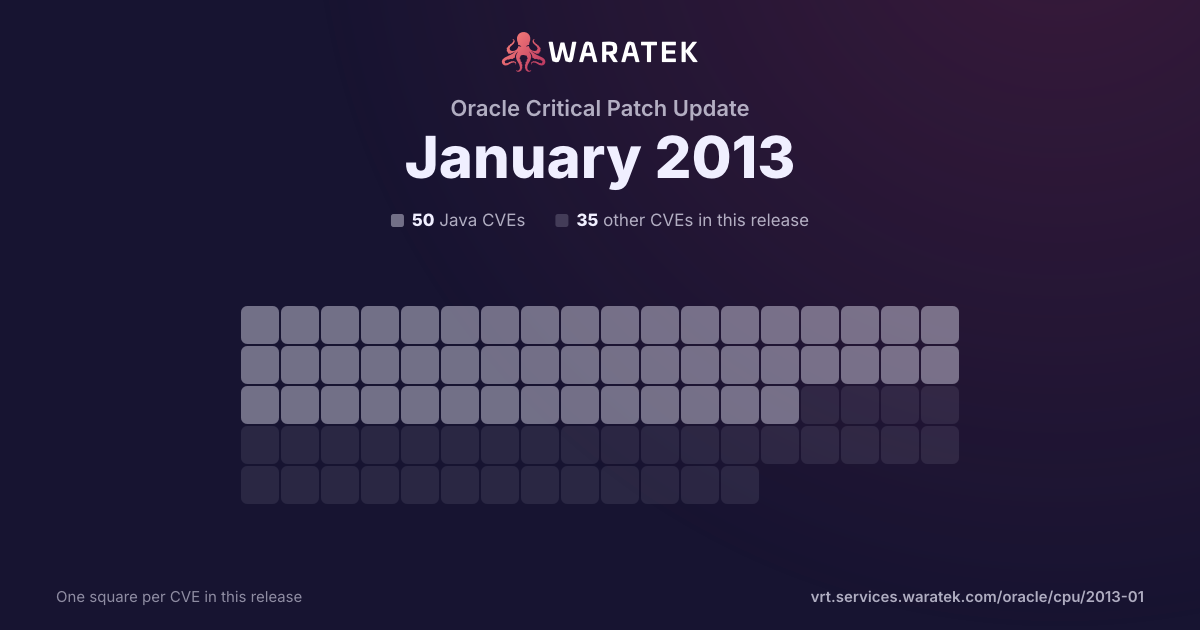
85 CVEs in this release, one square each
By status
No exploit published. For 48 of them, Oracle's security advisory is the source of public detail.
Overview 4 matches · 1 in Waratek scope · 0 protected · 0 exploited · 0 CISA KEV · 3 public PoC · 1 EPSS ≥ 0.5
4matches
1in Waratek scope25.0%
0protected0.0%
0exploited0.0%
0CISA KEV0.0%
3public PoC75.0%
1EPSS ≥ 0.525.0%
Protected by Waratek
0
0.0%
Rule in development
0
0.0%
Mitigation candidate
0
0.0%
No exploit published
1
25.0%
Outside Waratek scope
1
25.0%
Not applicable
2
50.0%
Withdrawn CVE
0
0.0%
blocked by ARMR today
0
0.0%
partly blocked
0
0.0%
not blocked
4
100.0%
not established
0
0.0%
unrecorded
0
0.0%
Exploited
0
0.0%
Working exploit published
3
75.0%
Proof of concept only
0
0.0%
Forecast only
0
0.0%
No public exploit
1
25.0%
split by
peak 2 / month
Dec 111
Outside Waratek scope1
Medium1
not blocked1
Working exploit published1
Jan 121
No exploit published1
Medium1
not blocked1
No public exploit1
Feb 120
Mar 120
Apr 120
May 120
Jun 120
Jul 120
Aug 120
Sep 120
Oct 120
Nov 120
Dec 122
Not applicable2
Medium2
not blocked2
Working exploit published2
Dec 11Feb 12Apr 12Jun 12Aug 12Oct 12Dec 12
| CVE | Severity | Published▾ | Status | Exploitation | Description |
|---|---|---|---|---|---|
| CVE-2012-5612 | Medium | 2012-12-03 | Not applicable | Working exploit published | Heap-based buffer overflow in Oracle MySQL 5.5.19 and other versions through 5.5.28, and MariaDB 5.5.28a and possibly other versions, allows remote authenticated users to cause a denial of service (memory corruption and crash) and possibly execute arbitrary code, as demonstrated using certain variations of the (1) USE, (2) SHOW TABLES, (3) DESCRIBE, (4) SHOW FIELDS FROM, (5) SHOW COLUMNS FROM, (6) SHOW INDEX FROM, (7) CREATE TABLE, (8) DROP TABLE, (9) ALTER TABLE, (10) DELETE FROM, (11) UPDATE, and (12) SET PASSWORD commands. |
| CVE-2012-5611 | Medium | 2012-12-03 | Not applicable | Working exploit published | Stack-based buffer overflow in the acl_get function in Oracle MySQL 5.5.19 and other versions through 5.5.28, and 5.1.53 and other versions through 5.1.66, and MariaDB 5.5.2.x before 5.5.28a, 5.3.x before 5.3.11, 5.2.x before 5.2.13 and 5.1.x before 5.1.66, allows remote authenticated users to execute arbitrary code via a long argument to the GRANT FILE command. |
| CVE-2012-0022 | Medium | 2012-01-19 | No exploit published | No public exploit | Apache Tomcat 5.5.x before 5.5.35, 6.x before 6.0.34, and 7.x before 7.0.23 uses an inefficient approach for handling parameters, which allows remote attackers to cause a denial of service (CPU consumption) via a request that contains many parameters and parameter values, a different vulnerability than CVE-2011-4858. |
| CVE-2011-5035 | Medium | 2011-12-30 | Outside Waratek scope | Working exploit published | Oracle Glassfish 2.1.1, 3.0.1, and 3.1.1, as used in Communications Server 2.0, Sun Java System Application Server 8.1 and 8.2, and possibly other products, computes hash values for form parameters without restricting the ability to trigger hash collisions predictably, which allows remote attackers to cause a denial of service (CPU consumption) by sending many crafted parameters, aka Oracle security ticket S0104869. |