
Oracle Critical Patch Update October 2012
Released October 2012 · Oracle's advisory ↗ · ← Critical Patch Update, July 2012 · Java SE Critical Patch Update, October 2012 →
107 CVEs in this release, one square each
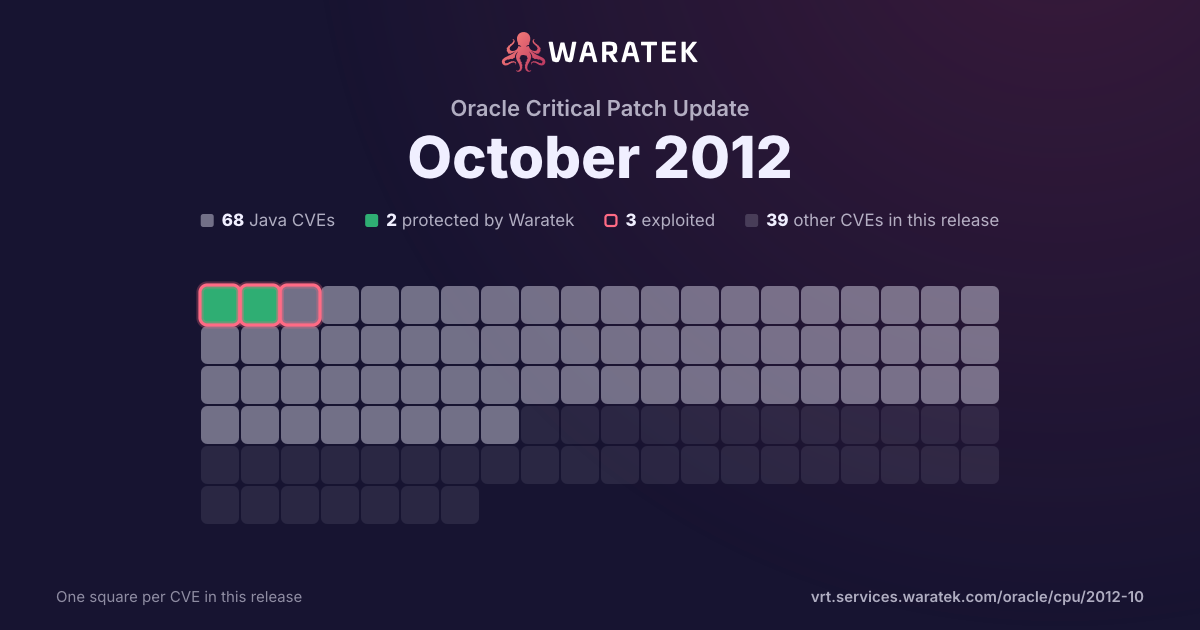
By status
2Protected by Waratek5Mitigation candidate61No exploit published5Outside Waratek scope34Not applicable
3Exploited, marked by the ring
No exploit published. For 61 of them, Oracle's security advisory is the source of public detail.
Protected by Waratek. Waratek RASP can block exploitation of these on systems that have not applied the patch yet.
Overview 6 matches · 5 in Waratek scope · 1 protected · 1 exploited · 0 CISA KEV · 1 EPSS ≥ 0.5
Protected by Waratek
1
16.7%
Rule in development
0
0.0%
Mitigation candidate
4
66.7%
No exploit published
0
0.0%
Outside Waratek scope
1
16.7%
Not applicable
0
0.0%
Withdrawn CVE
0
0.0%
blocked by ARMR today
1
16.7%
partly blocked
0
0.0%
not blocked
5
83.3%
not established
0
0.0%
unrecorded
0
0.0%
Exploited
1
16.7%
Working exploit published
5
83.3%
Proof of concept only
0
0.0%
Forecast only
0
0.0%
No public exploit
0
0.0%
| CVE | Severity | Published▾ | Status | Exploitation | Description |
|---|---|---|---|---|---|
| CVE-2012-3186 | Medium | 2012-10-17 | Mitigation candidate | Working exploit published | Unspecified vulnerability in the Oracle WebCenter Sites component in Oracle Fusion Middleware 6.1, 6.2, 6.3.x, 7, 7.0.1, 7.0.2, 7.0.3, 7.5, 7.6.1, 7.6.2, and 11.1.1.6.0 allows remote authenticated users to affect confidentiality and integrity via unknown vectors related to Advanced UI, a different vulnerability than CVE-2012-3183 and CVE-2012-3185. |
| CVE-2012-3185 | Medium | 2012-10-17 | Mitigation candidate | Working exploit published | Unspecified vulnerability in the Oracle WebCenter Sites component in Oracle Fusion Middleware 6.1, 6.2, 6.3.x, 7, 7.0.1, 7.0.2, 7.0.3, 7.5, 7.6.1, 7.6.2, and 11.1.1.6.0 allows remote authenticated users to affect confidentiality and integrity via unknown vectors related to Advanced UI, a different vulnerability than CVE-2012-3183 and CVE-2012-3186. |
| CVE-2012-3184 | Medium | 2012-10-17 | Mitigation candidate | Working exploit published | Unspecified vulnerability in the Oracle WebCenter Sites component in Oracle Fusion Middleware 6.1, 6.2, 6.3.x, 7, 7.0.1, 7.0.2, 7.0.3, 7.5, 7.6.1, 7.6.2, and 11.1.1.6.0 allows remote attackers to affect integrity via unknown vectors related to Advanced UI. |
| CVE-2012-3183 | Medium | 2012-10-17 | Mitigation candidate | Working exploit published | Unspecified vulnerability in the Oracle WebCenter Sites component in Oracle Fusion Middleware 6.1, 6.2, 6.3.x, 7, 7.0.1, 7.0.2, 7.0.3, 7.5, 7.6.1, 7.6.2, and 11.1.1.6.0 allows remote authenticated users to affect confidentiality and integrity via unknown vectors related to Advanced UI, a different vulnerability than CVE-2012-3185 and CVE-2012-3186. |
| CVE-2012-3153 | Medium | 2012-10-16 | Protected by Waratek | Exploited | Unspecified vulnerability in the Oracle Reports Developer component in Oracle Fusion Middleware 11.1.1.4, 11.1.1.6, and 11.1.2.0 allows remote attackers to affect confidentiality and integrity via unknown vectors related to Servlet. NOTE: the previous information is from the October 2012 CPU. Oracle has not commented on claims from the original researcher that the PARSEQUERY function allows remote attackers to obtain database credentials via reports/rwservlet/parsequery, and that this issue occurs in earlier versions. NOTE: this can be leveraged with CVE-2012-3152 to execute arbitrary code by uploading a .jsp file. |
| CVE-2012-3137 | Medium | 2012-09-21 | Outside Waratek scope | Working exploit published | The authentication protocol in Oracle Database Server 10.2.0.3, 10.2.0.4, 10.2.0.5, 11.1.0.7, 11.2.0.2, and 11.2.0.3 allows remote attackers to obtain the session key and salt for arbitrary users, which leaks information about the cryptographic hash and makes it easier to conduct brute force password guessing attacks, aka "stealth password cracking vulnerability." |