
Oracle Critical Patch Update July 2012
Released July 2012 · Oracle's advisory ↗ · ← Java SE Critical Patch Update, June 2012 · Critical Patch Update, October 2012 →
87 CVEs in this release, one square each
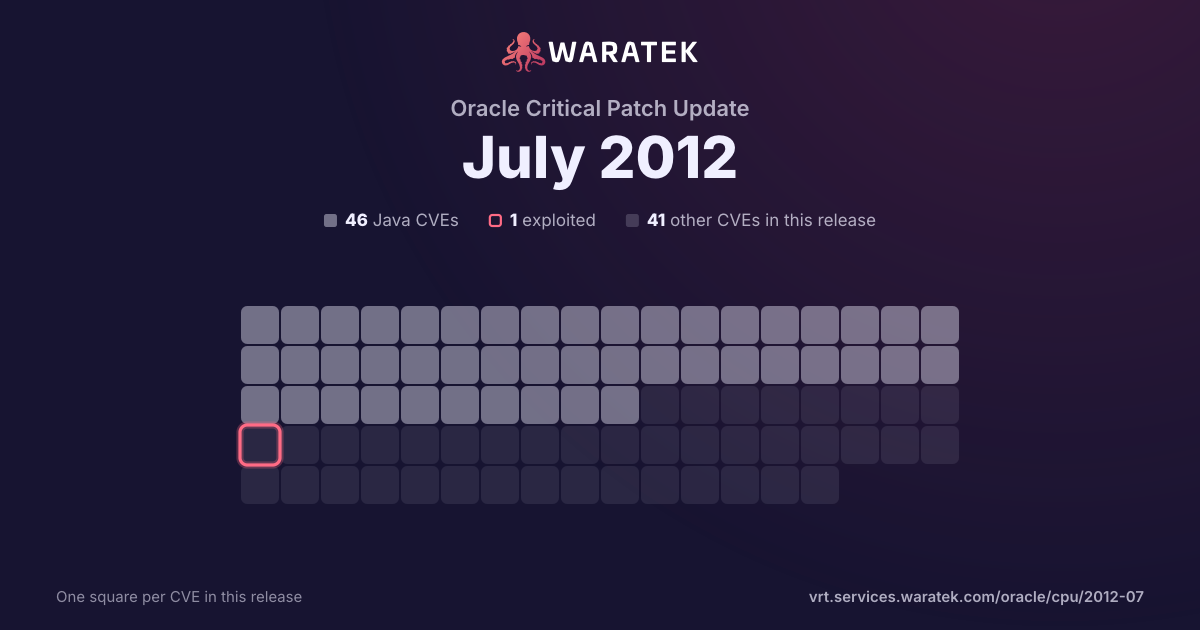
By status
3Mitigation candidate43No exploit published8Outside Waratek scope33Not applicable
1Exploited, marked by the ring
No exploit published. For 43 of them, Oracle's security advisory is the source of public detail.
Overview 3 matches · 0 in Waratek scope · 0 protected · 1 exploited · 0 CISA KEV · 2 public PoC · 1 EPSS ≥ 0.5
3matches
0in Waratek scope0.0%
0protected0.0%
1exploited33.3%
0CISA KEV0.0%
2public PoC66.7%
1EPSS ≥ 0.533.3%
Protected by Waratek
0
0.0%
Rule in development
0
0.0%
Mitigation candidate
0
0.0%
No exploit published
0
0.0%
Outside Waratek scope
0
0.0%
Not applicable
3
100.0%
Withdrawn CVE
0
0.0%
blocked by ARMR today
0
0.0%
partly blocked
0
0.0%
not blocked
3
100.0%
not established
0
0.0%
unrecorded
0
0.0%
Exploited
1
33.3%
Working exploit published
0
0.0%
Proof of concept only
1
33.3%
Forecast only
0
0.0%
No public exploit
1
33.3%
split by
peak 1 / quarter
Q4 08Q2 09Q4 09Q2 10Q4 10Q2 11Q4 11Q2 12
| CVE | Severity | Published▾ | Status | Exploitation | Description |
|---|---|---|---|---|---|
| CVE-2011-2699 | High | 2012-05-24 | Not applicable | No public exploit | The IPv6 implementation in the Linux kernel before 3.1 does not generate Fragment Identification values separately for each destination, which makes it easier for remote attackers to cause a denial of service (disrupted networking) by predicting these values and sending crafted packets. |
| CVE-2011-3192 | High | 2011-08-29 | Not applicable | Exploited | The byterange filter in the Apache HTTP Server 1.3.x, 2.0.x through 2.0.64, and 2.2.x through 2.2.19 allows remote attackers to cause a denial of service (memory and CPU consumption) via a Range header that expresses multiple overlapping ranges, as exploited in the wild in August 2011, a different vulnerability than CVE-2007-0086. |
| CVE-2008-4609 | High | 2008-10-20 | Not applicable | Proof of concept only | The TCP implementation in (1) Linux, (2) platforms based on BSD Unix, (3) Microsoft Windows, (4) Cisco products, and probably other operating systems allows remote attackers to cause a denial of service (connection queue exhaustion) via multiple vectors that manipulate information in the TCP state table, as demonstrated by sockstress. |