
Oracle Critical Patch Update July 2012
Released July 2012 · Oracle's advisory ↗ · ← Java SE Critical Patch Update, June 2012 · Critical Patch Update, October 2012 →
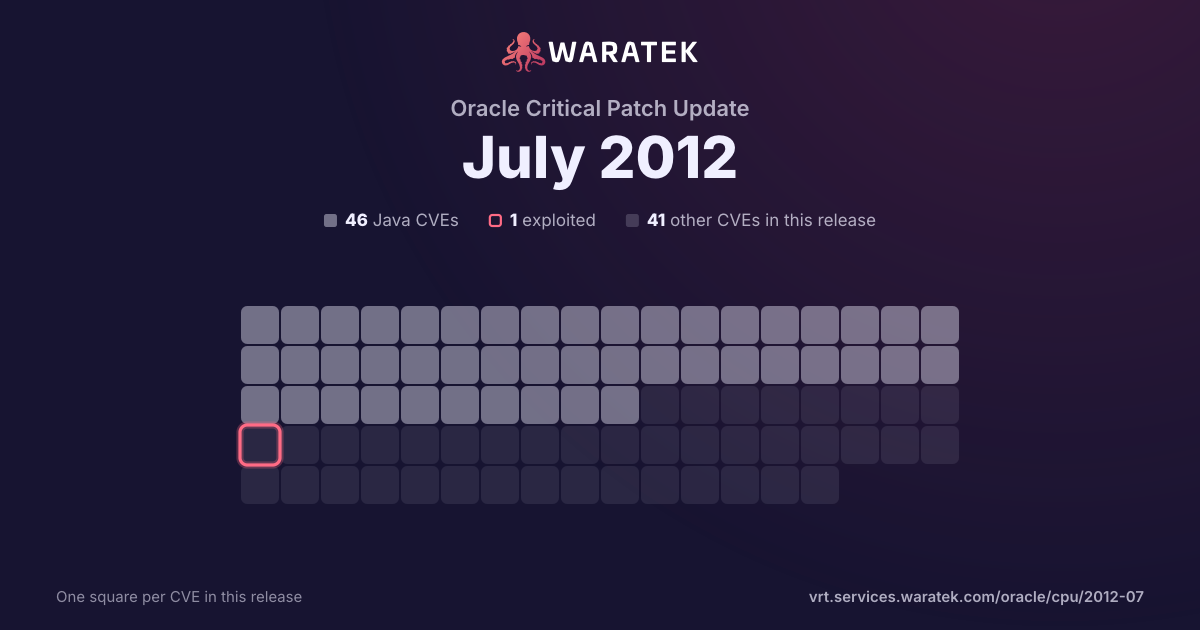
87 CVEs in this release, one square each
By status
3Mitigation candidate43No exploit published8Outside Waratek scope33Not applicable
1Exploited, marked by the ring
No exploit published. For 43 of them, Oracle's security advisory is the source of public detail.
Overview 33 matches · 0 in Waratek scope · 0 protected · 1 exploited · 0 CISA KEV · 6 public PoC · 4 EPSS ≥ 0.5
33matches
0in Waratek scope0.0%
0protected0.0%
1exploited3.0%
0CISA KEV0.0%
6public PoC18.2%
4EPSS ≥ 0.512.1%
Protected by Waratek
0
0.0%
Rule in development
0
0.0%
Mitigation candidate
0
0.0%
No exploit published
0
0.0%
Outside Waratek scope
0
0.0%
Not applicable
33
100.0%
Withdrawn CVE
0
0.0%
blocked by ARMR today
0
0.0%
partly blocked
0
0.0%
not blocked
33
100.0%
not established
0
0.0%
unrecorded
0
0.0%
split by
peak 26 / year
20011
Not applicable1
Medium1
not blocked1
No public exploit1
20020
20030
20040
20050
20060
20070
20081
Not applicable1
High1
not blocked1
Proof of concept only1
20090
20100
20115
Not applicable5
High1
Medium4
not blocked5
Exploited1
Working exploit published4
201226
Not applicable26
High3
Medium20
Low3
not blocked26
No public exploit26
200120022003200420052006200720082009201020112012
| CVE | Severity | Published▾ | Status | Exploitation | Description |
|---|---|---|---|---|---|
| CVE-2012-3131 | Medium | 2012-07-17 | Not applicable | No public exploit | Unspecified vulnerability in Oracle Sun Solaris 9, 10, and 11 allows remote attackers to affect confidentiality, related to Network/NFS. |
| CVE-2012-3130 | Medium | 2012-07-17 | Not applicable | No public exploit | Unspecified vulnerability in Oracle Sun Solaris 11 allows remote attackers to affect integrity via unknown vectors related to pkg.depotd. |
| CVE-2012-3129 | Medium | 2012-07-17 | Not applicable | No public exploit | Unspecified vulnerability in Oracle Sun Solaris 10 allows remote attackers to affect confidentiality, integrity, and availability, related to Gnome PDF viewer. |
| CVE-2012-3128 | Low | 2012-07-17 | Not applicable | No public exploit | Unspecified vulnerability in Oracle SPARC T-Series Servers running System Firmware 8.2.0 and 8.1.4.e or earlier allows local users to affect confidentiality, integrity, and availability via unknown vectors related to Integrated Lights Out Manager. |
| CVE-2012-3127 | Medium | 2012-07-17 | Not applicable | No public exploit | Unspecified vulnerability in Oracle Sun Solaris 10 allows remote attackers to affect availability, related to SCTP. |
| CVE-2012-3126 | Medium | 2012-07-17 | Not applicable | No public exploit | Unspecified vulnerability in the Solaris Cluster component in Oracle Sun Products Suite 3.3 allows local users to affect confidentiality, integrity, and availability via unknown vectors related to Apache Tomcat Agent. |
| CVE-2012-3125 | High | 2012-07-17 | Not applicable | No public exploit | Unspecified vulnerability in Oracle Sun Solaris 8, 9, and 10 allows remote attackers to affect availability, related to TCP/IP. |
| CVE-2012-3124 | Medium | 2012-07-17 | Not applicable | No public exploit | Unspecified vulnerability in Oracle Sun Solaris 10 allows remote attackers to affect availability, related to Kernel/KSSL. |
| CVE-2012-3123 | Medium | 2012-07-17 | Not applicable | No public exploit | Unspecified vulnerability in Oracle Sun Solaris 10 allows remote attackers to affect confidentiality, related to Apache HTTP Server. |
| CVE-2012-3122 | Low | 2012-07-17 | Not applicable | No public exploit | Unspecified vulnerability in Oracle Sun Solaris 8 and 9 allows local users to affect confidentiality and integrity via unknown vectors related to sort. |
| CVE-2012-3121 | Medium | 2012-07-17 | Not applicable | No public exploit | Unspecified vulnerability in Oracle Sun Solaris 9 and 10 allows remote attackers to affect availability via unknown vectors related to in.tnamed and NameServer. |
| CVE-2012-3120 | High | 2012-07-17 | Not applicable | No public exploit | Unspecified vulnerability in Oracle Sun Solaris 8 allows remote attackers to affect availability, related to TCP/IP. |
| CVE-2012-3112 | Medium | 2012-07-17 | Not applicable | No public exploit | Unspecified vulnerability in Oracle Sun Solaris 10 allows remote attackers to affect integrity via unknown vectors related to Solaris Management Console. |
| CVE-2012-1765 | Medium | 2012-07-17 | Not applicable | No public exploit | Unspecified vulnerability in Oracle Sun Solaris 10 allows local users to affect integrity via unknown vectors related to Branded Zone. |
| CVE-2012-1757 | Medium | 2012-07-17 | Not applicable | No public exploit | Unspecified vulnerability in Oracle MySQL Server 5.5.23 and earlier allows remote authenticated users to affect availability via unknown vectors related to InnoDB. |
| CVE-2012-1756 | Medium | 2012-07-17 | Not applicable | No public exploit | Unspecified vulnerability in Oracle MySQL Server 5.5.23 and earlier allows remote authenticated users to affect availability via unknown vectors. |
| CVE-2012-1752 | Medium | 2012-07-17 | Not applicable | No public exploit | Unspecified vulnerability in Oracle Sun Solaris 11 allows local users to affect availability, related to Kernel/NFS. |
| CVE-2012-1750 | Medium | 2012-07-17 | Not applicable | No public exploit | Unspecified vulnerability in Oracle Sun Solaris 8, 9, 10, and 11 allows local users to affect confidentiality, integrity, and availability via unknown vectors related to mailx. |
| CVE-2012-1738 | Medium | 2012-07-17 | Not applicable | No public exploit | Unspecified vulnerability in the Oracle iPlanet Web Server component in Oracle Sun Products Suite Java System Web Server 6.1 and Oracle iPlanet Web Server 7.0 allows remote attackers to affect availability via unknown vectors related to Web Server. |
| CVE-2012-1735 | Medium | 2012-07-17 | Not applicable | No public exploit | Unspecified vulnerability in Oracle MySQL Server 5.5.23 and earlier allows remote authenticated users to affect availability via unknown vectors related to Server Optimizer. |
| CVE-2012-1734 | Medium | 2012-07-17 | Not applicable | No public exploit | Unspecified vulnerability in Oracle MySQL Server 5.1.62 and earlier, and 5.5.23 and earlier, allows remote authenticated users to affect availability via unknown vectors related to Server Optimizer. |
| CVE-2012-1689 | Medium | 2012-07-17 | Not applicable | No public exploit | Unspecified vulnerability in Oracle MySQL Server 5.1.62 and earlier, and 5.5.22 and earlier, allows remote authenticated users to affect availability via unknown vectors related to Server Optimizer. |
| CVE-2012-1687 | Medium | 2012-07-17 | Not applicable | No public exploit | Unspecified vulnerability in Oracle Solaris 10 and 11 allows local users to affect integrity and availability, related to Logical Domains (LDOM). |
| CVE-2012-0563 | Low | 2012-07-17 | Not applicable | No public exploit | Unspecified vulnerability in Oracle Solaris 9, 10, and 11 allows local users to affect availability via unknown vectors related to Kerberos/klist. |
| CVE-2012-0540 | Medium | 2012-07-17 | Not applicable | No public exploit | Unspecified vulnerability in Oracle MySQL Server 5.1.62 and earlier and 5.5.23 and earlier allows remote authenticated users to affect availability, related to GIS Extension. |
| CVE-2011-2699 | High | 2012-05-24 | Not applicable | No public exploit | The IPv6 implementation in the Linux kernel before 3.1 does not generate Fragment Identification values separately for each destination, which makes it easier for remote attackers to cause a denial of service (disrupted networking) by predicting these values and sending crafted packets. |
| CVE-2011-4885 | Medium | 2011-12-30 | Not applicable | Working exploit published | PHP before 5.3.9 computes hash values for form parameters without restricting the ability to trigger hash collisions predictably, which allows remote attackers to cause a denial of service (CPU consumption) by sending many crafted parameters. |
| CVE-2011-4317 | Medium | 2011-11-30 | Not applicable | Working exploit published | The mod_proxy module in the Apache HTTP Server 1.3.x through 1.3.42, 2.0.x through 2.0.64, and 2.2.x through 2.2.21, when the Revision 1179239 patch is in place, does not properly interact with use of (1) RewriteRule and (2) ProxyPassMatch pattern matches for configuration of a reverse proxy, which allows remote attackers to send requests to intranet servers via a malformed URI containing an @ (at sign) character and a : (colon) character in invalid positions. NOTE: this vulnerability exists because of an incomplete fix for CVE-2011-3368. |
| CVE-2011-3368 | Medium | 2011-10-05 | Not applicable | Working exploit published | The mod_proxy module in the Apache HTTP Server 1.3.x through 1.3.42, 2.0.x through 2.0.64, and 2.2.x through 2.2.21 does not properly interact with use of (1) RewriteRule and (2) ProxyPassMatch pattern matches for configuration of a reverse proxy, which allows remote attackers to send requests to intranet servers via a malformed URI containing an initial @ (at sign) character. |
| CVE-2011-3192 | High | 2011-08-29 | Not applicable | Exploited | The byterange filter in the Apache HTTP Server 1.3.x, 2.0.x through 2.0.64, and 2.2.x through 2.2.19 allows remote attackers to cause a denial of service (memory and CPU consumption) via a Range header that expresses multiple overlapping ranges, as exploited in the wild in August 2011, a different vulnerability than CVE-2007-0086. |
| CVE-2011-0419 | Medium | 2011-05-16 | Not applicable | Working exploit published | Stack consumption vulnerability in the fnmatch implementation in apr_fnmatch.c in the Apache Portable Runtime (APR) library before 1.4.3 and the Apache HTTP Server before 2.2.18, and in fnmatch.c in libc in NetBSD 5.1, OpenBSD 4.8, FreeBSD, Apple Mac OS X 10.6, Oracle Solaris 10, and Android, allows context-dependent attackers to cause a denial of service (CPU and memory consumption) via *? sequences in the first argument, as demonstrated by attacks against mod_autoindex in httpd. |
| CVE-2008-4609 | High | 2008-10-20 | Not applicable | Proof of concept only | The TCP implementation in (1) Linux, (2) platforms based on BSD Unix, (3) Microsoft Windows, (4) Cisco products, and probably other operating systems allows remote attackers to cause a denial of service (connection queue exhaustion) via multiple vectors that manipulate information in the TCP state table, as demonstrated by sockstress. |
| CVE-2001-0323 | Medium | 2001-06-02 | Not applicable | No public exploit | The ICMP path MTU (PMTU) discovery feature in various UNIX systems allows remote attackers to cause a denial of service by spoofing "ICMP Fragmentation needed but Don't Fragment (DF) set" packets between two target hosts, which could cause one host to lower its MTU when transmitting to the other host. |