
Oracle Critical Patch Update January 2012
Released January 2012 · Oracle's advisory ↗ · ← Java SE Critical Patch Update, October 2011 · Java SE Critical Patch Update, February 2012 →
78 CVEs in this release, one square each
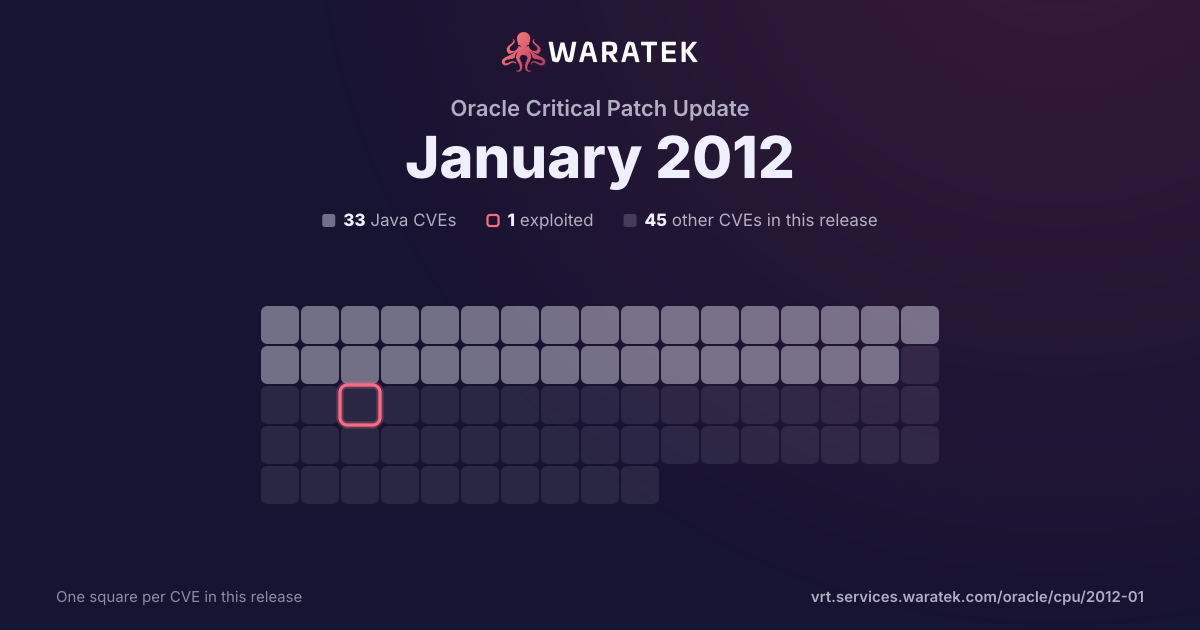
By status
No exploit published. For 33 of them, Oracle's security advisory is the source of public detail.
Overview 3 matches · 0 in Waratek scope · 0 protected · 0 exploited · 0 CISA KEV · 1 public PoC · 1 EPSS ≥ 0.5
3matches
0in Waratek scope0.0%
0protected0.0%
0exploited0.0%
0CISA KEV0.0%
1public PoC33.3%
1EPSS ≥ 0.533.3%
Protected by Waratek
0
0.0%
Rule in development
0
0.0%
Mitigation candidate
0
0.0%
No exploit published
0
0.0%
Outside Waratek scope
3
100.0%
Not applicable
0
0.0%
Withdrawn CVE
0
0.0%
blocked by ARMR today
0
0.0%
partly blocked
0
0.0%
not blocked
3
100.0%
not established
0
0.0%
unrecorded
0
0.0%
Exploited
0
0.0%
Working exploit published
1
33.3%
Proof of concept only
0
0.0%
Forecast only
0
0.0%
No public exploit
2
66.7%
split by
peak 2 / month
Dec 11Jan 12
| CVE | Severity | Published▾ | Status | Exploitation | Description |
|---|---|---|---|---|---|
| CVE-2012-0082 | Medium | 2012-01-18 | Outside Waratek scope | No public exploit | Unspecified vulnerability in the Core RDBMS component in Oracle Database Server 10.1.0.5, 10.2.0.3, 10.2.0.4, 10.2.0.5, 11.1.0.7, 11.2.0.2, and 11.2.0.3 allows remote authenticated users to affect integrity and availability via unknown vectors. |
| CVE-2012-0072 | Medium | 2012-01-18 | Outside Waratek scope | No public exploit | Unspecified vulnerability in the Listener component in Oracle Database Server 10.1.0.5, 10.2.0.3, 10.2.0.4, 10.2.0.5, 11.1.0.7, and 11.2.0.2 allows remote attackers to affect availability via unknown vectors. |
| CVE-2011-5035 | Medium | 2011-12-30 | Outside Waratek scope | Working exploit published | Oracle Glassfish 2.1.1, 3.0.1, and 3.1.1, as used in Communications Server 2.0, Sun Java System Application Server 8.1 and 8.2, and possibly other products, computes hash values for form parameters without restricting the ability to trigger hash collisions predictably, which allows remote attackers to cause a denial of service (CPU consumption) by sending many crafted parameters, aka Oracle security ticket S0104869. |