
Oracle Critical Patch Update January 2012
Released January 2012 · Oracle's advisory ↗ · ← Java SE Critical Patch Update, October 2011 · Java SE Critical Patch Update, February 2012 →
78 CVEs in this release, one square each
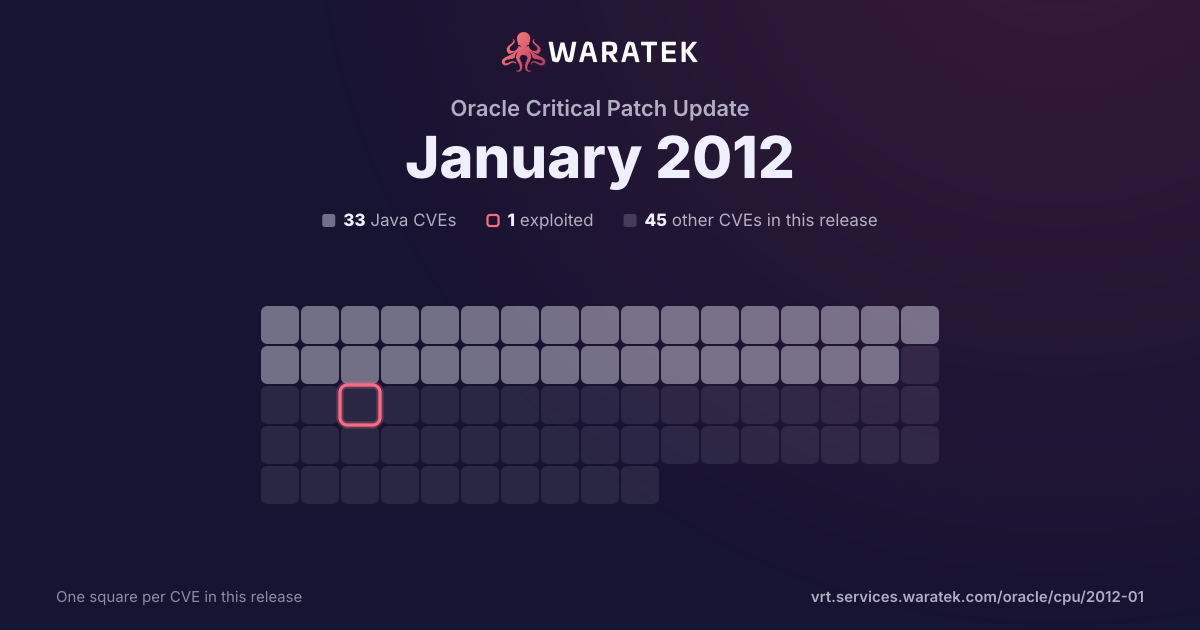
By status
No exploit published. For 33 of them, Oracle's security advisory is the source of public detail.
Overview 26 matches · 0 in Waratek scope · 0 protected · 0 exploited · 0 CISA KEV · 0 public PoC · 0 EPSS ≥ 0.5
26matches
0in Waratek scope0.0%
0protected0.0%
0exploited0.0%
0CISA KEV0.0%
0public PoC0.0%
0EPSS ≥ 0.50.0%
Protected by Waratek
0
0.0%
Rule in development
0
0.0%
Mitigation candidate
0
0.0%
No exploit published
0
0.0%
Outside Waratek scope
0
0.0%
Not applicable
26
100.0%
Withdrawn CVE
0
0.0%
blocked by ARMR today
0
0.0%
partly blocked
0
0.0%
not blocked
26
100.0%
not established
0
0.0%
unrecorded
0
0.0%
Exploited
0
0.0%
Working exploit published
0
0.0%
Proof of concept only
0
0.0%
Forecast only
0
0.0%
No public exploit
26
100.0%
split by
peak 24 / month
Dec 11Jan 12
| CVE | Severity | Published▾ | Status | Exploitation | Description |
|---|---|---|---|---|---|
| CVE-2012-0496 | Medium | 2012-01-18 | Not applicable | No public exploit | Unspecified vulnerability in the MySQL Server component in Oracle MySQL 5.5.x allows remote authenticated users to affect confidentiality and integrity via unknown vectors. |
| CVE-2012-0495 | Medium | 2012-01-18 | Not applicable | No public exploit | Unspecified vulnerability in the MySQL Server component in Oracle MySQL 5.5.x allows remote authenticated users to affect availability via unknown vectors, a different vulnerability than CVE-2012-0117, CVE-2012-0486, CVE-2012-0487, CVE-2012-0488, CVE-2012-0489, CVE-2012-0491, and CVE-2012-0493. |
| CVE-2012-0491 | Medium | 2012-01-18 | Not applicable | No public exploit | Unspecified vulnerability in the MySQL Server component in Oracle MySQL 5.5.x allows remote authenticated users to affect availability via unknown vectors, a different vulnerability than CVE-2012-0117, CVE-2012-0486, CVE-2012-0487, CVE-2012-0488, CVE-2012-0489, CVE-2012-0493, and CVE-2012-0495. |
| CVE-2012-0490 | Medium | 2012-01-18 | Not applicable | No public exploit | Unspecified vulnerability in the MySQL Server component in Oracle MySQL 5.0.x, 5.1.x, and 5.5.x allows remote authenticated users to affect availability via unknown vectors. |
| CVE-2012-0489 | Medium | 2012-01-18 | Not applicable | No public exploit | Unspecified vulnerability in the MySQL Server component in Oracle MySQL 5.5.x allows remote authenticated users to affect availability via unknown vectors, a different vulnerability than CVE-2012-0117, CVE-2012-0486, CVE-2012-0487, CVE-2012-0488, CVE-2012-0491, CVE-2012-0493, and CVE-2012-0495. |
| CVE-2012-0488 | Medium | 2012-01-18 | Not applicable | No public exploit | Unspecified vulnerability in the MySQL Server component in Oracle MySQL 5.5.x allows remote authenticated users to affect availability via unknown vectors, a different vulnerability than CVE-2012-0117, CVE-2012-0486, CVE-2012-0487, CVE-2012-0489, CVE-2012-0491, CVE-2012-0493, and CVE-2012-0495. |
| CVE-2012-0487 | Medium | 2012-01-18 | Not applicable | No public exploit | Unspecified vulnerability in the MySQL Server component in Oracle MySQL 5.5.x allows remote authenticated users to affect availability via unknown vectors, a different vulnerability than CVE-2012-0117, CVE-2012-0486, CVE-2012-0488, CVE-2012-0489, CVE-2012-0491, CVE-2012-0493, and CVE-2012-0495. |
| CVE-2012-0486 | Medium | 2012-01-18 | Not applicable | No public exploit | Unspecified vulnerability in the MySQL Server component in Oracle MySQL 5.5.x allows remote authenticated users to affect availability via unknown vectors, a different vulnerability than CVE-2012-0117, CVE-2012-0487, CVE-2012-0488, CVE-2012-0489, CVE-2012-0491, CVE-2012-0493, and CVE-2012-0495. |
| CVE-2012-0485 | Medium | 2012-01-18 | Not applicable | No public exploit | Unspecified vulnerability in the MySQL Server component in Oracle MySQL 5.1.x and 5.5.x allows remote authenticated users to affect availability via unknown vectors, a different vulnerability than CVE-2012-0112, CVE-2012-0115, CVE-2012-0119, CVE-2012-0120, and CVE-2012-0492. |
| CVE-2012-0484 | Medium | 2012-01-18 | Not applicable | No public exploit | Unspecified vulnerability in the MySQL Server component in Oracle MySQL 5.0.x, 5.1.x, and 5.5.x allows remote authenticated users to affect confidentiality via unknown vectors. |
| CVE-2012-0120 | Medium | 2012-01-18 | Not applicable | No public exploit | Unspecified vulnerability in the MySQL Server component in Oracle MySQL 5.1.x and 5.5.x allows remote authenticated users to affect availability via unknown vectors, a different vulnerability than CVE-2012-0112, CVE-2012-0115, CVE-2012-0119, CVE-2012-0485, and CVE-2012-0492. |
| CVE-2012-0119 | Medium | 2012-01-18 | Not applicable | No public exploit | Unspecified vulnerability in the MySQL Server component in Oracle MySQL 5.1.x and 5.5.x allows remote authenticated users to affect availability via unknown vectors, a different vulnerability than CVE-2012-0112, CVE-2012-0115, CVE-2012-0120, CVE-2012-0485, and CVE-2012-0492. |
| CVE-2012-0118 | Medium | 2012-01-18 | Not applicable | No public exploit | Unspecified vulnerability in the MySQL Server component in Oracle MySQL 5.1.x and 5.5.x allows remote authenticated users to affect confidentiality and availability via unknown vectors, a different vulnerability than CVE-2012-0113. |
| CVE-2012-0116 | Medium | 2012-01-18 | Not applicable | No public exploit | Unspecified vulnerability in the MySQL Server component in Oracle MySQL 5.1.x and 5.5.x allows remote authenticated users to affect confidentiality and integrity via unknown vectors. |
| CVE-2012-0115 | Medium | 2012-01-18 | Not applicable | No public exploit | Unspecified vulnerability in the MySQL Server component in Oracle MySQL 5.1.x and 5.5.x allows remote authenticated users to affect availability via unknown vectors, a different vulnerability than CVE-2012-0112, CVE-2012-0119, CVE-2012-0120, CVE-2012-0485, and CVE-2012-0492. |
| CVE-2012-0113 | Medium | 2012-01-18 | Not applicable | No public exploit | Unspecified vulnerability in the MySQL Server component in Oracle MySQL 5.1.x and 5.5.x allows remote authenticated users to affect confidentiality and availability via unknown vectors, a different vulnerability than CVE-2012-0118. |
| CVE-2012-0103 | Medium | 2012-01-18 | Not applicable | No public exploit | Unspecified vulnerability in Oracle Solaris 11 Express allows local users to affect availability via unknown vectors related to Kernel. |
| CVE-2012-0102 | Medium | 2012-01-18 | Not applicable | No public exploit | Unspecified vulnerability in the MySQL Server component in Oracle MySQL 5.0.x and 5.1.x allows remote authenticated users to affect availability via unknown vectors, a different vulnerability than CVE-2012-0087 and CVE-2012-0101. |
| CVE-2012-0101 | Medium | 2012-01-18 | Not applicable | No public exploit | Unspecified vulnerability in the MySQL Server component in Oracle MySQL 5.0.x and 5.1.x allows remote authenticated users to affect availability via unknown vectors, a different vulnerability than CVE-2012-0087 and CVE-2012-0102. |
| CVE-2012-0100 | Medium | 2012-01-18 | Not applicable | No public exploit | Unspecified vulnerability in Oracle Solaris 9, 10, and 11 Express allows local users to affect confidentiality, integrity, and availability via unknown vectors related to Kerberos. |
| CVE-2012-0096 | Medium | 2012-01-18 | Not applicable | No public exploit | Unspecified vulnerability in Oracle Solaris 8, 9, 10, and 11 Express allows remote attackers to affect availability via unknown vectors related to Network. |
| CVE-2012-0087 | Medium | 2012-01-18 | Not applicable | No public exploit | Unspecified vulnerability in the MySQL Server component in Oracle MySQL 5.0.x and 5.1.x allows remote authenticated users to affect availability via unknown vectors, a different vulnerability than CVE-2012-0101 and CVE-2012-0102. |
| CVE-2012-0079 | Medium | 2012-01-18 | Not applicable | No public exploit | Unspecified vulnerability in Oracle OpenSSO 7.1 and 8.0 allows remote attackers to affect integrity via unknown vectors related to Administration. |
| CVE-2011-2262 | Medium | 2012-01-18 | Not applicable | No public exploit | Unspecified vulnerability in the MySQL Server component in Oracle MySQL 5.1.x and 5.5.x allows remote attackers to affect availability via unknown vectors. |
| CVE-2011-4517 | Medium | 2011-12-15 | Not applicable | No public exploit | The jpc_crg_getparms function in libjasper/jpc/jpc_cs.c in JasPer 1.900.1 uses an incorrect data type during a certain size calculation, which allows remote attackers to trigger a heap-based buffer overflow and execute arbitrary code, or cause a denial of service (heap memory corruption), via a crafted component registration (CRG) marker segment in a JPEG2000 file. |
| CVE-2011-4516 | Medium | 2011-12-15 | Not applicable | No public exploit | Heap-based buffer overflow in the jpc_cox_getcompparms function in libjasper/jpc/jpc_cs.c in JasPer 1.900.1 allows remote attackers to execute arbitrary code or cause a denial of service (memory corruption) via a crafted numrlvls value in a coding style default (COD) marker segment in a JPEG2000 file. |