
Oracle Critical Patch Update April 2011
Released April 2011 · Oracle's advisory ↗ · ← Java SE Critical Patch Update, February 2011 · Java SE Critical Patch Update, June 2011 →
72 CVEs in this release, one square each
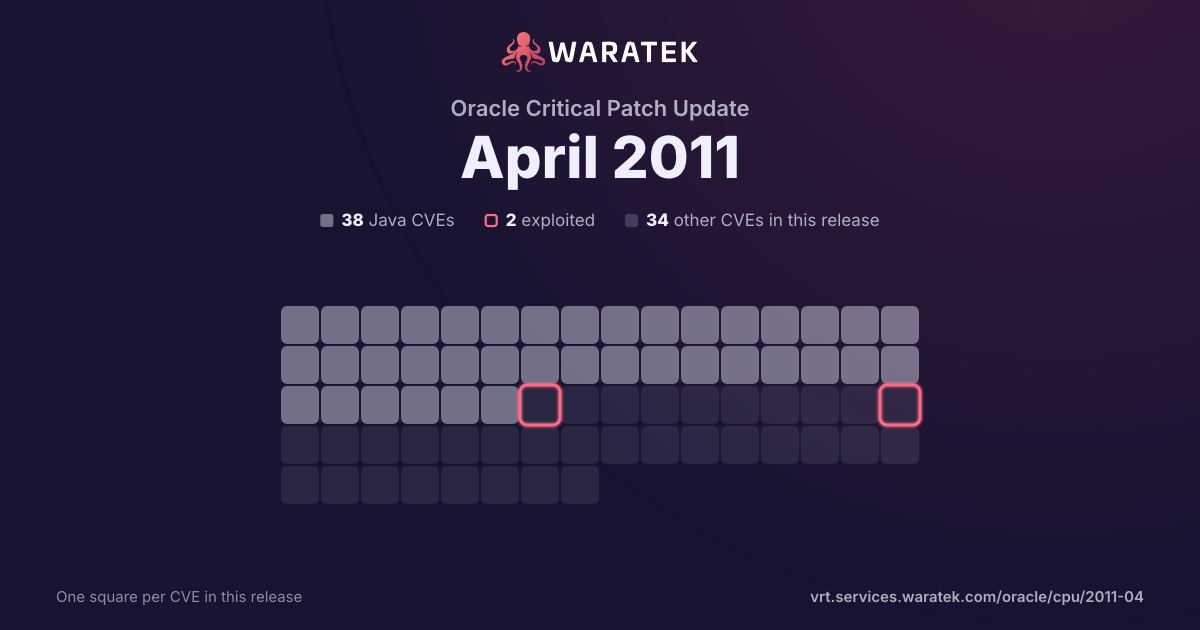
By status
3Mitigation candidate35No exploit published9Outside Waratek scope25Not applicable
2Exploited, marked by the ring
No exploit published. For 35 of them, Oracle's security advisory is the source of public detail.
Overview 6 matches · 0 in Waratek scope · 0 protected · 0 exploited · 0 CISA KEV · 0 public PoC · 0 EPSS ≥ 0.5
6matches
0in Waratek scope0.0%
0protected0.0%
0exploited0.0%
0CISA KEV0.0%
0public PoC0.0%
0EPSS ≥ 0.50.0%
Protected by Waratek
0
0.0%
Rule in development
0
0.0%
Mitigation candidate
0
0.0%
No exploit published
0
0.0%
Outside Waratek scope
0
0.0%
Not applicable
6
100.0%
Withdrawn CVE
0
0.0%
blocked by ARMR today
0
0.0%
partly blocked
0
0.0%
not blocked
6
100.0%
not established
0
0.0%
unrecorded
0
0.0%
Exploited
0
0.0%
Working exploit published
0
0.0%
Proof of concept only
0
0.0%
Forecast only
0
0.0%
No public exploit
6
100.0%
| CVE | Severity | Published▾ | Status | Exploitation | Description |
|---|---|---|---|---|---|
| CVE-2011-0839 | Low | 2011-04-20 | Not applicable | No public exploit | Unspecified vulnerability in Oracle Solaris 9, 10, and 11 Express allows local users to affect availability, related to LOFS. |
| CVE-2011-0821 | Low | 2011-04-20 | Not applicable | No public exploit | Unspecified vulnerability in Oracle Solaris 8, 9, and 10 allows local users to affect confidentiality and integrity via unknown vectors related to uucp. |
| CVE-2011-0812 | Low | 2011-04-20 | Not applicable | No public exploit | Unspecified vulnerability in the Solaris component in Oracle Solaris 8, 9, 10, and 11 Express allows local users to affect availability via unknown vectors related to Kernel. |
| CVE-2011-0801 | Low | 2011-04-20 | Not applicable | No public exploit | Unspecified vulnerability in Oracle Solaris 10 and 11 Express allows local users to affect confidentiality and integrity via unknown vectors related to cp. |
| CVE-2011-0790 | Low | 2011-04-20 | Not applicable | No public exploit | Unspecified vulnerability in Oracle Solaris 9 and 10 allows local users to affect confidentiality via unknown vectors related to wbem. |
| CVE-2011-0412 | Low | 2011-04-19 | Not applicable | No public exploit | Oracle Solaris 8, 9, and 10 stores back-out patch files (undo.Z) unencrypted with world-readable permissions under /var/sadm/pkg/, which allows local users to obtain password hashes and conduct brute force password guessing attacks. |