
Oracle Critical Patch Update April 2011
Released April 2011 · Oracle's advisory ↗ · ← Java SE Critical Patch Update, February 2011 · Java SE Critical Patch Update, June 2011 →
72 CVEs in this release, one square each
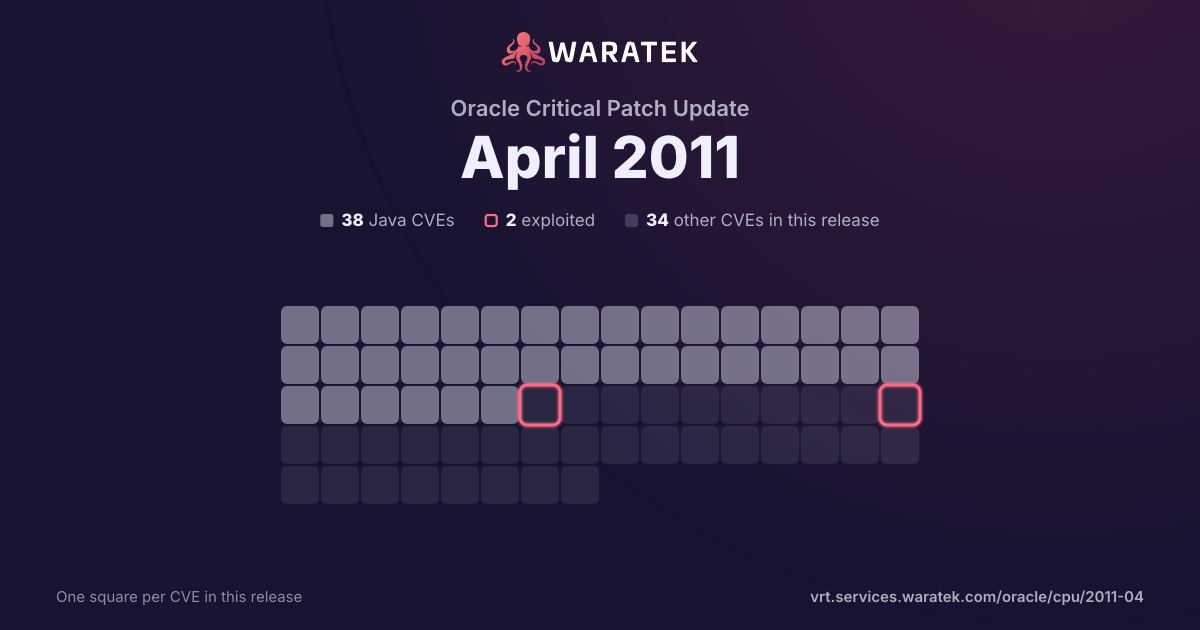
By status
3Mitigation candidate35No exploit published9Outside Waratek scope25Not applicable
2Exploited, marked by the ring
No exploit published. For 35 of them, Oracle's security advisory is the source of public detail.
Overview 11 matches · 1 in Waratek scope · 0 protected · 2 exploited · 0 CISA KEV · 3 public PoC · 2 EPSS ≥ 0.5
11matches
1in Waratek scope9.1%
0protected0.0%
2exploited18.2%
0CISA KEV0.0%
3public PoC27.3%
2EPSS ≥ 0.518.2%
Protected by Waratek
0
0.0%
Rule in development
0
0.0%
Mitigation candidate
1
9.1%
No exploit published
0
0.0%
Outside Waratek scope
1
9.1%
Not applicable
9
81.8%
Withdrawn CVE
0
0.0%
blocked by ARMR today
0
0.0%
partly blocked
0
0.0%
not blocked
11
100.0%
not established
0
0.0%
unrecorded
0
0.0%
Exploited
2
18.2%
Working exploit published
1
9.1%
Proof of concept only
0
0.0%
Forecast only
0
0.0%
No public exploit
8
72.7%
split by
peak 8 / month
Nov 091
Not applicable1
Critical1
not blocked1
Exploited1
Dec 090
Jan 100
Feb 100
Mar 100
Apr 100
May 100
Jun 100
Jul 100
Aug 100
Sep 100
Oct 100
Nov 100
Dec 100
Jan 118
Not applicable8
High7
Medium1
not blocked8
No public exploit8
Feb 112
Mitigation candidate1
Outside Waratek scope1
High1
Medium1
not blocked2
Exploited1
Working exploit published1
Dec 09Feb 10Apr 10Jun 10Aug 10Oct 10Dec 10Feb 11
| CVE | Severity | Published▾ | Status | Exploitation | Description |
|---|---|---|---|---|---|
| CVE-2010-4476 | Medium | 2011-02-17 | Mitigation candidate | Working exploit published | The Double.parseDouble method in Java Runtime Environment (JRE) in Oracle Java SE and Java for Business 6 Update 23 and earlier, 5.0 Update 27 and earlier, and 1.4.2_29 and earlier, as used in OpenJDK, Apache, JBossweb, and other products, allows remote attackers to cause a denial of service via a crafted string that triggers an infinite loop of estimations during conversion to a double-precision binary floating-point number, as demonstrated using 2.2250738585072012e-308. |
| CVE-2010-4452 | High | 2011-02-17 | Outside Waratek scope | Exploited | Unspecified vulnerability in the Deployment component in Java Runtime Environment (JRE) in Oracle Java SE and Java for Business 6 Update 23 and earlier allows remote untrusted Java Web Start applications and untrusted Java applets to affect confidentiality, integrity, and availability via unknown vectors. |
| CVE-2010-4643 | High | 2011-01-28 | Not applicable | No public exploit | Heap-based buffer overflow in Impress in OpenOffice.org (OOo) 2.x and 3.x before 3.3 allows remote attackers to cause a denial of service (application crash) or possibly execute arbitrary code via a crafted Truevision TGA (TARGA) file in an ODF or Microsoft Office document. |
| CVE-2010-4253 | High | 2011-01-28 | Not applicable | No public exploit | Heap-based buffer overflow in Impress in OpenOffice.org (OOo) 2.x and 3.x before 3.3 allows remote attackers to cause a denial of service (application crash) or possibly execute arbitrary code via a crafted PNG file in an ODF or Microsoft Office document, as demonstrated by a PowerPoint (aka PPT) document. |
| CVE-2010-3689 | Medium | 2011-01-28 | Not applicable | No public exploit | soffice in OpenOffice.org (OOo) 3.x before 3.3 places a zero-length directory name in the LD_LIBRARY_PATH, which allows local users to gain privileges via a Trojan horse shared library in the current working directory. |
| CVE-2010-3454 | High | 2011-01-28 | Not applicable | No public exploit | Multiple off-by-one errors in the WW8DopTypography::ReadFromMem function in oowriter in OpenOffice.org (OOo) 2.x and 3.x before 3.3 allow remote attackers to cause a denial of service (application crash) or possibly execute arbitrary code via crafted typography information in a Microsoft Word .DOC file that triggers an out-of-bounds write. |
| CVE-2010-3453 | High | 2011-01-28 | Not applicable | No public exploit | The WW8ListManager::WW8ListManager function in oowriter in OpenOffice.org (OOo) 2.x and 3.x before 3.3 does not properly handle an unspecified number of list levels in user-defined list styles in WW8 data in a Microsoft Word document, which allows remote attackers to cause a denial of service (application crash) or possibly execute arbitrary code via a crafted .DOC file that triggers an out-of-bounds write. |
| CVE-2010-3452 | High | 2011-01-28 | Not applicable | No public exploit | Use-after-free vulnerability in oowriter in OpenOffice.org (OOo) 2.x and 3.x before 3.3 allows remote attackers to cause a denial of service (application crash) or possibly execute arbitrary code via crafted tags in an RTF document. |
| CVE-2010-3451 | High | 2011-01-28 | Not applicable | No public exploit | Use-after-free vulnerability in oowriter in OpenOffice.org (OOo) 2.x and 3.x before 3.3 allows remote attackers to cause a denial of service (application crash) or possibly execute arbitrary code via malformed tables in an RTF document. |
| CVE-2010-3450 | High | 2011-01-28 | Not applicable | No public exploit | Multiple directory traversal vulnerabilities in OpenOffice.org (OOo) 2.x and 3.x before 3.3 allow remote attackers to overwrite arbitrary files via a .. (dot dot) in an entry in (1) an XSLT JAR filter description file, (2) an Extension (aka OXT) file, or unspecified other (3) JAR or (4) ZIP files. |
| CVE-2009-3555 | Critical | 2009-11-09 | Not applicable | Exploited | The TLS protocol, and the SSL protocol 3.0 and possibly earlier, as used in Microsoft Internet Information Services (IIS) 7.0, mod_ssl in the Apache HTTP Server 2.2.14 and earlier, OpenSSL before 0.9.8l, GnuTLS 2.8.5 and earlier, Mozilla Network Security Services (NSS) 3.12.4 and earlier, multiple Cisco products, and other products, does not properly associate renegotiation handshakes with an existing connection, which allows man-in-the-middle attackers to insert data into HTTPS sessions, and possibly other types of sessions protected by TLS or SSL, by sending an unauthenticated request that is processed retroactively by a server in a post-renegotiation context, related to a "plaintext injection" attack, aka the "Project Mogul" issue. |