
Oracle Critical Patch Update January 2011
Released January 2011 · Oracle's advisory ↗ · ← Java SE Critical Patch Update, October 2010 · Java SE Critical Patch Update, February 2011 →
66 CVEs in this release, one square each
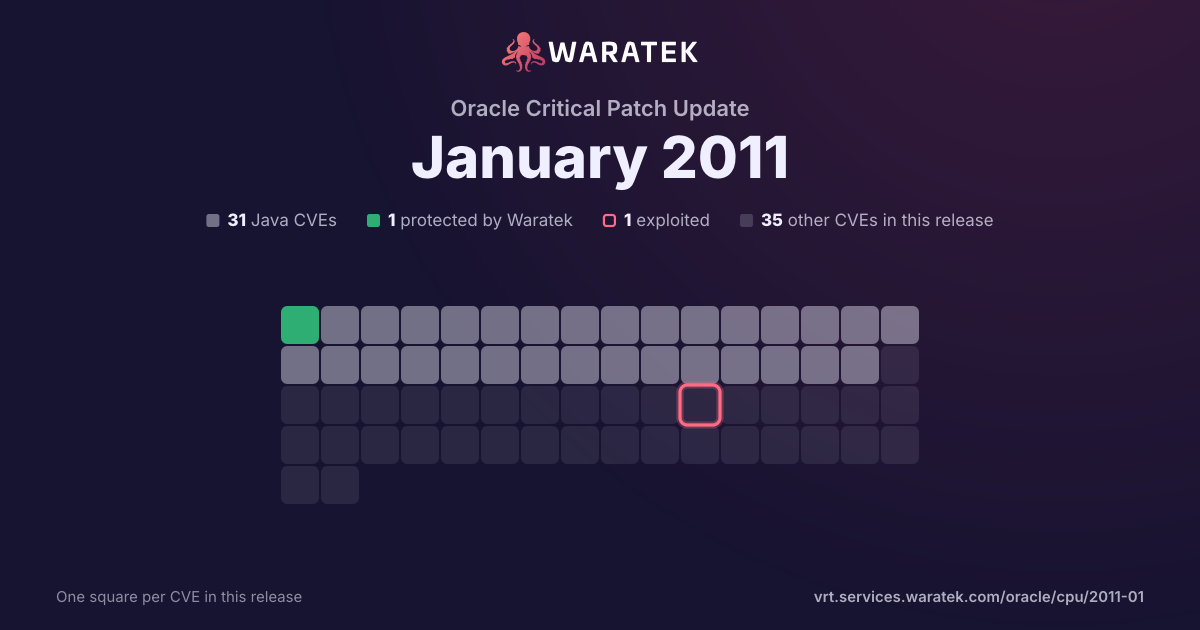
By status
1Protected by Waratek3Mitigation candidate27No exploit published11Outside Waratek scope24Not applicable
1Exploited, marked by the ring
No exploit published. For 26 of them, Oracle's security advisory is the source of public detail.
Protected by Waratek. Waratek RASP can block exploitation of these on systems that have not applied the patch yet.
Overview 3 matches · 0 in Waratek scope · 0 protected · 0 exploited · 0 CISA KEV · 0 public PoC · 0 EPSS ≥ 0.5
3matches
0in Waratek scope0.0%
0protected0.0%
0exploited0.0%
0CISA KEV0.0%
0public PoC0.0%
0EPSS ≥ 0.50.0%
Protected by Waratek
0
0.0%
Rule in development
0
0.0%
Mitigation candidate
0
0.0%
No exploit published
0
0.0%
Outside Waratek scope
1
33.3%
Not applicable
2
66.7%
Withdrawn CVE
0
0.0%
blocked by ARMR today
0
0.0%
partly blocked
0
0.0%
not blocked
3
100.0%
not established
0
0.0%
unrecorded
0
0.0%
Exploited
0
0.0%
Working exploit published
0
0.0%
Proof of concept only
0
0.0%
Forecast only
0
0.0%
No public exploit
3
100.0%
split by
peak 2 / month
Aug 10Sep 10Oct 10
| CVE | Severity | Published▾ | Status | Exploitation | Description |
|---|---|---|---|---|---|
| CVE-2010-3574 | High | 2010-10-19 | Outside Waratek scope | No public exploit | Unspecified vulnerability in the Networking component in Oracle Java SE and Java for Business 6 Update 21, 5.0 Update 25, 1.4.2_27, and 1.3.1_28 allows remote attackers to affect confidentiality, integrity, and availability via unknown vectors. NOTE: the previous information was obtained from the October 2010 CPU. Oracle has not commented on claims from a reliable downstream vendor that HttpURLConnection does not properly check for the allowHttpTrace permission, which allows untrusted code to perform HTTP TRACE requests. |
| CVE-2010-2936 | High | 2010-08-25 | Not applicable | No public exploit | Integer overflow in simpress.bin in the Impress module in OpenOffice.org (OOo) 2.x and 3.x before 3.3 allows remote attackers to cause a denial of service (application crash) or possibly execute arbitrary code via crafted polygons in a PowerPoint document that triggers a heap-based buffer overflow. |
| CVE-2010-2935 | High | 2010-08-25 | Not applicable | No public exploit | simpress.bin in the Impress module in OpenOffice.org (OOo) 2.x and 3.x before 3.3 does not properly handle integer values associated with dictionary property items, which allows remote attackers to cause a denial of service (application crash) or possibly execute arbitrary code via a crafted PowerPoint document that triggers a heap-based buffer overflow, related to an "integer truncation error." |