
Oracle Critical Patch Update January 2011
Released January 2011 · Oracle's advisory ↗ · ← Java SE Critical Patch Update, October 2010 · Java SE Critical Patch Update, February 2011 →
66 CVEs in this release, one square each
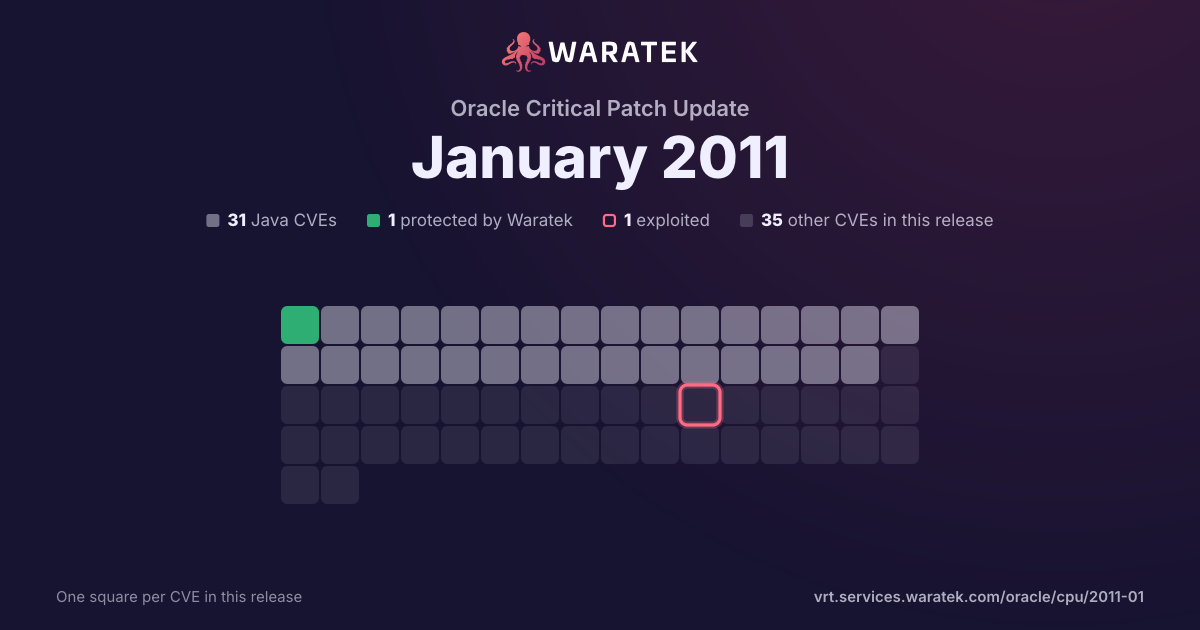
By status
1Protected by Waratek3Mitigation candidate27No exploit published11Outside Waratek scope24Not applicable
1Exploited, marked by the ring
No exploit published. For 26 of them, Oracle's security advisory is the source of public detail.
Protected by Waratek. Waratek RASP can block exploitation of these on systems that have not applied the patch yet.
Overview 3 matches · 0 in Waratek scope · 0 protected · 1 exploited · 0 CISA KEV · 1 EPSS ≥ 0.5
Protected by Waratek
0
0.0%
Rule in development
0
0.0%
Mitigation candidate
0
0.0%
No exploit published
0
0.0%
Outside Waratek scope
0
0.0%
Not applicable
3
100.0%
Withdrawn CVE
0
0.0%
blocked by ARMR today
0
0.0%
partly blocked
0
0.0%
not blocked
3
100.0%
not established
0
0.0%
unrecorded
0
0.0%
Exploited
1
33.3%
Working exploit published
2
66.7%
Proof of concept only
0
0.0%
Forecast only
0
0.0%
No public exploit
0
0.0%
split by
peak 2 / month
Nov 09Jan 10Mar 10May 10Jul 10Sep 10Nov 10Jan 11
| CVE | Severity | Published▾ | Status | Exploitation | Description |
|---|---|---|---|---|---|
| CVE-2010-4435 | High | 2011-01-19 | Not applicable | Working exploit published | Unspecified vulnerability in Oracle Solaris 8, 9, and 10 allows remote attackers to affect confidentiality, integrity, and availability, related to CDE Calendar Manager Service Daemon and RPC. NOTE: the previous information was obtained from the January 2011 CPU. Oracle has not commented on claims from other software vendors that this affects other operating systems, such as HP-UX, or claims from a reliable third party that this is a buffer overflow in rpc.cmsd via long XDR-encoded ASCII strings in RPC call 10. |
| CVE-2010-2632 | High | 2011-01-19 | Not applicable | Working exploit published | Unspecified vulnerability in the FTP Server in Oracle Solaris 8, 9, 10, and 11 Express allows remote attackers to affect availability. NOTE: the previous information was obtained from the January 2011 CPU. Oracle has not commented on claims from a reliable researcher that this is an issue in the glob implementation in libc that allows remote authenticated users to cause a denial of service (CPU and memory consumption) via crafted glob expressions that do not match any pathnames. |
| CVE-2009-3555 | Critical | 2009-11-09 | Not applicable | Exploited | The TLS protocol, and the SSL protocol 3.0 and possibly earlier, as used in Microsoft Internet Information Services (IIS) 7.0, mod_ssl in the Apache HTTP Server 2.2.14 and earlier, OpenSSL before 0.9.8l, GnuTLS 2.8.5 and earlier, Mozilla Network Security Services (NSS) 3.12.4 and earlier, multiple Cisco products, and other products, does not properly associate renegotiation handshakes with an existing connection, which allows man-in-the-middle attackers to insert data into HTTPS sessions, and possibly other types of sessions protected by TLS or SSL, by sending an unauthenticated request that is processed retroactively by a server in a post-renegotiation context, related to a "plaintext injection" attack, aka the "Project Mogul" issue. |