
Oracle Critical Patch Update January 2011
Released January 2011 · Oracle's advisory ↗ · ← Java SE Critical Patch Update, October 2010 · Java SE Critical Patch Update, February 2011 →
66 CVEs in this release, one square each
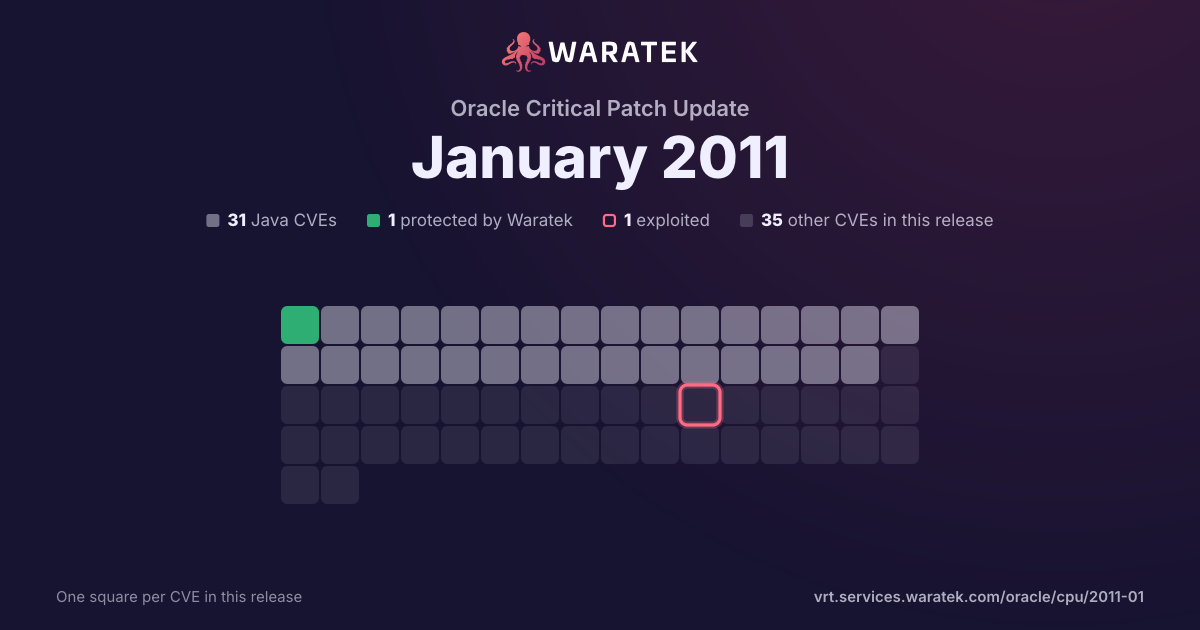
By status
1Protected by Waratek3Mitigation candidate27No exploit published11Outside Waratek scope24Not applicable
1Exploited, marked by the ring
No exploit published. For 26 of them, Oracle's security advisory is the source of public detail.
Protected by Waratek. Waratek RASP can block exploitation of these on systems that have not applied the patch yet.
Overview 3 matches · 1 in Waratek scope · 0 protected · 1 exploited · 0 CISA KEV
Protected by Waratek
0
0.0%
Rule in development
0
0.0%
Mitigation candidate
1
33.3%
No exploit published
0
0.0%
Outside Waratek scope
1
33.3%
Not applicable
1
33.3%
Withdrawn CVE
0
0.0%
blocked by ARMR today
0
0.0%
partly blocked
0
0.0%
not blocked
3
100.0%
not established
0
0.0%
unrecorded
0
0.0%
Exploited
1
33.3%
Working exploit published
2
66.7%
Proof of concept only
0
0.0%
Forecast only
0
0.0%
No public exploit
0
0.0%
split by
peak 2 / month
Nov 09Jan 10Mar 10May 10Jul 10Sep 10Nov 10Jan 11
| CVE | Severity | Published▾ | Status | Exploitation | Description |
|---|---|---|---|---|---|
| CVE-2010-4417 | High | 2011-01-19 | Mitigation candidate | Working exploit published | Unspecified vulnerability in the Services for Beehive component in Oracle Fusion Middleware 2.0.1.0, 2.0.1.1, 2.0.1.2, 2.0.1.2.1, and 2.0.1.3 allows remote attackers to affect confidentiality, integrity, and availability via unknown vectors. NOTE: the previous information was obtained from the January 2011 CPU. Oracle has not commented on claims from a reliable third party coordinator that voice-servlet/prompt-qa/Index.jspf does not properly handle null (%00) bytes in the evaluation parameter that is used in a filename, which allows attackers to create a file with an executable extension and execute arbitrary JSP code. |
| CVE-2010-3600 | High | 2011-01-19 | Outside Waratek scope | Working exploit published | Unspecified vulnerability in the Client System Analyzer component in Oracle Database Server 11.1.0.7 and 11.2.0.1 and Enterprise Manager Grid Control 10.2.0.5 allows remote attackers to affect confidentiality, integrity, and availability via unknown vectors. NOTE: the previous information was obtained from the January 2011 CPU. Oracle has not commented on claims from a reliable third party coordinator that this issue involves an exposed JSP script that accepts XML uploads in conjunction with NULL bytes in an unspecified parameter that allow execution of arbitrary code. |
| CVE-2009-3555 | Critical | 2009-11-09 | Not applicable | Exploited | The TLS protocol, and the SSL protocol 3.0 and possibly earlier, as used in Microsoft Internet Information Services (IIS) 7.0, mod_ssl in the Apache HTTP Server 2.2.14 and earlier, OpenSSL before 0.9.8l, GnuTLS 2.8.5 and earlier, Mozilla Network Security Services (NSS) 3.12.4 and earlier, multiple Cisco products, and other products, does not properly associate renegotiation handshakes with an existing connection, which allows man-in-the-middle attackers to insert data into HTTPS sessions, and possibly other types of sessions protected by TLS or SSL, by sending an unauthenticated request that is processed retroactively by a server in a post-renegotiation context, related to a "plaintext injection" attack, aka the "Project Mogul" issue. |