
Oracle Critical Patch Update October 2010
Released October 2010 · Oracle's advisory ↗ · ← Critical Patch Update, July 2010 · Java SE Critical Patch Update, October 2010 →
85 CVEs in this release, one square each
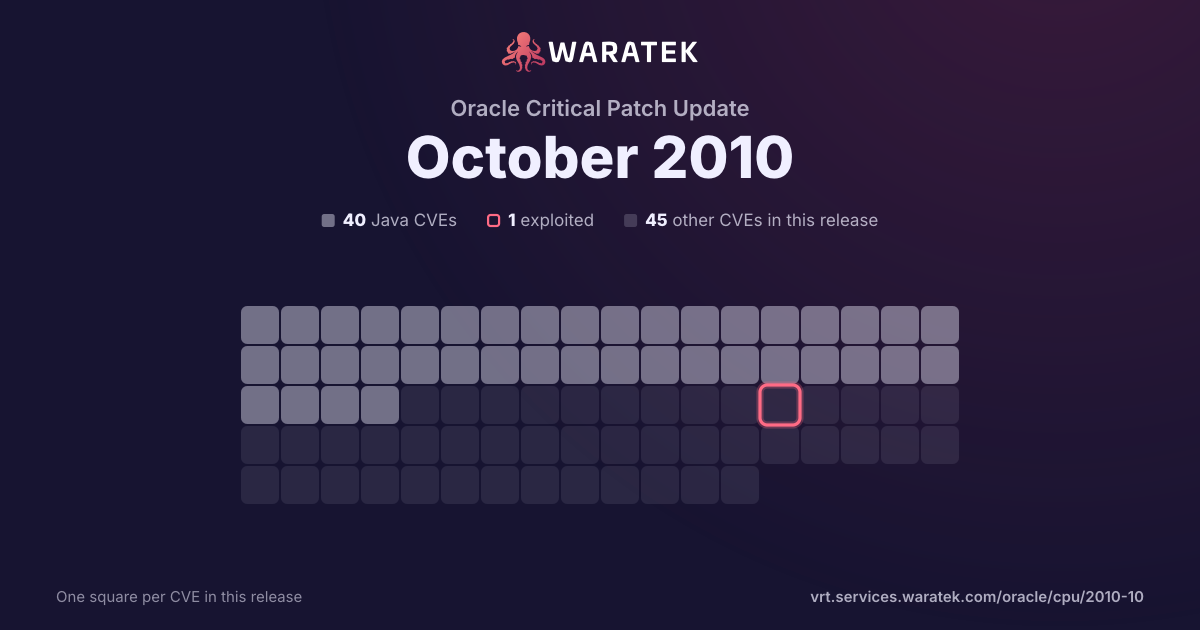
By status
1Mitigation candidate39No exploit published9Outside Waratek scope36Not applicable
1Exploited, marked by the ring
No exploit published. For 39 of them, Oracle's security advisory is the source of public detail.
Overview 59 matches · 38 in Waratek scope · 0 protected · 0 exploited · 0 CISA KEV · 0 public PoC · 0 EPSS ≥ 0.5
59matches
38in Waratek scope64.4%
0protected0.0%
0exploited0.0%
0CISA KEV0.0%
0public PoC0.0%
0EPSS ≥ 0.50.0%
Protected by Waratek
0
0.0%
Rule in development
0
0.0%
Mitigation candidate
0
0.0%
No exploit published
38
64.4%
Outside Waratek scope
6
10.2%
Not applicable
15
25.4%
Withdrawn CVE
0
0.0%
blocked by ARMR today
0
0.0%
partly blocked
0
0.0%
not blocked
59
100.0%
not established
0
0.0%
unrecorded
0
0.0%
Exploited
0
0.0%
Working exploit published
0
0.0%
Proof of concept only
0
0.0%
Forecast only
0
0.0%
No public exploit
59
100.0%
split by
peak 58 / month
May 10Jun 10Jul 10Aug 10Sep 10Oct 10
| CVE | Severity | Published▾ | Status | Exploitation | Description |
|---|---|---|---|---|---|
| CVE-2010-3584 | Medium | 2010-10-14 | Not applicable | No public exploit | Unspecified vulnerability in the Oracle VM component in Oracle VM 2.2.1 allows local users to affect confidentiality, integrity, and availability via unknown vectors related to ovs-agent. NOTE: the previous information was obtained from the October 2010 CPU. Oracle has not commented on claims from a third party researcher that this is related to the storage of passwords and password hashes in cleartext in files with insecure permissions. |
| CVE-2010-3580 | Medium | 2010-10-14 | Not applicable | No public exploit | Unspecified vulnerability in Oracle OpenSolaris allows local users to affect availability via unknown vectors related to Kernel/File System. |
| CVE-2010-3579 | Medium | 2010-10-14 | Not applicable | No public exploit | Unspecified vulnerability in the (1) Sun Convergence 1 and (2) Sun Java Communications Suite 7 components in Oracle Sun Products Suite 1.0 and 7.0 allows remote attackers to affect confidentiality and integrity via unknown vectors related to Webmail. |
| CVE-2010-3577 | Medium | 2010-10-14 | Not applicable | No public exploit | Unspecified vulnerability in Oracle OpenSolaris allows remote attackers to affect confidentiality and integrity, related to Kernel/CIFS. |
| CVE-2010-3575 | Medium | 2010-10-14 | Not applicable | No public exploit | Unspecified vulnerability in the Oracle Communications Messaging Server (Sun Java System Messaging Server) component in Oracle Sun Products Suite 6.0, 6.2, 6.3, and 7.0 allows remote attackers to affect confidentiality and integrity via unknown vectors related to Web Mail. |
| CVE-2010-3564 | Medium | 2010-10-14 | Not applicable | No public exploit | Unspecified vulnerability in the Oracle Communications Messaging Server (Sun Java System Messaging Server) component in Oracle Sun Products Suite 7.0 allows remote attackers to affect confidentiality and integrity via unknown vectors related to Webmail. NOTE: the previous information was obtained from the October 2010 CPU. Oracle has not commented on claims from a reliable downstream vendor that the Kerberos implementation does not properly check AP-REQ requests, which allows attackers to cause a denial of service in the JVM. NOTE: CVE has not investigated the apparent discrepancy between the two vendors regarding the consequences of this issue. |
| CVE-2010-3547 | Medium | 2010-10-14 | No exploit published | No public exploit | Unspecified vulnerability in the PeopleSoft FMS ESA - EX component in Oracle PeopleSoft and JDEdwards Suite 8.9 Bundle #38, 9.0 Bundle #31, and 9.1 Bundle #6 allows remote authenticated users to affect confidentiality and integrity via unknown vectors. |
| CVE-2010-3546 | Medium | 2010-10-14 | Not applicable | No public exploit | Unspecified vulnerability in the Sun Java System Identity Manager component in Oracle Sun Products Suite 8.1 allows remote attackers to affect confidentiality and integrity via unknown vectors. |
| CVE-2010-3545 | Medium | 2010-10-14 | Not applicable | No public exploit | Unspecified vulnerability in the Oracle iPlanet Web Server (Sun Java System Web Server) component in Oracle Sun Products Suite 7.0 allows remote attackers to affect confidentiality and integrity via unknown vectors related to Administration. |
| CVE-2010-3544 | Medium | 2010-10-14 | Not applicable | No public exploit | Unspecified vulnerability in the Oracle iPlanet Web Server (Sun Java System Web Server) component in Oracle Sun Products Suite 7.0 allows remote attackers to affect integrity and availability via unknown vectors related to Administration. NOTE: the previous information was obtained from the October 2010 CPU. Oracle has not commented on claims from a reliable source that this is cross-site request forgery (CSRF) that allows remote attackers to stop an instance via the management console. |
| CVE-2010-3540 | Medium | 2010-10-14 | Not applicable | No public exploit | Unspecified vulnerability in Oracle Solaris 10 and OpenSolaris allows local users to affect availability, related to ZFS. |
| CVE-2010-3539 | Medium | 2010-10-14 | No exploit published | No public exploit | Unspecified vulnerability in the PeopleSoft Enterprise FMS - GL component in Oracle PeopleSoft and JDEdwards Suite 8.9 Bundle #38, 9.0 Bundle #31, and 9.1 Bundle #6 allows remote authenticated users to affect confidentiality and integrity via unknown vectors, a different vulnerability than CVE-2010-3538. |
| CVE-2010-3538 | Medium | 2010-10-14 | No exploit published | No public exploit | Unspecified vulnerability in the PeopleSoft Enterprise FMS - GL component in Oracle PeopleSoft and JDEdwards Suite 8.9 Bundle #38, 9.0 Bundle #31, and 9.1 Bundle #6 allows remote authenticated users to affect confidentiality and integrity via unknown vectors, a different vulnerability than CVE-2010-3539. |
| CVE-2010-3537 | Medium | 2010-10-14 | No exploit published | No public exploit | Unspecified vulnerability in the PeopleSoft Enterprise FMS - AM component in Oracle PeopleSoft and JDEdwards Suite 8.9 Bundle #38, 9.0 Bundle #31, and 9.1 Bundle #6 allows remote authenticated users to affect confidentiality and integrity via unknown vectors. |
| CVE-2010-3536 | Medium | 2010-10-14 | No exploit published | No public exploit | Unspecified vulnerability in the PeopleSoft Enterprise SCM component in Oracle PeopleSoft and JDEdwards Suite 8.9 Bundle #38, 9.0 Bundle #31, and 9.1 Bundle #6 allows remote authenticated users to affect confidentiality and integrity via unknown vectors. |
| CVE-2010-3535 | Medium | 2010-10-14 | Not applicable | No public exploit | Unspecified vulnerability in the Directory Server Enterprise Edition component in Oracle Sun Products Suite 6.0, 6.1, 6.2, and 6.3 allows local users to affect confidentiality, integrity, and availability via unknown vectors related to Identity Synchronization for Windows. |
| CVE-2010-3534 | Medium | 2010-10-14 | No exploit published | No public exploit | Unspecified vulnerability in the Primavera P6 Enterprise Project Portfolio Management component in Oracle Primavera Products Suite 6.21.3.0 and 7.0.1.0 allows local users to affect confidentiality, integrity, and availability via unknown vectors related to the Project Management Module. |
| CVE-2010-3533 | Medium | 2010-10-14 | No exploit published | No public exploit | Unspecified vulnerability in the PeopleSoft Enterprise SCM OM and CRM Order Capture component in Oracle PeopleSoft and JDEdwards Suite 8.9, 9.0, and 9.1 allows remote authenticated users to affect confidentiality and integrity via unknown vectors. |
| CVE-2010-3532 | Medium | 2010-10-14 | No exploit published | No public exploit | Unspecified vulnerability in the PeopleSoft Enterprise CRM - Order Capture component in Oracle PeopleSoft and JDEdwards Suite 9.0 Bundle #28 and 9.1 Bundle #4 allows remote authenticated users to affect confidentiality and integrity via unknown vectors. |
| CVE-2010-3531 | Medium | 2010-10-14 | No exploit published | No public exploit | Unspecified vulnerability in the PeopleSoft Enterprise FMS ESA - RM component in Oracle PeopleSoft and JDEdwards Suite 8.9 Bundle #38, 9.0 Bundle #31, and 9.1 Bundle #6 allows remote authenticated users to affect confidentiality and integrity via unknown vectors. |
| CVE-2010-3530 | Medium | 2010-10-14 | No exploit published | No public exploit | Unspecified vulnerability in the PeopleSoft Enterprise HCM - HR component in Oracle PeopleSoft and JDEdwards Suite 9.0 Bundle #13 and 9.1 Bundle #3 allows remote authenticated users to affect confidentiality and integrity via unknown vectors. |
| CVE-2010-3529 | Medium | 2010-10-14 | No exploit published | No public exploit | Unspecified vulnerability in the PeopleSoft Enterprise FMS - Cash Management component in Oracle PeopleSoft and JDEdwards Suite 8.9 Bundle #38, 9.0 Bundle #31, and 9.1 Bundle #6 allows remote authenticated users to affect confidentiality and integrity via unknown vectors. |
| CVE-2010-3528 | Medium | 2010-10-14 | No exploit published | No public exploit | Unspecified vulnerability in the PeopleSoft Enterprise CRM - Common Components component in Oracle PeopleSoft and JDEdwards Suite 8.9 Bundle #41, 9.0 Bundle #28, and 9.1 Bundle #4 allows remote authenticated users to affect confidentiality via unknown vectors. |
| CVE-2010-3527 | Medium | 2010-10-14 | No exploit published | No public exploit | Unspecified vulnerability in the PeopleSoft Enterprise FMS - AM component in Oracle PeopleSoft and JDEdwards Suite 8.9 Bundle #38, 9.0 Bundle #31, and 9.1 Bundle #6 allows remote authenticated users to affect integrity and availability via unknown vectors. |
| CVE-2010-3526 | Medium | 2010-10-14 | No exploit published | No public exploit | Unspecified vulnerability in the PeopleSoft Enterprise SCM - PO component in Oracle PeopleSoft and JDEdwards Suite 8.9 Bundle #38, 9.0 Bundle #31, and 9.1 Bundle #6 allows remote authenticated users to affect confidentiality and integrity via unknown vectors. |
| CVE-2010-3525 | Medium | 2010-10-14 | No exploit published | No public exploit | Unspecified vulnerability in the (1) PeopleSoft Enterprise FMS, (2) SCM, (3) EPM, (4) CRM, and (5) Campus Solutions components in Oracle PeopleSoft and JDEdwards Suite 8.9, 9.0, and 9.1 allows remote authenticated users to affect confidentiality and integrity via unknown vectors. |
| CVE-2010-3524 | Medium | 2010-10-14 | No exploit published | No public exploit | Unspecified vulnerability in the PeopleSoft Enterprise SCM - Strategic Sourcing component in Oracle PeopleSoft and JDEdwards Suite 8.9 Bundle #38, 9.0 Bundle #31, and 9.1 Bundle #6 allows remote authenticated users to affect confidentiality and integrity via unknown vectors. |
| CVE-2010-3523 | Medium | 2010-10-14 | No exploit published | No public exploit | Unspecified vulnerability in the PeopleSoft Enterprise PeopleTools component in Oracle PeopleSoft and JDEdwards Suite 8.49.28 and 8.50.12 allows remote attackers to affect integrity via unknown vectors. |
| CVE-2010-3522 | Medium | 2010-10-14 | No exploit published | No public exploit | Unspecified vulnerability in the PeopleSoft Enterprise PeopleTools component in Oracle PeopleSoft and JDEdwards Suite 8.49.28 and 8.50.12 allows remote authenticated users to affect confidentiality via unknown vectors. |
| CVE-2010-3521 | Medium | 2010-10-14 | No exploit published | No public exploit | Unspecified vulnerability in the PeopleSoft Enterprise HCM ePay component in Oracle PeopleSoft and JDEdwards Suite 9.0 to Payroll Update 10-C and 9.1 to Payroll Update 10-C allows remote authenticated users to affect confidentiality and integrity via unknown vectors. |
| CVE-2010-3520 | Medium | 2010-10-14 | No exploit published | No public exploit | Unspecified vulnerability in the PeopleSoft Enterprise HCM - GP France component in Oracle PeopleSoft and JDEdwards Suite 8.81 SP1 Bundle #12, 8.9 GP Update 2010-E, 9.0 GP Update 2010-E, and 9.1 GP Update 2010-E allows remote authenticated users to affect confidentiality and integrity via unknown vectors. |
| CVE-2010-3519 | Medium | 2010-10-14 | No exploit published | No public exploit | Unspecified vulnerability in the PeopleSoft Enterprise PeopleTools component in Oracle PeopleSoft and JDEdwards Suite 8.49.28 and 8.50.12 allows remote authenticated users to affect integrity via unknown vectors. |
| CVE-2010-3518 | Medium | 2010-10-14 | No exploit published | No public exploit | Unspecified vulnerability in the PeopleSoft Enterprise HCM GP - Japan component in Oracle PeopleSoft and JDEdwards Suite 8.81 SP1 Bundle #13, 8.9 GP Update 2010-E, 9.0 GP Update 2010-E, and 9.1 GP Update 2010-E allows remote authenticated users to affect confidentiality and integrity via unknown vectors. |
| CVE-2010-3517 | Medium | 2010-10-14 | Not applicable | No public exploit | Unspecified vulnerability in Oracle Solaris 10 and OpenSolaris allows local users to affect availability, related to Kernel/X86. |
| CVE-2010-3516 | Medium | 2010-10-14 | Not applicable | No public exploit | Unspecified vulnerability in Oracle Solaris 10 and OpenSolaris allows local users to affect availability via unknown vectors related to InfiniBand. |
| CVE-2010-3515 | Medium | 2010-10-14 | Not applicable | No public exploit | Unspecified vulnerability in the Solaris component in Oracle Solaris 9 and 10, and OpenSolaris, allows local users to affect availability via unknown vectors related to Kernel/Disk Driver. |
| CVE-2010-3507 | Medium | 2010-10-14 | Not applicable | No public exploit | Unspecified vulnerability in Oracle Solaris 8, 9, and 10 allows local users to affect confidentiality, integrity, and availability via unknown vectors related to Live Upgrade. |
| CVE-2010-3504 | Medium | 2010-10-14 | No exploit published | No public exploit | Unspecified vulnerability in the Oracle Applications Technology Stack component in Oracle E-Business Suite 11.5.10.2, 12.0.6, and 12.1.2 allows remote attackers to affect integrity via unknown vectors. |
| CVE-2010-3502 | Medium | 2010-10-14 | No exploit published | No public exploit | Unspecified vulnerability in the Siebel Core component in Oracle Siebel Suite 7.7.2.12, 7.8.2.14, 8.0.0.10, and 8.1.1.3 allows remote authenticated users to affect confidentiality via unknown vectors. |
| CVE-2010-3501 | Medium | 2010-10-14 | No exploit published | No public exploit | Unspecified vulnerability in the OID component in Oracle Fusion Middleware 10.1.2.3, 10.1.4.3, and 11.1.1.2.0 allows remote attackers to affect availability via unknown vectors. |
| CVE-2010-3500 | Medium | 2010-10-14 | No exploit published | No public exploit | Unspecified vulnerability in the Siebel Core - Highly Interactive Client component in Oracle Siebel Suite 7.7.2.12, 7.8.2.14, 8.0.0.10, and 8.1.1.3 allows remote authenticated users to affect confidentiality, integrity, and availability via unknown vectors, a different vulnerability than CVE-2010-2405. |
| CVE-2010-2419 | Medium | 2010-10-14 | Outside Waratek scope | No public exploit | Unspecified vulnerability in the Java Virtual Machine component in Oracle Database Server 10.1.0.5, 10.2.0.4, 11.1.0.7, and 11.2.0.1 allows remote authenticated users to affect confidentiality, integrity, and availability via unknown vectors. |
| CVE-2010-2418 | Medium | 2010-10-14 | No exploit published | No public exploit | Unspecified vulnerability in the Oracle Territory Management component in Oracle E-Business Suite 11.5.10.2, 12.0.6, and 12.1.3 allows remote attackers to affect integrity via unknown vectors. |
| CVE-2010-2417 | Medium | 2010-10-14 | No exploit published | No public exploit | Unspecified vulnerability in the Agile PLM component in Oracle Supply Chain Products Suite 9.3.0.0 allows remote authenticated users to affect integrity via unknown vectors. |
| CVE-2010-2416 | Medium | 2010-10-14 | No exploit published | No public exploit | Unspecified vulnerability in the Oracle E-Business Intelligence component in Oracle E-Business Suite 11.5.10.2, 12.0.6, and 12.1.3 allows remote attackers to affect integrity via unknown vectors. |
| CVE-2010-2415 | Medium | 2010-10-14 | Outside Waratek scope | No public exploit | Unspecified vulnerability in the Change Data Capture component in Oracle Database Server 10.1.0.5, 10.2.0.4, 11.1.0.7, and 11.2.0.1 allows remote authenticated users to affect confidentiality and integrity, related to DBMS_CDC_PUBLISH. |
| CVE-2010-2413 | Medium | 2010-10-14 | No exploit published | No public exploit | Unspecified vulnerability in the BI Publisher component in Oracle Fusion Middleware 10.1.3.3.2 and 10.1.3.4.1 allows remote attackers to affect integrity via unknown vectors. |
| CVE-2010-2412 | Medium | 2010-10-14 | Outside Waratek scope | No public exploit | Unspecified vulnerability in the OLAP component in Oracle Database Server 11.1.0.7 allows remote authenticated users to affect confidentiality and integrity via unknown vectors. |
| CVE-2010-2411 | Medium | 2010-10-14 | Outside Waratek scope | No public exploit | Unspecified vulnerability in the Job Queue component in Oracle Database Server 11.2.0.1, 11.1.0.7, 10.2.0.3, 10.2.0.4, and 10.1.0.5 allows remote authenticated users to affect confidentiality, integrity, and availability, related to SYS.DBMS_IJOB. |
| CVE-2010-2410 | Medium | 2010-10-14 | No exploit published | No public exploit | Unspecified vulnerability in the Cabo/UIX component in Oracle Fusion Middleware 10.1.2.3 and 10.1.3.5 allows remote attackers to affect integrity via unknown vectors, a different vulnerability than CVE-2010-2395 and CVE-2010-2409. |
| CVE-2010-2409 | Medium | 2010-10-14 | No exploit published | No public exploit | Unspecified vulnerability in the Cabo/UIX component in Oracle Fusion Middleware 10.1.2.3 and 10.1.3.5 allows remote attackers to affect integrity via unknown vectors, a different vulnerability than CVE-2010-2395 and CVE-2010-2410. |
| CVE-2010-2408 | Medium | 2010-10-14 | No exploit published | No public exploit | Unspecified vulnerability in the Oracle iRecruitment component in Oracle E-Business Suite 11.5.10.2, 12.0.6, and 12.1.3 allows remote attackers to affect integrity via unknown vectors. |
| CVE-2010-2407 | Medium | 2010-10-14 | Outside Waratek scope | No public exploit | Unspecified vulnerability in the XDK component in Oracle Database Server 10.1.0.5, 10.2.0.4, and 11.1.0.7 allows remote attackers to affect integrity via unknown vectors. |
| CVE-2010-2406 | Medium | 2010-10-14 | No exploit published | No public exploit | Unspecified vulnerability in the Siebel Core - Highly Interactive Client component in Oracle Siebel Suite 7.7.2.12, 7.8.2.14, 8.0.0.10, and 8.1.1.3 allows remote authenticated users to affect confidentiality via unknown vectors. |
| CVE-2010-2405 | Medium | 2010-10-14 | No exploit published | No public exploit | Unspecified vulnerability in the Siebel Core - Highly Interactive Client component in Oracle Siebel Suite 7.7.2.12, 7.8.2.14, 8.0.0.10, and 8.1.1.3 allows remote authenticated users to affect confidentiality, integrity, and availability via unknown vectors, a different vulnerability than CVE-2010-3500. |
| CVE-2010-2396 | Medium | 2010-10-14 | No exploit published | No public exploit | Unspecified vulnerability in the Forms component in Oracle Fusion Middleware 10.1.2.3 allows remote attackers to affect integrity via unknown vectors. |
| CVE-2010-2395 | Medium | 2010-10-14 | No exploit published | No public exploit | Unspecified vulnerability in the Cabo/UIX component in Oracle Fusion Middleware 10.1.2.3 and 10.1.3.5 allows remote attackers to affect integrity via unknown vectors, a different vulnerability than CVE-2010-2409 and CVE-2010-2410. |
| CVE-2010-2388 | Medium | 2010-10-14 | No exploit published | No public exploit | Unspecified vulnerability in the Oracle Applications Manager component in Oracle E-Business Suite 11.5.10.2 allows remote attackers to affect confidentiality and integrity via unknown vectors. |
| CVE-2010-1321 | Medium | 2010-05-19 | Outside Waratek scope | No public exploit | The kg_accept_krb5 function in krb5/accept_sec_context.c in the GSS-API library in MIT Kerberos 5 (aka krb5) through 1.7.1 and 1.8 before 1.8.2, as used in kadmind and other applications, does not properly check for invalid GSS-API tokens, which allows remote authenticated users to cause a denial of service (NULL pointer dereference and daemon crash) via an AP-REQ message in which the authenticator's checksum field is missing. |