
Oracle Critical Patch Update July 2010
Released July 2010 · Oracle's advisory ↗ · ← Critical Patch Update, April 2010 · Critical Patch Update, October 2010 →
59 CVEs in this release, one square each
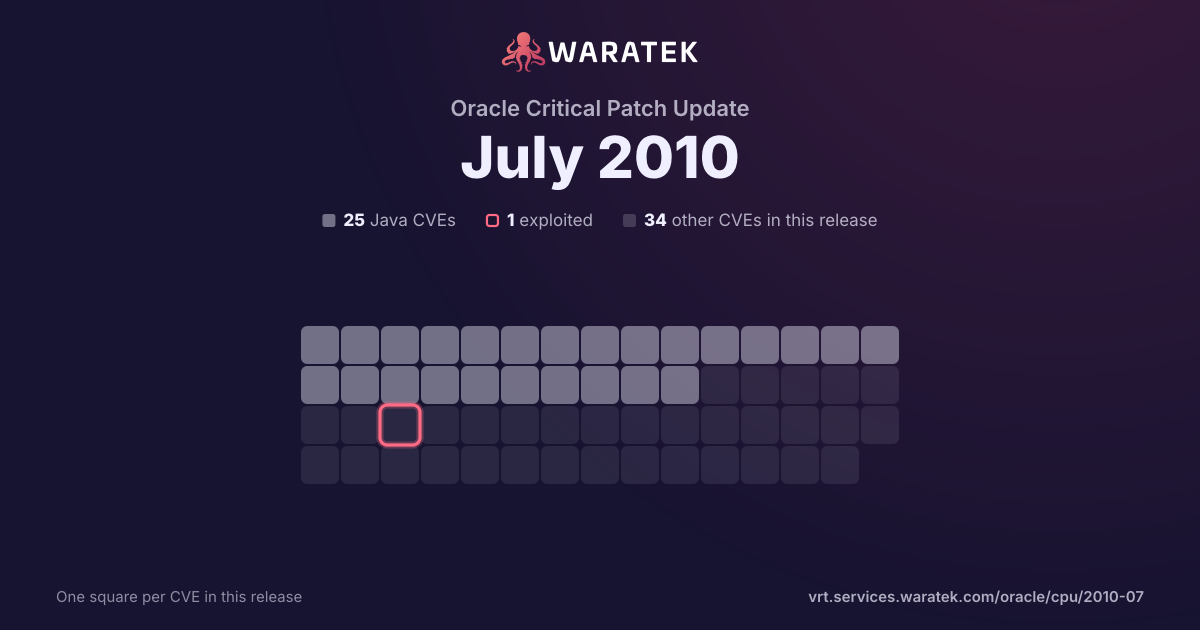
By status
2Mitigation candidate23No exploit published7Outside Waratek scope27Not applicable
1Exploited, marked by the ring
No exploit published. For 23 of them, Oracle's security advisory is the source of public detail.
Overview 7 matches · 0 in Waratek scope · 0 protected · 0 exploited · 0 CISA KEV · 0 public PoC · 0 EPSS ≥ 0.5
7matches
0in Waratek scope0.0%
0protected0.0%
0exploited0.0%
0CISA KEV0.0%
0public PoC0.0%
0EPSS ≥ 0.50.0%
Protected by Waratek
0
0.0%
Rule in development
0
0.0%
Mitigation candidate
0
0.0%
No exploit published
0
0.0%
Outside Waratek scope
7
100.0%
Not applicable
0
0.0%
Withdrawn CVE
0
0.0%
blocked by ARMR today
0
0.0%
partly blocked
0
0.0%
not blocked
7
100.0%
not established
0
0.0%
unrecorded
0
0.0%
Exploited
0
0.0%
Working exploit published
0
0.0%
Proof of concept only
0
0.0%
Forecast only
0
0.0%
No public exploit
7
100.0%
split by
peak 6 / month
Jul 09Sep 09Nov 09Jan 10Mar 10May 10Jul 10
| CVE | Severity | Published▾ | Status | Exploitation | Description |
|---|---|---|---|---|---|
| CVE-2010-0911 | High | 2010-07-13 | Outside Waratek scope | No public exploit | Unspecified vulnerability in the Listener component in Oracle Database Server 9.2.0.8, 9.2.0.8DV, 10.1.0.5, 10.2.0.4, 11.1.0.7, and 11.2.0.1 allows remote attackers to affect availability via unknown vectors. |
| CVE-2010-0903 | High | 2010-07-13 | Outside Waratek scope | No public exploit | Unspecified vulnerability in the Net Foundation Layer component in Oracle Database Server 9.2.0.8, 10.1.0.5, 10.2.0.4, 11.1.0.7, and 11.2.0.1, when running on Windows, allows remote attackers to affect availability via unknown vectors. |
| CVE-2010-0902 | Medium | 2010-07-13 | Outside Waratek scope | No public exploit | Unspecified vulnerability in the Oracle OLAP component in Oracle Database Server 9.2.0.8, 9.2.0.8DV, 10.1.0.5, 10.2.0.4, 11.1.0.7, and 11.2.0.1 allows remote authenticated users to affect confidentiality, integrity, and availability via unknown vectors. |
| CVE-2010-0901 | Low | 2010-07-13 | Outside Waratek scope | No public exploit | Unspecified vulnerability in the Export component in Oracle Database Server 9.2.0.8, 9.2.0.8DV, 10.1.0.5, 10.2.0.4, 11.1.0.7, and 11.2.0.1 allows remote authenticated users to affect confidentiality via unknown vectors related to Select Any Dictionary. |
| CVE-2010-0900 | Low | 2010-07-13 | Outside Waratek scope | No public exploit | Unspecified vulnerability in the Network Layer component in Oracle Database Server 9.2.0.8, 10.1.0.5, 10.2.0.4, 11.1.0.7, and 11.2.0.1, when running on Windows, allows remote attackers to affect availability via unknown vectors. |
| CVE-2010-0892 | Medium | 2010-07-13 | Outside Waratek scope | No public exploit | Unspecified vulnerability in the Application Express component in Oracle Database Server 3.2.0.00.27 allows remote attackers to affect integrity via unknown vectors. |
| CVE-2009-0217 | Medium | 2009-07-14 | Outside Waratek scope | No public exploit | The design of the W3C XML Signature Syntax and Processing (XMLDsig) recommendation, as implemented in products including (1) the Oracle Security Developer Tools component in Oracle Application Server 10.1.2.3, 10.1.3.4, and 10.1.4.3IM; (2) the WebLogic Server component in BEA Product Suite 10.3, 10.0 MP1, 9.2 MP3, 9.1, 9.0, and 8.1 SP6; (3) Mono before 2.4.2.2; (4) XML Security Library before 1.2.12; (5) IBM WebSphere Application Server Versions 6.0 through 6.0.2.33, 6.1 through 6.1.0.23, and 7.0 through 7.0.0.1; (6) Sun JDK and JRE Update 14 and earlier; (7) Microsoft .NET Framework 3.0 through 3.0 SP2, 3.5, and 4.0; and other products uses a parameter that defines an HMAC truncation length (HMACOutputLength) but does not require a minimum for this length, which allows attackers to spoof HMAC-based signatures and bypass authentication by specifying a truncation length with a small number of bits. |